1971 – Packard Speeches

Box 2, Folder 14 – Department of Defense


February 18, 1971, Symposium at Fort Rucker, AL. It is not clear who the audience was, probably officers in the Armed Forces.


2/18/71, Typewritten text of Packard’s talk. Written in outline format.

Saying that he has now been on the job for two years and two months, Packard says that, “In addition to dealing with day-to-day problems, we have had some opportunity to look down the road – Force Planning, based on Nixon Doctrine – President’s statement on future U. S. foreign policy.


Force planning based on realities:


  1. Build-up of  Soviet strategic forces – conventional forces more important.
  2. NATO-Warsaw pact is not only potential area of conflict:


Middle-East

Asia

Probably not South America and Africa south of Sahara

  1. Fiscal realities – human programs; no tax increase
  2. Domestic political realities – zero draft; manpower limit


Conventional forces of US and allies must be designed to provide credible deterrent. Guidelines for future forces:


  1. Maintain credible nuclear deterrent non-nuclear force


  1. with friends and allies
  2. with lower manpower levels
  3. at about present budget level

(1)     continuing rise in manpower cost:

53% of budget

2.5M cost 13B – 1964

2.5M cost 29B – 1972

We must do a better job in applying technology to conventional tactical warfare. We must find more effective, more efficient, ways to develop and procure military hardware.


Both requirements dictate better decisions on what to develop – the issue you have been discussing here.

Some lessons have been learned in Vietnam and some others – very important lessons – were learned during the middle east crisis last year.


Unfortunately, the Defense Department system has a very poor ability to learn anything – even the obvious.


One has to only look at two things – photographs of areas bombed in Vietnam and expenditures made over the last few years for conventional ordnance expended there – to conclude our so-called air power – particularly interdiction – has been very ineffective – disgracefully so. I am pleased to report that very substantial improvements have been achieved during the past two years – gunships, guided weapons, and improved tactics.


We have begun to see what can be done – and the key point is that substantial improvements in effectiveness can be achieved with substantially lower costs both in dollars and in lives.


Sensors – better night vision – better range finders – better ordinance – all have given our ground forces greatly increased capability over what they had five years ago.


I know you have been discussing some of these things at this conference.


I am greatly troubled that what gains as have been made – in spite of system, DCPG – sensor, etc.


Not all good – speed-cost, gunships – small group, system – two years, back to small group – 6 months.


We are entering an exciting era in the things you are discussing here.


New imagination – what to do – get out into real world – fort Hood – operational jesting – development needs to be coupled better with requirements.


Service staff – wrong way – get the development people out with operational people -–tell the paper shufflers to go home.


We are going to try some new approaches, DCPG – Defense Special Projects Group, DSPG.


We are setting up new group for tactical communications, Tri Tac. Battle short around system.


More reliance on hardware, less paper.


New aircraft designs – new weapon system concept, no total package procurement.


Good old fashioned approach. Design it before you produce it.


Cost incentive contracts for development – fixed price – hold to it.


Better management – Services.


The future


Smaller forces – if credible deterrence must be more effective. Must get more for defense dollar – need your help – it won’t be done in the Pentagon. Want to be done by Service staff people – must be done at working level.


Box 2, Folder 15 – Department of Defense


March 3, 1971, Council on Foreign Relations


3/3/71, Typewritten text , in outline format, of Packard’s talk.


1. Immediately after taking office in 1969 extensive reviews were undertaken by the Nixon Administration to reorient United States foreign Policy for the 1970s.


A   A changed  — and changing – world environment.

  1. Frustration with role in Vietnam.
  2. Need for more federal resources to help solve domestic problems.


(1)     Changes in free world

(2)     Changes in communist world


  1.  Studies under Security Council machinery and real issues – Vietnam, Mid-East, Korea, SALT


2.  President Nixon’s statement in Guam in the summer of 1969 and his November  1969 address to the nation laid out elements of new partnership.


  1. U.S. will keep all treaty commitments.
  2. U.S. shall provide shield if a nuclear power threatens the freedom of a nation allied with us or one whose survival we consider vital to our security
  3. In cases involving other type of aggression we will provide military and economic assistance but look to nation threatened to provide manpower for its defense.


3. The President’s statement on U.S. foreign policy for the 1970s released last week reflects these realities.


  1. A major American role in the world remains indispensable.


Middle East – NATO – Asia

  1. Other nation can and should assume a greater responsibility for their sake as well as ours.


  1. The change in the strategic relationship calls for new approaches – new doctrines. Parity – more reliance on non-nuclear.


  1. Changes in the communist world present different challenges and new opportunities. Sino/Soviet conflict – real. Keep open communication Soviets – open China.


  1.  Defense planning has been undertaken since 1969 to be consistent with this evolving policy for the 1970s


  1. To implement the Nixon Doctrine.
  2. To accommodate a reordering of  federal resource priorities – larger share for human needs – smaller share for defense needs.


  1.  Some problems in implementing a defense program to meet these objectives.


A. Growing Soviet military strength – strategic nuclear – naval forces in particular.


  1.  Increased cost of military manpower, e. g. 1972 = 185% of 1964 for military pay vs. 125% for goods and services. 2.5 million military force cost $13B in 1964 but $29B in 1971.  All volunteer force.


  1. All allies are stronger but traditional reliance on U.S. difficult to change.


  1. During these past two years we have taken some important steps to implement the Nixon Doctrine.


  1. Vietnam – 549,000 U.S. troops in 1968 – 330,000 now and 284,000 May 1, 1971. ARVN forces now carry major combat role there.
  2. South Korea – 20,000 fewer U.S. troops – more equipment aid for ROK.
  3. Reductions – 12,000 in Japan, 5,000 in Okinawa, 16,000 in Thailand, 9,000 in Philippines – worldwide government personnel reductions – 86,000 people.
  4. The Nixon Doctrine calls for Fewer people but more aid — MAP supplemental of $1B approved closing days of 1970.
  5. Defense budget has gone from 9.5% of GNP in 1968 to a projected 7.8% for FY 72 – from 42.5% of federal budget to 31.6%
  6. People adjustments have been substantial


Military

Civilian

Defense Related

Total


Defense budget lower force levels

Higher R & D

More readiness

A budget realistic deterrence


  1. The most important test of the Nixon Doctrine is in southeast Asia.


  1. Early in 1969 it appeared that negotiations were not a likely route to an acceptable solution in VN
  2. Vietnamization emphasized. Military progress excellent – million man VDN forces – capability demonstrated in Cambodia. Some problems which will take a little more time – will be solved. We are close to time when no U.S. forces needed – won’t withdraw until POW issue solved.


  1. Southeast Asia,  Vietnamization was a new policy begun in spring of 1969.


  1. Planning – how to get U.S. forces out in six months
  2. SVN handle situation if NVN left country


Idea was feasible – it should support negotiations – alternate if negotiations failed.

Leadership and training

Logistic capability – supply – repair

Communications

Intelligence

Tactical Air – B-52d, Laos interdiction, air defense

Naval – Riverine –coastal

Much progress made – Fall ’69 visit

New capability – fight enemy

Supplies and sanctuaries – Cambodia & Laos

Supplies through Sianoukville

Cambodian operation

Over 20,000 tons – PRC – successful

Cut supplies

Lowered casualties

Cambodian response

Nationalistic Spirit

30,000 to 200,000

Fair capability – improving

Changed enemy tactics

Small unit operations

Terror remains high

Harassment in Cambodia

Isolate Phnom Penh

ARVN forces very effective

Beginning of dry season

Major supply effort through Laos

If successful, support activities in SVN and Cambodia

Possible to move on ground to disrupt supply movement in Laos

Increased ARVN capability

Low activity in south

Expected tough fight – North bad to respond –(contrast    Cambodia)

Already some success – 900,000 # rice

Will require two or three weeks more to get clear picture.

Vietnamization already clearly successful – military

Economic – time business friends go look

Political

Withdrawal of U.S. troops continue

Prisoner of Wear problem

Negotiations bring end

Guerrilla fighting continue

Fighting just fade down


  1. What does the future hold for the Nixon Doctrine


Partnership

Strength

Negotiation


Partnership – friends and allies not only carry larger share of burden – but have larger voice in determining the best approach to their own problems.


Strength – the realities of the world dictate that U.S. leadership must be backed by strength – not only U.S. strength but strength of our friends and allies.


  1. Vietnam must be strong enough to handle its own problems
  2. The strength of Jordan in handling Fedayeen problem a good example


We must negotiate from a position of strength – SALT – Mideast


A look ahead shows us on a difficult course. We are embarked on that course and are making progress. If we can move ahead with a sense of unity and a sense of purpose, I am convinced we can indeed reach the President’s goal – a generation in peace.


Box 2, Folder 16 – Department of Defense


March 24, 1971, The Department of Defense in a Generation of Peace, IEEE Convention and Exposition, New York City

3/24/71, Typewritten text of Packard’s speech, includes handwritten notations by him.


Packard apologizes for a “bit of nostalgia” and notes that, up until he joined the Department of Defense in 1969 he had attended the IEE annual Convention every year since 1940. He says these three decades have been “the center of action” – “exiting and expansive times for the electronic profession.” He adds that “They were exciting and expansive times for me, too.”


Packard says that prior to World War II, electronics “was radio and communications.”  In these early days the industry was not “highly dependent upon national defense funds to support its research, or to keep its factories going.” But, “As weapons production built up in 1941 in response to the war in Europe and the Pacific, defense requirements became a substantial factor in the electronics industry.”


“There was no better place to observe – as well as to be a part of – this great drama of electronics as it unfolded over these past three decades than to have been here, year after year, at this Annual IEEE Convention and Show.”


“During those exciting years there was no nonsense about basic research having to be directly related – in an immediately obvious, provable way – to known military requirements. If Defense experts thought it was good research, it was supported.


“Independent research and development was viewed as an essential element of progress, and it was recognized that new knowledge would flow from such research to the benefit of society at large and that it then would support the nation’s defense effort indirectly, if not directly.”


“A few years ago” Packard says, “a changing attitude began to develop in this country toward Defense-supported research. In fact, the attitude began to change in respect to all research.


“Underlying this change  was the realization that the products of science are not always purely beneficial to mankind; that more wisdom and more judgment should enter into the decisions about how science should be applied to the needs and problems of the world. Disillusionment and concern about the Vietnam war was certainly a factor in these changing attitudes.


“Many people at all levels of government and science have come to believe during these past few years that it is time to think through again some of our past axioms. One sees evidence that this is happening by looking at this convention’s program. I see more broad philosophical issues being addressed in the papers presented here this week than was the case ten years ago.”


“The Defense Department has had a very important and, I believe, constructive role in this rethinking, rededication, and revitalization.”


“President Nixon does not intend for the United States to back away from its role of world leadership. We do intend to exercise our power for peace. I find myself troubled, however, because our vision is too often blurred by domestic bickering and by partisan politics in matters related to world affairs. Apparently, this is nothing new, however. DeTocqueville stated the case very well in a special reference to the United States 140 years ago.” Packard reads this 1830 quote from DeTocqueville:


‘Foreign politics demand scarcely any of those qualities which are peculiar to a democracy. They require, on the contrary, the perfect use of almost all those in which it is deficient. A democracy can only with great difficulties regulate the details of an important undertaking, persevere in a fixed design and work out its execution in spite of serious obstacles. It cannot combine its measures with secrecy or avert their consequences  with patience.’


Packard refers to President Nixon’s statement regarding a new course for United States leadership: ’No goal could be greater than to make the next generation the first in this century in which America is at peace with every nation in the world.’


Packard says that, since he and Secretary Laird came to the Depart of Defense in the spring of 1969, “…we have been working hard on a reassessment of our military commitments and our military forces against the background of a changed –and still changing –world. We want to be sure our future forces will provide the Realistic Deterrence necessary for a generation of peace.”


Packard talks about trying to balance the goal of providing this deterrence, against such problems as the continuing frustration over the unresolved situation in Southeast Asia, large Federal deficits, and increasing defense spending. “I sincerely believe”, he says, [ that in planning our nation’s military forces we have recognized] “the realistic need and desire of our nation’s people to have a larger share of federal resources applied to domestic problems and programs.”


“We are winding down U.S. involvement in Southeast Asia.”


“In 1968 the Defense budget was 9 ½  percent of the gross national product. For the fiscal year beginning next July it will be down to 6.8 percent of the gross national product.”


“The additional $23 billion which would be required in 1972 to support forces at the level they were in 1968 has been applied to domestic programs”


“…it is not an easy task to be sure we can have adequate capability at lower force levels.


“During the past few years, the soviets have been building up their nuclear forces. They now have forces equal to ours, and their build-up is continuing. They are building a navy capable of world-wide operations, and they continue to improve their tactical nuclear and conventional ground force capability on the Warsaw Pact front. The Communist Chinese are continuing to develop their nuclear weapons and missiles to deliver  them. They, too, are building submarines and naval forces, and they maintain large armies with modern weapons. There is no evident reduction of subversion, terrorism, or violence anywhere in the world.


“In the face of these challenges, our Defense task is to develop and to support United States military capability adequate to deter the use of these forces by those countries that have them. We recognize we must do this with lower manpower levels and reasonable budgets in the future.”


“We have some favorable factors on our side, Our friends and allies around the world have increasing military capability backed by increasing economic strength. This is true in Korea and Indo-China, in Taiwan and Japan. Our NATO allies recognize they should do more, and they have the wherewithall to do more.


“There are hopeful developments in the Middle East – hope for a successful negotiation supported and sustained subsequently by adequate deterrent strength.”


“The essential requirement toward achieving Realistic Deterrence with lower forces is that we focus on capabilities rather than on mere units of forces.


“It is very clear that there is much support and historical precedent for great attention on numbers of ships, airplanes, and divisions. It is equally clear that we easily can be misled into the mistaken assumption that these numbers alone contain useful information about capabilities.”


“Better application of technology, new and old, can enhance the capability of our military forces – land, sea, and air. That is why we are requesting in the Fiscal 72 Budget increased finds for Research and Development. I am referring here to a real increase, not just enough to overcome inflation, but enough to really increase our Research and Development over the level of effort of the past two years.


“If approved, this real increase in the R&D budget will impact directly on the members of this society and this industry. The increase reflects both the end of transition budgets and a conscious decision to return to this nation’s greatest source of relative strength – technology – to provide forces for Realistic Deterrence at realistic budget levels.


“It is my honest opinion that if we are to maintain forces that ensure Realistic Deterrence with lower budget levels and fewer men and women in uniform then the most important contribution we can make toward better capability is to increase the effectiveness of our DEFENSE research and Development program. That’s the message I bring you tonight. And, I believe congress will support this emphasis on Research and Development because I believe they will agree that this country simply cannot afford to risk the future security of our people to both lower forces and inferior weapons.”


“I do not know how many of you here tonight are interested in doing Research and Development for the defense Department in the future. I hope you have not all been misled into believing that the only fields worthy of scientific and intellectual effort are health and environment. I hope some of you are still willing to work on national security problems. I want to tell you – we need you; your nation needs you. And we need your best efforts and new initiative now.


“Let’s all understand that if Congress approves my request for increased research and development funding in FY 1972, it has a binding commitment from me – a personal pledge – that research and development programs will be better managed in the future than they have been in the past.


“If you tell us you can develop a new system for national defense, we will expect you to build it, test it, and prove to us that it works; and we will expect that before we buy production quantities.


“Gentlemen, there is going to be no more brochure engineering. We want hardware that works – not paper that claims it’s going to work. And working hardware is what I’m going to get – hardware that increases the capabilities of our smaller forces.


“There are, in fact, some very important and exciting jobs to be done. We are going to encourage those new initiatives. We are going to place more dependence on technology in the future. We are going to defend this greatest, freest nation in history. And with your help, she will remain free.”


3/24/71, Copy of  Press Release issued by the Department of Defense containing full text of Packard’s speech.

3/24/71, Copy of IEEE 71 Annual Banquet program

11/2/70,  Copy of letter to Packard from Emmet G. Cameron, IEEE, inviting him to speak at the International Exposition and Conference banquet in New York on March 24, 1971.

11/7/70, Copy of memorandum to Packard from Daniel Z Henkin, Assistant Secretary of Defense, recommending that Packard to accept IEEE’s invitation.

11/12/70, Copy of letter to Emmet G. Cameron, IEEE, from Julian R. Levine, Assistant Secretary of Defense, accepting, on behalf of Packard,  the invitation to speak on 3/24/71.

2/9/71, Letter to Packard from Emmet G. Cameron of IEEE giving details on the dinner arrangements.

2/19/71, Copy of letter to Emmet G. Cameron, IEEE,  from Packard confirming his attendance at the 3/24/71 event.

2/23/71, Copy of letter to J. H. Schumacher from Margaret Paull, Packard’s secretary, discussing hotel arrangements.

Undated, Schedule of day of 3/24/71

3/29/71, Letter to Packard from Thomas H. O’Brien saying he enjoyed Packard’s speech.

Undated,  Two Flyers from a local anti-military group attacking Packard personally.


Box 2, Folder 17 – Department of Defense


April 8, 1971, WEMA, San Francisco, CA


4/8/71, Copy of transcription of speech


Referring rather jokingly to recent dissent activities [and the fact that this speech was moved from Palo Alto to San Francisco by the DOD for security reasons] Packard says “I can tell you in all sincerity that the Department of Defense has made considerable progress during these past two and a half years under the leadership of my good friend Mel Laird.” And he says he wants to talk about three areas in particular where he believes some contributions have been made.


”The first is in the realm of international policy.


“Second, is in the reorder of the priorities of the Federal government.


“And the third is the changes that we have made in the management of the Department of Defense.


Saying that President Nixon “has set our country on a new course in foreign policy for the decade of the 1970s,” Packard refers to the President’s statement by saying  “no goal could be greater than to make the next generation the first in this country in which America has been at peace with every nation of the world. This has been a major transition in our national policy and in our foreign policy, and the Defense Department has had a substantial role in the development of this new foreign policy.”


Packard says “It is our objective to move this country from an era of confrontation into an era of negotiation.” And he cites examples where negotiation has been taking place: with the Soviet Union on arms limitation, with the North Vietnamese trying to solve the problems in Southeast Asia, in the Middle East, and with China.


“In addition to negotiations, there are two other pillars to this Nixon Doctrine, the pillar of partnership and the pillar of strength.


“And as the President has explained, the central thesis of the Nixon Doctrine, is that the United States will participate in the necessary defense and support of our allies and friends; that America cannot and will not conceive all of the plans, design all of the programs, execute all of the decisions, pay all of the bills, provide all of the manpower, and undertake all of the defense for the Free nations of the world.”


Packard says there are three elements to the Nixon Doctrine:


“The United States will keep all of its treaty commitments.


“Second, we will provide a shield if a nuclear power threatens the freedom of a nation allied with us or a nation whose survival we consider vital to our own security.


“And third, in the case of non-nuclear aggression, we will furnish such military and economic assistance as is required and as is appropriate.


“Vietnamization is the first major application of the Nixon Doctrine, and I am particularly proud of our Vietnamization program, because it was Secretary Laird and I, I believe, who first recognized in the spring of 1969, that it was very unlikely that there could be any profitable, substantial, effective results from the Paris negotiations, short of turning all of Southeast Asia over to the Communists, and, that indeed, a different solution had to be found to that problem.”


Packard gives some statistics showing the reduction of forces in Vietnam: “In 1969, the United States had an authorized military strength of 549,000 in South Vietnam….In May of this year, less than a month from now, the authorized strength will be down to 284,000. By Christmas of this year, we will be down to 180,000…”


Packard adds the thought that “This war will end not when the United States forces go home. This war will end when the North Vietnamese forces go home.”


“But as we emphasize partnership and negotiation in implementing this Nixon Doctrine, we must maintain a sufficient military strength of our own United States military forces. We cannot overlook the fact that the Soviets, the Chinese, in fact all aggressor nations and potential aggressor nations, respect strength.”


Packard tells of lessons learned in dealing with the “Jordan crises last fall.”


“First, it is important for the United States to have armed forces ready for unexpected developments.


“Second, the Soviet Navy is a growing threat to our ability to support our friends in the Mideast.


“Third, a very serious development was avoided primarily because Jordan had the military strength to solve her own problems. This stemmed in a large part from past American help.


“And, fourth, the existence of allies and friends in an area is crucial if the United States is to cope with a crisis in that area.”


“Now in reorienting our defense programs to support the Nixon Doctrine these past two and a quarter years, we have also been able to bring about a very substantial reordering of the Federal priorities. As you in this audience sell know, we are spending less on defense. No one wants to give us much credit for helping provide for more—for non-defense domestic programs, but that is in fact what we have done.


“In 1969, the Defense budget was nine and one-half per cent of the Gross National Product. In 1972, it will be 6.8 per cent of the Gross National product. This is the lowest it has been since 1951 when it was 6.7 per cent of the Gross national Product.


“The reallocation of resources within the Federal budget has brought defense down to 32 per cent for fiscal 1972. It averaged 51.4 per cent in the decade of the 50s, 32.4 per cent in the decade of the 60s, and I am confident that we can provide this country the military strength to support the Nixon Doctrine with an average of less than 30 per cent of the Federal budget in the decade of the 70s.


“The non-defense programs of this country received less than 50 per cent of the Federal budget in the decade of the 50s, less than 50 per cent of the Federal budget in the decade of the 60s, but will average more than 70 per cent of the Federal budget in the decade of the 70s.


“Now let me outline for you some of the problems we have in planning our military forces with adequate strength to support the Nixon doctrine for the decade of the 70s. To hopefully achieve this generation of peace we must have the strength to deter war; we must have strength adequate for a realistic deterrent. This must include our strategic nuclear forces as well as our conventional forces.


“Let me cite some of the problems we have, and some of the figures:


“In 1968, Defense outlays were $78 billion. In that year there were 4.8 million men and women on the payrolls of the Defense Department, military and civilian. In 1972 Defense Department outlays will be $76 billion. This $76 billion, however, will support only three and one-half million military men. To put it another way, it would cost us in 1972, $23 billion more than we plan to spend if we were to support the forces we had in 1968.”


“A part of our problem has been inflation, as I am sure you know. But our problem is primarily one of military pay. We have been asking the young men of our country to not only devote two years of their life to military services when they are drafted but we have been asking them also to make a very substantial financial contribution. It depends a little bit on the service and on the number of dependents and so forth, but as a ball park figure, pay and allowances for people who go into the service, first year, second year, amounts to about $2500 a year. We train young people to go into the New York police force and get $9,000 a year; they can go into other areas and get comparable amounts. So, in effect, we have been asking our young people in this country to contribute two years of their life in uniform and probably at least $10,000 in terms of their potential enemy [should be earnings].”


Packard says they are trying to correct this situation. He shows how military pay is rising faster than inflation.


“We have already said we will have in 1972, about three and a half-million people altogether on DOD payrolls, military and civilian. In 1964, there were about the same…actually 3.6 million. Pay and related costs for these 3.6 million people in 1964 were $22 billion. Pay and related costs for three and a half million people in 1972 will be $39 billion, almost twice as much.“


“So it is not an easy task to be sure that we can have the necessary military strength to support the Nixon doctrine with the budget levels I have suggested. It is not clear that we are going to be able to have the adequate capability at lower force levels, although, as I will now try and outline for you, I am convinced myself that this can be done.”


“But,” Packard says, “we have some problems to face.” And he describes the military buildup of both the Soviets and the Chinese.


“In the face of these challenges our defense task then is to develop and support the forces that will have the military capability adequate to deter the use of the forces by those countries that have them. We must recognize that this will have to be done with lower manpower levels and reasonable budgets in the future. Now the important word here is capability. Now a deterrence can be realistic only if our forces have capability.”


Even though “Our friends and allies around the world have increasing military capability, backed by increasing economic strength….Nevertheless, our Nation’s defense programs place before us some very demanding tasks “


“The essential requirement toward achieving realistic deterrence with lower military forces, is that we focus on the capabilities of these forces rather than on more units of forces.”


“As an example, we can be concerned about the number of our tactical air squadrons and make assumptions about their capabilities to the foreign missions. We could double the numbers of our airplanes at costs of billions of dollars, and thus, increase the capabilities, at least on paper.

“But we have elected instead, and we are going to provide improved weapons for our aircraft, and we believe by doing this, we can improve the capability of our forces by factors of 3 and 4, with only modest increases in expenditures.”


“There are, I am convinced, many, many things we can do to substantially improve the capability of our forces, things that we have not done effectively in the past, and I am confident that by applying a better—making a better application of our technology to our military problems,  that this job can be done. And that is why we are requesting in Fiscal 1972 budget, increased funds for research and development. And I am referring here to a real increase, not just enough to overcome inflation but enough to really increase our research and development over the level of effort over the past two years.


“If approved, this real increase in R&D can, of course, impact directly on the members of this industry. This increase reflects both the end of transition budgets and a constant decision to return to this Nation’s source of relative strength, its technology to provide forces for the realistic deterrents we need for the decade of the 70s at realistic budget levels.”


Packard gives some specific objectives in their 1972 budget.


“We are requesting $7.8 billion in the 72 budget [compared to $7 billion in the 71 budget]. We have a budget request based—focused on three significant areas. One is to make sure that we can maintain an adequate level of basic research in the military areas so that there will be no surprises, so that we are not likely to encounter a military sputnik over the years ahead.


“Second, we are requesting the Congress to address the question of funding the important research and development programs to make sure that they are funded so that they can be managed efficiently. And funding has been a problem in many ways. If you go back and change the funding of the programming every year it is impossible to have that program managed in an efficient way.


“And third, and perhaps most important, we are trying to place new emphasis on areas which hopefully can give us a quantum jump in our capability. New initiatives, as we call them. Some of these are already underway, but many of them are considered to be too expensive. The services would rather have a thousand 500-pound bombs than one weapon that would really do the job that might cost $200,000 or something like that. And we finally, I think, are getting our military people to come around to recognize these facts.


“It is my honest opinion that if we are to maintain forces that will insure the realistic deterrents at lower budget levels, the most important contribution we can make toward better capability is to increase the effectiveness of our defense research and development program.


“That is the message I bring to you here tonight, and I believe the Congress will support this emphasis on research and development because I believe they will agree that this country simply cannot afford to take the risks to the security of our people and to our position in world leadership with both lower forces and inferior weapons.


“Now whether an increase now in research and development for defense will bring back the good old days to your profession and to your industry, I cannot predict. I do not know how many of you here tonight are interested in doing research and development for the Defense Department in the future. I hope you have not all been misled into believing that the only field worthy of scientific and intellectual effort are health and environment. I hope some of you are still willing to work on national security problems. I want to tell you, we need you. Your Nation needs you, and we need your best efforts and your new initiatives now.


“And let us all understand that if the Congress includes my request for increased research and development funding for 1972, it has a binding commitment from me, a personal commitment, that research and development programs in the future will be better managed than they have been in the past.


“If you tell us you can develop a new system for national defense, we will expect you to build it, test it, and prove to us that it works, and we will expect that before we buy production quantities.


“Gentlemen, there is going to be less of this brochure engineering than there has been in the past. We want hardware that works, and not paper that claims it is going to work. And working hardware is what we are going to get, hardware that will increase the capability of our smaller forces.


“There are in fact some very important and exciting jobs to be done, and I have been very encouraged as I travel around the country and see some of the things that we are doing. It is a tremendously thrilling thing to see the enthusiasm and capability that we have in this area. We are going to place more dependence on technology in the future, and we are going to defend this greatest free nation in the history, and with your help, she will remain free.


“It has been a great honor and a pleasure for me to be with you here tonight. As I said in the beginning, I think it is a little unfortunate that here the leaders of the industry in this area are unwilling to stand up to that bunch of radicals down the peninsula. I just want to remind all of you that they want to destroy everything our country stands for, what you and I have been working together these past three decades to achieve. The Dave Harrises, the Jane Fondas, and all of those who support them, I want to remind you are your deadly enemies. They want to destroy you as well as me. Don’t let them do it.” [Notation in transcript: – Standing ovation]


1/4/71, Letter to Packard from R. L. Conlisk, WEMA, discussing details of the forthcoming WEMA banquet.

1/25/71, Letter to Packard from James N. Donovan, Varian, saying he is delighted Packard will be speaking.

3/25/71, Letter to Packard from Ed Ferry, WEMA, discussing the banquet and the audience. A copy of the program is attached.

4/16/71,  Letter to Packard from Ed Ferry, thanking him for speaking to WEMA.

3/30/71,  Strongly negative editorial from the Stanford Daily

Another neutral newspaper clipping, paper unknown

Eleven letters to Packard in support of his speech nineteen letters against what he was saying.

Box 2, Folder 18 – Department of Defense


April 29, 1971, Conference on Domestic Action, Ft. McNair

It is not clear exactly what Domestic Action refers to, but judging from Packard’s comments it must have to do with people

.

4/29/71, Typewritten text of Packard’s talk – written in semi-outline format.


Packard thanks the audience for their “achievements over the past two years,” adding that their program has the strong support of both Secretary Laird and himself. “We have reports that many have done outstanding jobs in the many areas of domestic Action. Yet, it is also the nature of DA that much more can and should be done. I note that the main theme of this conference addresses what needs to be done.”


Packard says he would like to speak “informally” for a few minutes about two  :

points


“First,  despite all the debate you see in the press about the costs of our weapons systems and the size of our procurement accounts – by far the most costly resource in DOD is people.


“Second, DOD has been an active participant in the current reordering of national priorities, and these priorities have shifted to programs that emphasize people.


“People as a Resource”


“—In both military and civilian organizations the senior people by the nature of their work tend to become insulated from the problems of individuals. Must guard against this. All the effort within DOD to manage dollars, to improve technology, to make progress in attaining a peaceful world – all the effort depends on the people who make up DOD – men and women, civilian and military.


“—Effectiveness is not just efficiency. It includes the satisfaction one feels in doing his job. A great strength of the DAP is that people get a great deal of personal satisfaction in my being part of such an effort.


“—No one can be effective unless he had self respect and a sense of individual dignity. DOD efforts in equal opportunity are directed toward this.


Packard says that while the above points may be well understood, “What is not generally recognized is how much people cost and how fast these costs are going up.


“– Within DOD, pay and related costs have increased by $17.6 billion since FY 64, our pre-Vietnam base year. This is an increase of over 80%. Yet over the same period, defense manpower has decreased 3.5% In short, we are paying a great deal more for less people than we did eight years ago.


“– Another measure is that in 1964 43% of the defense dollar was for pay and related costs. It is now 52% — an increase of almost 10%. Put another way, over half our budget is for people.


“—When you return to your organization, it may be useful for you to point out just how much our manpower costs us. You can properly sell most Domestic Action projects on the proposition that they enable DOD to get better performance and effectiveness from each individual. Clearly, we must do this in a period of declining budgets and rising cost.


Reordering of National Priorities


“—This is a problem of communication and understanding. Few people appreciate the extent to which national priorities have been changed.


“—Critics of DOD talk about the need to stop the increase in Defense spending and the need to reduce defense programs.


“—These critics argue that defense is a source of funds for other Federal programs that are under-funded in the areas of education, health, housing, welfare, mass transit, the environment, and many others.


“—In fact, this reordering has already taken place and DOD has played a leading role.

“—The FY 72 Defense budget is 6.8% of GNP, the lowest since 1951. It is 32.1% of the total Federal budget, the lowest since 1950.


“—Our Defense budget for “72 is $76B which is 50% higher than for 1964. The non-

Defense portion of the budget for the same period is 230% higher. This says the non-Defense increase is four times that for defense.


“—My point is that we in DOD have actively supported and agreed with this change of emphasis in the Federal budget. Our first obligation, of course, is providing adequate security for this country, and in general we believe that this shift has gone about as far as it can.


“—The DOD DAP is additional evidence of our interest in increasing the emphasis on human values and goals. This audience is very familiar with the details of  that program. Truly, the DAP does get double duty for the dollars allocated to defense. This is an added increment to those parts of the non-Defense dollar devoted to human programs.


“Conclusion


“—This conference is one way of spreading the word that domestic action has the strong support of Secretary Laird and myself.


“—I wish you good luck in your conference.


“—I am sure that at next year’s conference each activity and department will report ‘We have done more.’


Box 2, Folder 19 – Department of Defense


May 19, 1971, Remarks at U. S. Investment Conference, Washington D. C.


5/19/71, Typewritten text of Packard’s remarks


Packard’s remarks are essentially a summary of the Department of Defense’s position on Vietnam  and the fiscal budget. His audience is apparently made up of investment analysts.


He says that “…our move into Cambodia for an essential, short, military operation may make it seem to the foreign observer that our policies and our aspirations have changed. They have not. On Vietnam we are anxious to keep the negotiations going.”


“North Vietnam has refused to negotiate on any basis short of allowing them to take over South Vietnam. That is why we are pursuing the alternate course we call Vietnamization. The sole purpose of the Cambodian operation is to accelerate the progress of Vietnamization.


“The world is in a period of rapid change and whatever changes come about on the world-wide scene will be influenced by attitudes inside the United States. If the American people seem to be too disunited to assume any international responsibility, there will be a vacuum of leadership that will encourage conflict in the international sphere. It is our hope that the United States can exercise leadership to bring about the change President Nixon envisioned when he said we must move from an era of confrontation to an era of negotiation. Unfortunately, here at home we seem to be going in the opposite direction.


“We believe it is time to bring more than two decades of confrontation during the cold war into a period of negotiation in which countries of the world can begin to devote to peaceful constructive ends at least some portion of the vast resources and energies which have formerly been devoted to increasing military power.”


Packard says that the Nixon administration policies have re-directed Federal resources from defense to non-defense programs.  He says “This has placed a stringent requirement on DOD to maintain strength of military forces at lower levels of expenditure” And he gives the numbers going from $78.7B in FY 1969 to $71.8B in FY 1971.


“One of the important objectives of this exercise is to apply more of the nation’s resources to domestic programs. The reallocation of financial resources is significant. The resulting reallocation of people will – already has – generated some serious problems.”


Packard says “…we are doing what we can in helping local communities.”  However he adds that “The Federal mechanism is not as effective as the market place in allocation of resources in the American economy.


“The skills of the aerospace industry cannot be quickly reorientated (sic). The impact on professionals, scientists, engineers, young graduates. Impact on scientific progress.”


“What does this mean for the investment community?


(1)  “DOD budget and therefore defense-related industries will be lower and will continue lower if we are indeed able to move the world scene from confrontation to negotiation.”


(2)  “The transition to lower defense spending will cause dislocations in economy and the transition will take time….These budget actions are a major reorientation of our priorities. This should be ample evidence that we mean what we say.”


(3)   “It is not a safe course for the United States or its free world allies to go very far in this direction unless the Communist countries are willing – by agreement or by their actions – to move ahead on a similar course.”


(4)  “If the domestic attitude of the U.S. does not respond, if this country refuses to accept its proper responsibility in international affairs, the results for the world could become drastic and traumatic – particularly for people who wish to maintain their freedom.”


Box 2, Folder 20 – Department of Defense


August 3, 1971, Speech at the Defense Management School, Fort Belvoir, VA

This was the opening day ceremony of the school and the audience consisted of representatives from each of the three military departments, staff, faculty, students and wives of DSMS, and selected persons including contractors who contributed to the establishment of the facility.


8/3/71, Typewritten text of Packard’s speech, with some handwritten notations by him.


Packard says it gives him “more than the usual pleasure to be with you here today for the opening of the Defense Systems Management School.” And he explains that the school “…had its origins two and a half years ago in the discussions and assessments we made as we sought ways to improve the management of our development and procurement programs.


“There was no doubt about the need for improvement. As we reviewed program after program –the F-111, the C-5A, the Mark 48, the MBT-70, the Cheyenne, and many more, it was almost impossible to find a major program that was not in trouble. All were behind schedule, although in most cases this was because impossible schedules had been set at the beginning of the program. All showed large cost growths and again, in many cases, this was because unrealistic cost targets had been set or because the Services had accepted “buy-ins” by the contractors. This was a shocking experience for me – case after case of just plain poor management by the largest department of the government and by well-known and large firms in the industry.


“The Congress and the public were critical of this gross mismanagement of this country’s resources and talent. And well they should have been.


“As we sought to discover reasons for this dismal performance and to find ways for improvement, several conclusions came to the surface. One conclusion was that if we wanted better management of these important programs, we must have better managers in charge. The so-called “system,” – the attitudes and practices that had been developed and were condoned over the years – had a great deal to do with the situation. But, given that all of the other factors could be corrected, it was clear to me that putting better managers in charge would do more to bring about improvement than anything else.


“And that is why we are here today. This Defense Systems Management School has been established for the specific purpose of making a substantial improvement in the capability and effectiveness of managers for the important development and production of the Department of Defense.


“We want this school to become the Academy of Management for the Department and for all four Services. We want it to be a school of high distinction where the best of modern management practices are taught. We want it to become a center of research for the improvement of managerial practices. We wanted it to be located in the Washington area where it can both have an influence on and be influenced by the high level people and policies of the department.


“Now, I have a special hope for this important new endeavor we are christening here today. I hope it will be a practical school for, after all, management is a practical profession. Management is getting things done – good management is getting things done right. That is what this school is for – to help us get things done right.


“Toward that end I have some specific suggestions for the policy guidance of this school. First, I want you to remember that the quality of any school is determined only by the quality of the faculty and the quality of its students.”


“As to the faculty,  I hope you will be able to attract and select the best people for your permanent staff I hope you will also bring in distinguished men from the ranks of public and private management for lectures, seminars and other activities which will expose your students to the best practices of good management throughout the country.


“As to your students, I hope you will establish high standards for admission. You should admit no student from any Service unless he is committed to a career in management. Today’s problems of defense management are just too large to be handled by the two-year wonder. These jobs can be done right only by men committed to a career in management I hope you will not waste your time, your energies, and your resources on any others.


“Don’t rely on computers to solve your management problems. Computers can’t think. What we need most of all is more good judgment. Plain common sense – the ability to make a good decision and stand up for it.


“I am pleased to note that you have assembled a fine faculty and a fine group of students for the opening session.”


“Finally, I want you to know that this Defense Systems Management School we are opening here today has the complete support of my office. I have high hopes for what you can accomplish with this new endeavor. I assure you that Secretary Laird and I consider this a very important step in the all important goal of giving this country more and better defense for the billions of dollars we have to spend.


“You are entering upon a new and an exciting and important journey here today. If you and those that follow you do your job well, you can make an enormous contribution to your country. You have my encouragement, my support, and my blessing.”


7/9/81, Letter to Packard from Brig. Gen. William E. Thurman, Defense Systems Management College, thanking Packard for speaking at their “Unveiling Ceremony.” The General says, “The day would not have been complete without you because of your efforts toward making the defense systems Management College what it is today. We speak of you often and use many of your thoughts with each class to establish the purpose of the College.,”


Box 2, Folder 21 – Department of Defense


August 11, 1971, Major Defense Systems Acquisition, DOD/NSIA Symposium,

Washington D. C.


8/11/71, Typewritten text of Packard’s speech.


Packard says he is pleased that this symposium is being held at this time. ”During these past two and a half years we have been giving this subject a great deal of attention as you know. We have made what I believe is a good start in delineating some new policies and procedures which will make it possible for the Department and the Services to work more effectively with the Industry. I believe these new policies and procedures will enable the government to obtain more and better equipment for the billions of dollars of the taxpayers’ money that are being spent. I believe also these new policies can result in a stronger, healthier defense-related industry in the future.”


Packard says there will be continuing pressures on the defense budget and funds available for defense systems and equipment will be limited. This limitation, he says, is the result of a general anti-defense attitude in the country, and large cost over-runs by the Services and by industry. “There is no way to avoid this criticism except to do a better job in the future.


“When a system ends costing twice as much as the original contract target, as did the C-5A for example, there is no explanation but to admit it was bad management….The only answer is to find a way to do these jobs right and I presume that is why we are here today.”


Proceeding to outline some new policies and procedures, Packard says that “The first step for a successful Major Defense Systems Acquisition is to make the right decisions in the beginning. To do this is not a simple matter.” He goes over some examples of reasons this decision can be difficult.


Saying that “We are doing a number of things which we believe will enable better decisions to be made at the beginning of a major program,” he gives some specifics.


“First, we in the Department of Defense are going to better describe and understand what we want and need. As a part of this you can expect us to focus more on effectiveness and less on platforms. For example, in many cases it is just very much more efficient and practical to double the capability of weapons than it is to double the number of platforms to deliver the present weapons. Secondly, we are taking a broader perspective on what we already have and what we might need….We first describe what we want to be able to do within … functional areas, look at what we already have, and then identify what needs to be done.”


“We want to keep programs in Advanced Development longer, until we are sure we know what we are doing. We want to put more reliance on hardware and less on paper studies in Advanced Development.”


“…As an example, the AX program is based upon competitive prototypes that will be built and tested before we approve this system for procurement or select a contractor. In the case of the B-1, there will be a prototype before we approve this system for acquisition. The HARPOON missile will be expensively tested and developed in preproduction form before production is approved.”


“As I reviewed program after program beginning in the spring of 1969, almost all were in trouble from a common fault – production had been started before engineering development was finished. I am sure you all know all about this problem. Several important policies and procedures have been established to help avoid the disastrous results of concurrency:


  1. “We will not use total package procurement contracts on major programs;


  1. “In general, major development contracts will be cost-incentive type with performance milestones rather than calendar milestones, and will require close working relationships between Service managers and Industry managers;


  1. “Fixed-price production contracts will be negotiated on major programs after the development has proceeded far enough that we know what we are to produce, and we know it will work the way we want it to work.


“Again, we have established procedures to assure that programs are in fact set up the way they should be – that appropriate milestones of performance are established and are met before the program moves ahead.


“What we are proposing is very simple – these major acquisition programs will turn out better only if they are managed better. There is no better way to improve the management of a program than to get a better manager and give him the responsibility and authority to manage, We are making some progress in this direction. All of the Services have accepted the need to select better people for program management.


“We opened a new school last week at Fort Belvoir to improve management training. We have made some progress to clarify and improve the authority of the project manager. We have not yet gone as far as we need to go. The decision making process on many programs is still too much of a committee process in most of the Services. Worse than that, the members of the committees that make the decisions often know very little about the project except what they have been told and the decisions are often driven by the wrong considerations. There is, however, already considerable improvement.


“Two and a half years ago we had only a few programs that were going the way they should. Often I would go to a briefing on the status of a project and was completely disgusted with what I heard. Last week I was briefed on the status of four projects by one of the Services and I came away very proud of the way these projects were being managed.


‘There is, then, some hope we can, working together – the Services, the Office of the Secretary of Defense, and the Industry – do this job of “Major Defense Systems Acquisition  the way this country should expect us to do it. I hope we will gain a better understanding of how to do the job the way it should be done. I wish to emphasize that better management of these important programs is a responsibility above the parochial interests of the Services and above the selfish interests of the Industry. This would be a big challenge in times of rising budgets and enthusiasm for defense – it is an even greater challenge for us in the environment of this decade of the 1970s.”


8/11/71, Copy of DOD News Release with full text of Packard’s speech


Box 2, Folder 22 – Department of Defense


September 10, 1971, Federal Bar Association, New Orleans, LA


9/10/71, Typewritten text of Packard’s speech


“Today,” Packard says, “The rate of change in both domestic and foreign affairs perhaps exceeds any previously experienced. Our problem today is to guide and fashion these forces of change with wisdom and patience so that change is accomplished in a peaceful and orderly way. I believe the President’s programs – foreign and domestic – provide the basis for bringing about change in such a way that we can and we will move away from war and violence and toward lasting peace.


“It is our job in the Defense Department to provide the military strength adequate to support the President’s foreign policy for the decade of the 1970s.” And Packard refers to other priorities of the Defense Department. “We have substantially reduced the defense share of the Federal budget to enable the nation to devote more resources to the attainment of non-defense goals. But we believe that, without adequate national security strength, all these other goals in fields of domestic policy would be placed in jeopardy.


“We have reoriented our national defense programs in keeping with the Nixon Doctrine and our supporting National Security Strategy of Realistic Deterrence. In the process we have made significant reductions in the levels of our military forces.. In achieving these results, the greatly scale of our Vietnam involvement has been a major accomplishment. This and other reductions have made it possible to cut the cost of our defense forces from 9.5% of the Gross national Product in FY 1968 to only 6.8% in FY 1972.”


“We have now gone as far as we safely can go in reducing the defense budget. Further reductions in the defense budget below the present level could be very dangerous to our position of world leadership in the decade ahead.”


“In 1964 the United States had a significant superiority in strategic nuclear forces over the Soviet Union. The Peoples Republic of China had no nuclear forces.


“Today, the situation is vastly different. The Soviets not only have larger land-based inter-continental missiles than we, they have about 40% more of such weapons than we have. Their submarine-based nuclear force is growing by leaps and bounds and will be equal in size to ours in two or three years. In other aspects as well, their nuclear forces have been rapidly expanded since 1964.


“The result of this Soviet buildup is that now the Soviet Union stands on a par with us in overall offensive strategic power and surpasses us in defensive strategic weapons systems. The Peoples Republic of China also has tested nuclear weapons and missiles, and could, therefore, have in this decade a strategic force capable of threatening our friends and allies in Asia and perhaps even the U. S.


“Hopefully, we may, by careful negotiations with the Soviets, be able eventually to reduce the level of destructive nuclear power possessed by both sides to a lower level. But I believe we cannot and must not, under any circumstances, make unilateral reductions in the already-restrained levels of our nuclear forces, as some recommend.”


“Even with an agreement – which might be reached in the near future – I do not anticipate that there could be a significant and immediate reduction in the Defense Budget, particularly in view of rising manpower costs as we move toward an all-volunteer force.


“Another area of concern is Naval Forces. This is so because of the large Soviet Naval buildup since 1964. In that year, we had a decisive superiority in every class of combat ship in both numbers and capability except for non-nuclear submarines. During the past few years the Soviets have greatly expanded their naval forces, and now they can challenge our Navy in the Mediterranean and elsewhere, sending impressive naval task forces throughout the world’s oceans.


“Our planning for the future must include funds to strengthen our Navy, and it does.”


“…the national strength we need to give enlightened leadership to this troubled world is more…than just military strength. It includes our moral strength and our economic strength. This was explicitly taken into account when we framed our National Security Strategy of Realistic Deterrence. This strategy is embodied in our new Total force concept which seeks to utilize all appropriate resources for deterrence  — U.S. and the free world – in order to capitalize best on all available assets. Moral and economic strength are part and parcel of the overall strength necessary for this country to exercise its role in world affairs and to work in pursuit of President Nixon’s goal of achieving a generation of peace.”


“We need strength and moral fiber at home in order to succeed abroad. A nation that is weak internally and timid in spirit, cannot provide stabilizing leadership in international affairs.”


“I deplore any attitude that says – let Washington solve all problems. I have been in government long enough to know that Washington alone simply cannot do it.


“I believe it is very important that we arrest any attitude of increasing dependence on Washington. We must instead reemphasize our proven traditional concept that individuals working together in every part of this country – South, North, East and West – have the brains and energy to solve most of the problems that affect their daily lives.”


“Individual responsibility, decentralization of political power, and voluntary action in a pluralistic society are sources of American national strength. And there are other sources of our national strength to be protected and cultivated – free speech, full, open and enlightened debate on national policies, and a system of impartial justice based on law.


“Differences of opinion on the domestic front are not evidence of weakness. It is the nature of a democracy that we encourage a free exchange of ideas and must have constructive and peaceful dissent. But how dissent is expressed is important. Dissent expressed in violence is anarchy, not democracy. Democracy requires that we recognize one another’s rights. Violence is the antithesis of reasoned dissent and a denial of the rights of others.


“I need not explain to this audience that free debate, the rule of law, and the integrity of the process of law enforcement are essential ingredients of our national strength. Nor need I remind you of your obligation as members of the bar to uphold these things. It may be true that some countries can be at least temporarily strong without these things – but not the United States.”


“These historic principles need not, and do not, block needed change. On the contrary, they facilitate change. In my experience both prior to and within the Department of Defense, I have found that rational discussion among reasonable men can lead to change on both sides. We seek the opportunity to talk with those interested in change.”


“The Federal government must serve all of the people all of the time. It cannot yield to violence and disruption by a militant minority. And, your government – and the great majority of the American people – are determined that threats to bring the people’s government to a halt will not be permitted to succeed.


“In summary, I believe that we must emphasize a sense of responsibility in our deliberations and in our debates and actions to bring about change. This administration is taking steps to move toward peace and justice in a responsible fashion.”


Packard says despite the troubled times he is encouraged by the progress made over the past two and a half years.


“On the international front, we are well on our way to ending American military involvement in Vietnam without abandoning our friends in that part of the world. We are talking to the Soviet Union about strategic arms limitations, but we remain firm against precipitous, unilateral reductions. Navy Under Secretary John Warner will begin important talks with the Soviets next month on items of mutual interest to the two leading sea powers. There has been some hopeful progress recently on Berlin, and the President has reopened communications with the Peoples Republic of China.


“On the domestic front, I see signs of progress in drug control, in race relations, in reducing poverty and suffering, in educational opportunities, in controlling pollution, in fighting crime and toward new economic prosperity.


“I particularly applaud the President’s recent moves on the economic front. I believe these actions clearly recognize the fundamental problems underlying the serious inflationary pressures as well as the changing pattern of world economics.


“We may not reach the millenium in the 1970s but I believe we are off to a good start. I am confident that your organization, under the leadership of Normand Poirier and Dick Kleindienst, will continue to make a great contribution to the preservation of the vitality of our democracy – preservation of the vitality of our democracy – preservation of a national environment of excellence in which each individual can make his and here contribution to progress to prosperity and to peace for the next generation and beyond.”


9/10/71, Press Release from Department of Defense with full text of Packard’s speech

9/10/71, Copy of the program of the Federal Bar Association Annual Convention

9/10/71, Typewritten copy of speech given at this Convention by John Warner Director , Ocean Affairs – amended by hand written notations.

7/20/71, Letter to Margaret Paull (Packard’s Secretary) from Elaine Crane Assistant to Deputy Attorney General Richard Kleindienst talking about details of the banquet at the Convention.

8/20/71, Letter to Packard from Marshall Gardner , The Federal Bar Association, discussing details of Packard’s trip to New Orleans.

9/9/71, Memorandum from Col. James Boatner giving itinerary for Packard’s trip to New Orleans.


Box 2, Folder 23 – Department of Defense


November 4, 1971, Meeting With Newsmen


11/4/71, Typewritten transcription of question and answer session Packard had with newsmen.


Packard starts by introducing Dr. Albert C. Hall who, he explains, will be the new Assistant Secretary of Defense for Intelligence. Packard goes on to discuss the intelligence field and what he has in mind for this job.


“Let me go back now and talk about intelligence in general terms, and in terms of the three areas that we sometimes think about, which is national intelligence, tactical intelligence, and technical intelligence. National intelligence is that information and its interpretation that is needed by the President, his Cabinet, the Secretary and other officials to make important decisions.”


“Tactical intelligence, I think, is just about self-explanatory. That’s what the field commander needs to command his forces and this is, of course, a very critical matter because the extent to which he knows what the enemy is going to do, he’s in a position then to command his forces in a more effective way.


“…as we address the question of what kind of new weapons we should develop, it’s very important that we have some understanding about the characteristics of the enemy weapons because we are anxious to either have superior weapons, weapons that will be able to counter whatever the enemy capability may be.”


In response to questions as to the specific nature of Dr. Hall’s position Packard says he (Dr. hall) will be coordinating the budget control of the intelligence operations, but will not be supervising the operations themselves.


Another question asks about two complaints; one, that with each Service and the CIA “doing their own thing” there is no direct civilian control, and two, with all the “mountains” of data collected whoever gets time to read it all?


In answer to the first question Packard says “…our problem [in gathering all types of intelligence] is not to say there can be only one intelligence activity because the issue is just too complex, but to try to be sure that we bring all of these into focus….We will be looking at those issues – the balance between technical, tactical and national intelligence and the balance between those people who are involved in those areas, [is] going to be a very important part of [Dr. Hall’s] job.


“On the use of resources, this again is an issue and as I’ve intimated you have two problems in intelligence. One is to collect all the information that’s available and the second is to be able to understand what that information means. We have already spent some time in addressing this matter of balance between how much information we’re collecting and our ability to utilize it effectively, and that again will be something that will be continually addressed.”


Q: The questioner says he understands there are 140,000 people or so on the Defense Department payroll involved in intelligence. And he asks if this number will be cut.


A: Packard says “I couldn’t give you any judgment about what reductions, if any, can be made. I’m confident from what I know about it that we can do a more efficient job of managing these resources, but I just can’t give you any specific predictions nor even a very good calibration point that I can confirm to you today.”


Q: “Again, without centralized authority, Mr. Secretary, what can you do about the problem of redundancy?”


A: “The way you worry about the redundancy of functions is to be able to examine what this group is doing and to be able to do that in relation to what some other group is doing If you find there are duplications that are not appropriate, you can make the necessary changes. I think one way to consider these staff jobs, and this applies not only to intelligence but to other jobs, one of the responsibilities is to make sure that there’s not unnecessary duplication and second to assure that we’re not leaving something out, and this applies to DDR&E and other people as well as this function.


Q: “Let me raise another criticism and see what your answer will be. The criticism would be that a businessman’s approach to intelligence is the wrong technique and the wrong place. Intelligence by its nature has to be inefficient, has to be redundant, and that to use normal business efficiency methods is going to deprive you of some opposing intelligence views from the field.”


A: “I think that’s perhaps an oversimplification, but there is something to that, and it relates to the sort of thing I talked about in national intelligence. It’s impossible to have one crystal ball that’s going to be perfect, and I’m not at all troubled with maybe having two separate groups involved in certain of these things simply because you have no assurance that one group is going to do it right and maybe have a little competition is a helpful thing, so I don’t think you just go through this and say there can be no duplication.


Q: A questioner asks about foreign aid.


A: ”I’d be very glad to say a word about foreign aid. As a good many of you know, I’ve been working very closely in this foreign affairs area since I came out here. I started out working closely with Dr. Kissinger, the NSC, and doing some of the analysis that resulted in the backup for the Nixon Doctrine; the decision that we would move toward more reliance on our friends and allies, that we would move from an era of confrontation into an era of negotiation has been something that I’ve been very much interested in and very close to. I think that most of you know probably that I have supported the President very strongly, even in the Cambodian incident, and so I’m fully and enthusiastically behind the things that the President has been doing these past 2 ½ years and I’ve been frankly very pleased to have had some part in working with the White House and the President in supporting this program.


“To me, the Senate action last Friday was an absolute disaster. Here at the time when we’re trying to move into a new and, I think, very important inter-national posture where the President has moved out into some areas which I see as beginning a new era in the United States relationship with the rest of the world, not only the Free World but the entire world, and for at this time the Senate to undercut this whole program by voting against foreign aid, by turning down the foreign aid bill, is just about the worst thing that could have happened.


“The thing that troubles me in particular is that I don’t believe that a good many of the Senators who were involved in this really understand what a serious blow they’ve given to this matter.”


“The trouble with the situation is that the damage has been done, and the confidence that our friends and allies and other people around the world can have in what we will do in the future to support them and to work with them has been seriously undercut by this Senate action. It will help if the full foreign aid request of the President is reinstated, either through a continuing resolution—and this as you know will have to be done before the 15th of this month because that’s when the present continuing resolution runs out – or by a substantial reinstatement of the original request, I think any piecemeal program that cuts in any substantive way to military assistance or economic assistance will just confirm the fears that have been generated by this action.”


Q: The questioner says that critics say it is meaningless to “shower” arms on a country if the population is not behind the local government; and asks why that won’t happen in Cambodia.


A: “I just can assure you that we’ve learned a lesson. We’re not going to get involved in Cambodia. We have a very low presence there, but at the same time the Cambodians are very anxious to defend their country and the thing that everybody forgets is there’s one way for this war to end in a hurry and that’s just for the North Vietnamese to go home.


Q: A questioner asks if there is a direct link between the cutoff of aid and withdrawal of troops from South Vietnam.


A: The answer is no, and I would not want to comment about the withdrawal of troops. As you know, the President is going to make an announcement here in a couple of weeks and I think we’ll just wait and see what he says about that matter.


Q: Mr. Secretary, it’s not clear to me whether you’re saying this is a disaster no matter what happens from now on or whether you think there’s some way to save the chestnut and that’s to back out of the fire.


A: “What I’m saying is that I think a significant amount of damage has been done almost no matter what happens.”


Q: “Secretary Packard, are you just inferring that our allies are going to lose confidence or do you have specific concerns from certain countries?


A: I can’t fill in specific details today, but we’ve had specific concerns from a great many very important people.


Q: I wonder as you survey the legislative wreckage, and you said that you did not anticipate the shellacking you got in the senate, and it’s been pretty clear that Senator Symington and others on the Hill don’t trust the Pentagon and what it’s doing in these foreign countries before you’re not giving them an adequate amount of information, and yesterday we went around about how tight your ISA is about telling what it’s doing in the world and what the military loans are doing, and they won’t even admit when you call them and say what are you doing about this aerospace plan in Greece, and we could go on and on. My question is, have you perhaps thought about reassessing what you do say publicly to try and explain what this military aid is all about and what you’re trying to do and what concessionary loans are and what they’re buying with them and where they’re going. I think you have a credibility gap.


A: I don’t want to answer those specific questions, but I’m quite willing to admit that we’ve failed to get the story over. As I said, I’ve been working in this issue very closely. I’ve been very enthusiastic about it. I think it’s the right way to go and somehow we haven’t gotten the story over. What we can do to improve in the future I’m sure we will give some consideration to. I can’t talk about specific actions.


Box 2, Folder 24 – Department of Defense


November 21, 1971, Society of Medical consultants to the Armed Forces


11/21/71, Ten 3×5 inch cards upon which Packard wrote an outline of his comments.


Thanks for 26 years of important contributions


Medical practice and medical research are important to Services.


Acknowledge Dr. Richard Wilbut


This has been an interesting and busy three years for Department – much criticism’ but satisfying progress


Changes in organization and management philosophy


Re-ordering of priorities:  DOD budget 9.5% if GNP to 6.8%


Development of Foreign Policy for the decade of 1970s


President Nixon has made a historic transition from an era of confrontation into an era of negotiation


Post WW II Foreign Policy – Dominant military, dominant economic


Containment of Communism NATO, CENTO, SEATO, DOREA, JAPAN


The world has changed from period which spawned this policy


Soviet military strength, economy growth – Europe, Japan, also Korea, Thailand, Taipei


Split in Communist Block – competition between free world remains but war between major powers is not attractive…Negotiation, Strength, Partnership


Vietnam – Most influential


Indo China – key to stabilization of SEA

Korea, Japan


NATO – U. S. Must remain


Mid-East, South Asia and Indian Ocean


Negotiation – Salt, Berlin, MBFR, Mid-East


Foreign Aid essential


Moral of friends essential


World relations are going through major changes


President Nixon has shown great leadership – he needs our support


11/3/71, Letter to Packard from Bernard Pisani, M.D., society of Medical Consultants to the Armed Forces, discussing details of their Meeting

Undated, Typewritten draft of outline “for possible remarks to Society of Medical Consultants to the Armed Forces.” Source not clear.

1970 – Packard Speeches

Box 1, Folder 51 – Department of Defense


January 10, 1970, Launching of Bluefish, Electric Boat Co., Groton CN


1/10/70, Typewritten text of Packard’s speech.


Packard says he is “honored to play a part in the launching of this fine ship.” But he adds that “I am here only because of the function Mrs. Packard performs today in her role as sponsor…”


Packard reflects on the significance of the launching by noting that “today precedes by just seven days the anniversary of that winter morning in 1955, here at the Electric Boat Division of General Dynamics, when Commander Eugene Wilkinson ordered the crew of the NAUTILUS to cast off her lines. As most of you know, Rear Admiral – soon to be Vice Admiral – Wilkinson is here with us today, and I offer my personal congratulations to him for the important contributions he has made over the years to the nuclear power program.”


Packard also pays tribute to Vice Admiral Hyman G. Rickover – “the man who played the key role in the development of nuclear propulsion technology.” [Rickover was not present, Packard notes]


Referring to Rickover’s “pioneering work”, Packard says that “it takes extraordinary effort and dedication to transform vision into reality. Prior to NAUTILUS, there was no true submarine. Our early submarines using batteries and diesel engines were required to come to the surface frequently to charge their batteries and obtain oxygen for their crews….Only by harnessing the atom was man able to achieve the first true submersible, a ship that was at home under the water rather than on its surface.”


Packard mentions some of the achievements of the early nuclear boats: “On her shakedown cruise in 1955, in only 84 hours NAUTILUS traveled submerged more than 1300 miles – a distance greater by a factor of ten than previously traveled by a continuously submerged submarine.


“In August 1958, NAUTILUS …crossed from the Pacific to the Atlantic under the North Pole during a four-day, 1800 mile voyage. In that same month SKATE reached the North Pole and in the following year pushed her way through the ice to surface at the geographic North Pole.


“In 1960, TRITON, following the route taken by Magellan over 400 years earlier, went completely around the world in 83 days and traveled 36,000 miles without surfacing.”


“But in sharp contrast even with this impressive durability, the nuclear fuel installed in the BLUEFISH will provide power for about 400,000 miles of travel while costing slightly less than the NAUTILUS fuel.”


“The advent of nuclear submarines made possible the development of one of our most important strategic weapons. Even while the NAUTILUS was still undergoing operational testing, the Navy began development of the sea-based ballistic missile…. The POLARIS projects a new dimension of sea power, and the 41 POLARIS Fleet Ballistic missile submarines we now have in operation constitute a vital pillar of this nation’s security.”


“Nuclear propulsion has not been limited to submarines. The Navy presently has one nuclear powered aircraft carrier, a nuclear powered cruiser and two nuclear powered guided missile frigates. Today we are building the USS NIMITZ, our second nuclear powered aircraft carrier. We are also building two new nuclear frigates, the keel for the first of which, the CALIFORNIA, will be laid down later this month These ships provide the foundation of a nuclear powered surface Navy that can go anywhere in the world at instant notice.


“Why do we build such ships? As Secretary of Defense Laird has recently stated, we build them to keep the peace.


“If history teaches anything, it is surely that weakness invites attack. Our military power is our peace insurance. But military power is not enough: it must by backed up by an unshakable national resolve to defend our vital interests throughout the world.


“The Soviet Union understands seapower and she is mounting a formidable challenge to our ability to control the seas in wartime. It is clear that sea power will continue to be an indispensable instrument of our national policies and those of the Free World alliance, and that is why we continue to build those ships necessary to maintain a Navy equal to any challenge we may face.”


Returning to the BLUEFISH Packard says “She incorporates thousands of technical advances developed by our scientists and engineers over the last decade and a half. She represents one of the most sophisticated and complex weapon systems that can be built today.”


“All of you here at Electric Boat can take pride in this ship – a symbol of the finest effort of American industry and labor.


“I am enormously proud of the men and women who serve in uniform of our country. I am told that there are representatives of 38 nuclear submarines here today, and it is fitting that their wives are here as well, since they too share the sacrifices inherent in military service.


“Finally, we have that small group of men who will one day take BLUEFISH to sea. It is their judgment and skill which will make BLUEFISH an effective, fighting ship – a proud addition to the Navy. On behalf of your country I wish you and BLUEFISH success – and smooth sailing.”


1/10/70, Typewritten address from President Nixon apparently read by someone at the launching ceremony.

1/7/70, Copy of a telegram from Vice Admiral Rickover to Mrs. Packard congratulating her for being a sponsor of the BLUEFISH.

Undated, Copy of suggested guest list for the ceremony.


Box 1, Folder 52 – Department of Defense


February 13, 1970,  American Management Association, Gantt Medal Award, Chicago IL

Mr. Packard spoke at this luncheon after receiving the 1969 Henry Laurence Gantt Memorial Medal which is given annually by the American Management Association and the American Society of Mechanical Engineers. The Medal is awarded for “distinguished achievement in management as a service to the community.” The recipients are “leaders who have demonstrated a profound understanding of management as something beyond the pursuit of profits for an organization or self-aggrandizement for an individual.”


2/13/70, Typewritten copy of speech by Packard with some of his handwritten notations.


Packard says  he is grateful for this award, but he is not sure whether it is in recognition of his work in the private sector, or for his present activities as Deputy Secretary of Defense. He notes “with some dismay” that 1969, the year he was away, was the best year Hewlett-Packard Company has had. And as for his governmental assignment, Packard concludes “that members of the Board are not regular readers of certain daily newspapers. If they did, their decision would certainly have been otherwise.”


Packard says he plans “to wear this medal whenever I testify before congressional committees.”


Packard talks about the differences between management in private industry and in the Defense Department – “sheer size…4.6 million people, military and civilian. ..assets of $200 billion. The Department annually engages in more than 200,000 procurement actions of $10,000 or more involving more than 100,000 prime and sub-contractors. It manages installations and facilities, equipment and manpower in all 50 states and in more than 100 foreign countries.”


“A second difference between management in the Department of Defense and in a private enterprise is in evaluating results. We have no profit and loss statement to work against. The weapons we build for the defense of our country serve the country best if they never have to be used. This is most emphatically true of our nuclear weapons.


“The performance of the Department of Defense can be measured only by the extent to which the Department contributes to the overall interest of the nation. All management decisions in the Department must be measured against this all-important criterion.


“Since so much of the business of defense is preparation to avert possible future calamity, only after many years will we be able to determine with complete assurance whether we are doing the right things in the right amount and in the right way today.”


Packard cites “two additional factors that make Defense management a difficult  — indeed, a hazardous – occupation.


“The first factor is the opposition to things military on the part of an articulate body of public opinion. When a large number of people view an enterprise with suspicion or hostility, the problem of giving effective management to that enterprise is compounded.”


“The second factor that currently adds to the difficulty of managing the Defense Department is the fact that the Department is no longer a growth industry. On the contrary, it is now in the throes of rather rapid shrinkage.”


Packard cites reductions in expenditures and manpower in FY 70 and planned for FY 71.


“While these special management problems are inherent in the Department, and are not likely to change, we have taken a number of steps during the past year which I believe are in the direction of much needed improvement.


“Three important steps are directed toward making better decisions on the size and character of military forces which are needed to support the national interest. These are the key decisions which must be made before questions relating to the kinds and numbers of weapons to be developed and procured can be addressed.


“Fist,  the National Security Council machinery has been revitalized to evaluate more carefully what the worldwide commitments of the United States should be, and what military force levels are necessary to support those commitments.


“Second, a new arm of the National Security Council has been established called the Defense Program Review Committee to address questions of defense policy at the level of specific military programs. The PackardRC has the task of considering major defense matters, not only from a military standpoint, but also from a broader viewpoint. In particular, this group addresses defense matters in relation to the non-defense priorities of the nation and recommends resource allocation between defense and non-defense programs.


“Third, we have made changes in procedures within the Department of Defense for developing budgets, five-year plans, and programs. The changes, which provide for more effective participation by the Joint Chiefs and the military services, are producing more realistic planning and budgeting and better teamwork among the services.”


Packard then turns to a problem they have been addressing – “the question of how to improve the management of the development and procurement of specific weapons and equipment. With the great furor this last year about cost growth and cost overruns, it should come as no surprise that we in the Defense Department are also concerned.


“As one examines programs which are in trouble – and we find lots of examples – there are some conclusions that can be drawn about the origins of the problems.


“It is clear that the problems of developing new and complex weapons and equipment have, in nearly every case, been under-estimated with the result that early estimates of both cost and time required for development proved faulty.


“Too much emphasis has been placed on meeting rigid time schedules with the result that production was undertaken too often before development was finished. The short cut of rushing into production before resolving the problems encountered in research and development has been costly.


“Altogether, too little attention has been given to controlling cost.


“Program managers have been rotated out of their jobs before they became fully effective to be replaced by new managers without prior experience with their programs.


“Authority and responsibility have been diffused among many offices and individuals so that decision making has been retarded.”


Packard then describes “one fundamental change in management concepts that is gradually being introduced in the Defense Department which I think will lead to improvement across-the-board -–the concept of selective decentralization.


“We believe that more decentralization will improve management efficiency. This involves reducing the number of layers of management, and a more precise definition of the responsibility and authority of various offices in the OSD and in the Services.”


“When Secretary Laird and I assumed office, it seemed that too many decisions had to be made at the top and that too detailed a supervision of operation was carried on in the Office of Secretary of Defense. We are shifting to the military services more decision making authority.”


“Increased authority at lower levels requires increased responsibility for results.


“This means more emphasis on people and so I cannot conclude a discussion of management of the Defense Department without a word about people, who, as you know, are far more important to successful management than procedures.


“We are seeking to open up channels through which bright ideas down the line can be brought to the attention of those at the top. We are seeking to broaden the flow of information on Defense policy throughout the Department. And we are doing our utmost to assure that no barriers exist to the upward movement of talented people – particularly barriers based on race or creed or national origin.”


“Successful management of the Department of Defense depends to an important degree on the quality of management in the private industry of our nation. This is true for a number of reasons. Those who come to us to fill managerial positions often have had experience and training in private industry. Further, we must look to industry to produce the equipment and the arms with which our armed forces defend our nation.


“At the present time the Department of Defense is taking advantage of the managerial talent of the private sector in the study of its organization and operation that has been undertaken by the Blue Ribbon Commission chaired by Gilbert Fitzhugh, Chief Executive Officer of the Metropolitan Life Insurance Company. The report of this Commission, expected in mid-1970 after its year long study, should result in greater efficiency and effectiveness in the use of the resources committed to defense.”


“I accept this medal, established in memory of a great pioneer of good management, Henry Laurence Gantt, with a commitment to do my best to apply those principles to the job of making sure this country receives maximum value for every dollar spent on defenses.”


12/13/70, AMA Program for the Conference and Gantt Award

2/13/70, Press release issued by the DoD Public Affairs office containing the complete text of Packard’s speech.

2/13/70, Copy of the program for the award event.

12/2/69, Letter to Packard from Theodore T. Miller, Chairman Gantt Medal Board of Award acknowledging Packard’s willingness to receive the Gantt Award.

12/10/69, Press release from AMA announcing Gantt Award.

12/16/69, Letter to Packard from Fred Lee, AMA, discussing details of the award ceremony.

12/23/69, Letter to Packard from Richard R. Deupree, saying the AMA had invited him to the Gantt Award honoring Packard, and he is sorry he will not be able to attend.

1/6/70, Copy of a letter from Packard to Lawrence A. Kimpton, Director, Standard Oil Company of Indiana expressing his appreciation that Mr. Klimpton will present him at the Gantt Award.

1/12/70, Copy of a letter from Fred E. Lee, AMA, to Lawrence A. Kimpton saying the AMA is happy to hear he will present Packard at the Gantt Award, and asking for a copy of his remarks.

1/18/70, Letter to Packard from Lawrence A. Kimpton saying it will be a pleasure to present Packard at the Gantt Award.

1/21/70, Letter to Packard from Fred E. Lee asking for Packard’s travel plans.

1/12/70, Copy of letter to Packard from John McClane AMA, asking for a copy of Packard’s speech if prepared.

1/13/70, Letter to Packard from Professor Paul E. Holden, Stanford, who says he received the Gantt Award in 1941. He regrets he will not be able to attend the presentation to Packard

1/22/70, Copy of letter to John McClane, AMA, saying Packard will not have a copy of his speech ready in advance.

12/14/71, Letter to Packard from Robert G. Butler, AMA , inviting Packard to the Gantt Award ceremony for the 1971 recipient. Packard has written “No”  at the bottom.

2/12/70, Copy of a telegram to Packard from Mel Laird congratulating him on receiving the award.

Also included are several pamphlets about the AMA and the Gantt Award


Box 1, Folder 53 – Department of Defense


February 19, 1970, Consequences of the Nixon Doctrine, American Enterprise Institute, Washington D. C.


2/19/70, Typewritten text of speech by Packard.


Packard says it is a pleasure to join the American Enterprise Institute at their annual banquet. He recognizes the contribution the AEI has made “to the improvement of communication and the elevation of the level of debate about public policy issues.”


Packard continues saying “One of the things I have learned in the course of approximately one year in public office is the difficulty of effective communication between government and the public. In every controversy in which the Department of Defense has been involved during the past year…we have had great difficulty in obtaining public understanding of the real issues. And a useful dialog on public policy is not possible without such understanding. I am aware also that there are some who permit their emotions to take charge in their consideration of certain issues and who do not want to understand.”


“So I am grateful for the help that an organization like AEI provides in offering objective analysis of policy alternatives. The clarification of issues is a great service to the strengthening of the political process by which the American people have chosen to govern themselves.”


Packard says there are many things he could talk about –“fires to put out – problems with new weapons procurement – problems with new weapons procurement – cost growth and – yes, cost overruns – to mention a few of the things that currently absorb my time and attention.


“This evening, however, I want to explore some aspects of the significant and profound change in the nation’s foreign and defense policy now in process of implementation.”


The new policy was announced by President Nixon during a TV address to the nation, and Packard lists the primary points:


“First, the United States will keep all of its treaty commitments.


“Second, we shall provide a shield if a nuclear power threatens the freedom of a nation allied with us or of a nation whose survival we consider vital to our security.


“Third, in cases involving other types of aggression, we shall furnish military aid and economic assistance when requested in accordance with our treaty commitments. But we shall look to the nation directly threatened to assume the primary responsibility of providing the manpower for its defense.”


“The Nixon Doctrine is a new policy for the United States, better attuned both to international reality and to the mood of the American people in the 1970s.


“Within our country a feeling had spread that the United States had become the world’s policeman and thereby had overcommitted itself. The long conflict in Vietnam with no end in sight and the growing strains of critical domestic problems had resulted in widespread disillusionment which focused on our foreign policy.


“The people of other nations which looked to us for protection had developed a kind of love-hate relationship toward us. Even while expecting continued support and defense from the United States, such nations became restive under what seemed to them excessive American tutelage, and, in some of them, anti-Americanism in varying degrees became part of their standard political rhetoric.”


Packard does say that “It should not be overlooked that these facts on international life, although they suggested the need for a new policy for the 1970s, do indicate that past policy was appropriate in the period in which it was developed. In most respects it achieved its objectives of providing effective security and fostering development for our friends and allies.”


“One of the dangers that faced the nation last year – and it is a continuing danger – is the possibility of overreaction against policies that were no longer appropriate. The swing of the pendulum from a policy that had become too paternalistic, both for the American people and for other nations, could very easily be so strong as to take us to the opposite extreme of isolationism and rejection of any international responsibility.


“The Nixon Doctrine avoids both extremes. It reaffirms our international responsibility and serves notice that we will not be a drop-out from the world community. At the same time it makes clear that we will not be the world policeman or the world fire brigade.


“The essence of the Nixon Doctrine is that the responsibility for international security should be shared. While the United States will continue to bear an important part of the burden, other nations will be expected to assume a greater responsibility in providing for their own defense.”


Packard says that “In Vietnam the first application of the Nixon doctrine is taking place. There, in an orderly way, the responsibility for combat is being transferred to the Armed Forces of Vietnam, and American troop strength and involvement in the conflict are being reduced.”


“A basic consequence of the Nixon Doctrine is reflected in the larger slice of the budget devoted to domestic needs and the smaller slice to defense. In fiscal year 1971, for the first time in 20 years the share of the federal budget devoted to human resources will exceed that allotted to military purposes.”


“This does not reflect any downgrading of defense.


“The protection of the nation is our first responsibility, and we must always maintain the strength required for this task


“Keeping this responsibility in mind, we are making cuts of some magnitude in the Defense budget. In current dollars, the Department’s expenditure in fiscal year 1971 is estimated at $6.9 billion less than in fiscal year 1969. In real terms, however, the reduction is almost twice this amount – a whopping $12.8 billion. This is the true measure of the program reduction that is being accomplished.”


Packard points out that these figures “portend some very important implications for the economy of the nation….There will …be important reorientation of resources.


“The curtailment of the claims on the nation’s resources for defense means a drastic shrinkage in the demand for manpower both for the armed forces and for employment in defense industry. We estimate that more than one million fewer men will be employed directly by the Defense Department or by private industry in defense-related production by June 30, 1971 than were on June 30, 1969. This should bring an easing of tight labor markets and of one source of the inflationary pressures that have troubled the economy.”


“On the other hand, Packard points out that “Over the longer time this transition of resources from defense to human needs poses problems which will impact on the entire economy  of the country. The problems of transferring scientists and engineers from defense problems to human problems is not easy….Unless other opportunities for employment become available, we must recognize the obvious fact that as total jobs in the industry are reduced, national unemployment could rise and the brunt could fall on those who are just beginning to make some progress toward their rightful aspirations.”


Packard says that in formulating their budget recommendations, Secretary Laird and he have been mindful of the “dangers of cutting too abruptly and too deeply….We believe that any reduction in the Defense budget beyond that submitted to congress would run serious risks of the kind I have described.”


Packard moves on to a discussion of the implications the Nixon Doctrine will have regarding the “long standing policy of assistance to friendly foreign nations.


“If our friends and allies are to assume an expanded role in defending themselves, certain steps must be taken to improve their military capabilities. Since many of these nations are still economically less developed countries, they are unable to stretch their won financial resources to acquire the military equipment, supplies, and services which they need immediately….”…there is a real need to get ahead quickly with the task of replacing obsolescent equipment.”


Since these countries will not be able to pay out the large funds required immediately, Packard says “…the Foreign Military Sales Act, and particularly its provisions for credit and credit guarantees for the lesser developed countries, will become an increasingly important tool for the furtherance of our common foreign policy objectives.”


Packard also says the Military Assistance Program can be considered  to assist those countries where “cash and credit sales will not suffice to meet essential needs.”


“Yesterday, in his message to the Congress entitles United States Foreign Policy for the 1970s, President Nixon spoke of the three cornerstones of a foreign policy that seeks to restore and maintain peace – partnership, strength, and willingness to negotiate.


“ I have chosen tonight to speak about the first of these, the concept of partnership as the President is implementing it.


“But these three principles are indivisible. Our foreign policy must be guided by all three if it is to make progress toward the goal of peace.


“The new road to peace on which we have begun will be long and arduous. We have embarked on a course of policy which the President declared is “an adventure realized not in the exhilaration of a single moment, but in the lasting rewards of patient, detailed and specific efforts – a step at a time.”


“We are far from the end of this road to peace, but we have taken our first steps.”


2/19/70, Copy of press release from the DOD with the complete text of Packard’s speech.


Box 1, Folder 54 – Department of Defense


February 26, 1970, University of Rochester College of Business Administration


2/26/70, Copy of typewritten text of speech by Packard. This speech is very similar to that which Packard gave to the American Management Association on the occasion of his receiving the Gantt Medal. Also included in this file is an outline of  his remarks at the University of Rochester. The following first gives a digest of from the text of the speech at the AMA, and then notes from his handwritten notes. It would appear he used both in his address at the U. of R.

From the AMA address text:

Packard says that the job of managing the Department of Defense “includes all aspects of management that are involved in any enterprise”… but he cites a few differences:


The first being size. “The Department currently employs 4.6 million people, military and civilian – almost as many as the 30 largest industrial companies. It is spending $77 billion dollars in the current fiscal year. Its assets run in the neighborhood of $200 billion, more than the combined assets of the 75 largest companies. In the private sector of the economy, more than two million workers are employed to fill defense orders. The Department annually engages in more than 200,00 procurement actions of $10,000 or more involving more than 100,000 prime and sub-contractors. It manages installations and facilities, equipment and manpower in all 50 states and in more than 100 foreign countries.”

 

“A second difference between management in the Department of Defense and in a private enterprise is in evaluating results. We have no profit and loss statement to work against. The weapons we build for the defense of our country serve the country best if they never have to be used. This is most emphatically true of our nuclear weapons.


“The performance of the Department of Defense can be measured only by the extent to which the Department contributes to the overall interest of the nation. All management decisions in the Department must be measured against this all-important criterion.


“Since so much of the business of defense is preparation to avert possible future calamity, only after many years will we be able to determine with complete assurance whether we are doing the right things in the right amount and in the right way today.”


Packard adds that there are “…two additional factors make Defense management a difficult – indeed, a hazardous – occupation.


The first factor is the opposition to things m8litary on the part of an articulate body of public opinion. When a large number of people view an enterprise with suspicion or hostility, the problem of giving effective management to that enterprise is compounded.”


Packard makes it clear he is not complaining about close scrutiny by Congress , the press, or the public, all of which he agrees are quite proper and necessary. “If it is responsible, it is wholesome and can be a spur to more efficient operation. When, however, surveillance is exercised in a way that needlessly erodes morale, it does not contribute to good management.”


“The second factor that currently adds to the difficulty of managing the Defense Department is the fact that the Department is no longer a growth industry. On the contrary, it is now in the throes of rather rapid shrinkage.”


“In the period from last June 30 through the next fiscal year, the military forces will have been reduced by 551,000 men and the civilian work force, by 130,000. Expenditures in FY 69 were $78.7 billion,…and we will spend less than $72 billion in FY 71.”


Packard says that while these special problems are not likely to change, they have implemented a number of steps over the past year toward improvement.


“Three important steps are directed toward making better decisions on the size and character of military forces which are needed to support the national interest. These are the key decisions which must be made before questions relating to the kinds and numbers of weapons to be developed and procured can be addressed.


“First, the National Security Council machinery has been revitalized to evaluate more carefully what the worldwide commitments of the United States should be, and what military force levels are necessary to support those commitments.”


Packard says the National Security Council has made a comprehensive study of the nation’s needs, and  “On the basis of that study, Defense needs have been allotted their place in a scheme of national priorities.”


“Second, a new arm of the National Security council has been established called the Defense program Review committee to address questions of Defense Policy at the level of specific military programs.”


“Third, we have made changes in procedures within the Department of Defense for developing budgets, five-year plans, and programs.”


“We have also been addressing the question of how to improve the management of the development and procurement of specific weapons and equipment. With the great furor this last year about cost growth and cost overruns, it should come as no surprise that we in the Defense Department are also concerned.”


“As one examines programs which are in trouble – and we find lots of examples – there are some conclusions that can be drawn about the origins of the problems.


“It is clear that the problems of developing new and complex weapons and equipment have, in nearly every case, been under-estimated with the result that early estimates of both cost and time required for development proved faulty.


“Too much emphasis has been placed on meeting rigid time schedules with the result that production was undertaken too often before development was finished. The short cut of rushing into production before resolving the problems encountered in research and development has been costly.


“Altogether, too little attention has been given to controlling cost.


“Program managers have been rotated out of their jobs before they became fully effective to be replaced by new managers without prior experience with their programs.”


“Authority and responsibility have been diffused among many offices and individuals so that decision making has been retarded.


“Changes in funding from year to year have required expensive modifications of programs.


“These deficiencies all have contributed to the well-publicized problem of cost growth for military equipment. In addition to these deficiencies, inflation has been an important contributing cause.”


Saying that he while he will not try to detail the changes introduced to secure more realistic cost estimates and better monitoring of progress through development and production, he mentions one fundamental change in management concepts that is being introduced:


“We believe that more decentralization will improve management efficiency. This involves reducing the number of layers of management, and a more precise definition of the responsibility and authority of various offices in the OSD and in the Services. Action to do this has been started during the past year, and again, we intend to proceed further during the FY 71 budget period.


“When Secretary Laird and I assumed office, it seemed that too many decisions had to be made at the top and that too detailed a supervision of operation was carried on in the Office of Secretary of Defense. We are shifting to the military services more decision making authority.”


Saying that these measures to decentralize the decision making process will put more emphasis on people, Packard talks about the importance of people.


“We are seeking to open up channels through which bright ideas down the line can be brought to the attention of those at the top. We are seeking to broaden the flow of information on Defense policy throughout the Department. And we are doing our utmost to assure that no barriers exist to the upward movement of talented people – particularly barriers based on race or creed or national origin.


“We want every person in the Defense Department to be proud of his organization and to feel tat he is an important person doing a vital job.”


Another point Packard emphasizes is that “Successful management of the Department of Defense depends to an important degree on the quality of management in the private industry of our nation. This is true for a number of reasons. Those who come to us to fill managerial positions often have had experience and training in private industry. Further, we must look to industry to produce the equipment and the arms with which our armed forces defend our nation.”


From Packard’s handwritten notes titled U. of R. College of Business Administration


“Interesting experience [Referring to his time with the Department of Defense.]


“Basic principles same [DOD and private industry]


[Management] Done through people”


“Some differences

[DOD] Complex organization

Services  – dual reporting


The complexity of the organization makes problems – as does size.


“Role of System Analyst


Performed a very important function in:

More objective evaluation of programs

Overall deployment of assets into balanced force structure.


“Services have developed capability and they should evaluate their own programs.


“Too much of a decision making function instead of an aid to decision making.


“Those who are responsible for implementing a decision should have part in making it.


“If people don’t accept decision they can find effective ways of thwarting it.


“There are judgments from experience and other factors that must be taken into account.


2/26/70, Program for Packard’s speech at University of Rochester, Guest Lecturer Series


Box Listing

Box 1, Stanford……………………….1957–1961; Folders 1/1–1/8

            HP Management………………1957–1994; Folders 1/9–1/35

Department of Defense……….1969–1970; Folders 1/36-1/54

Box 2,  Department of Defense………1970–1972; Folders 2/1-2/25

General Speeches……………..1954–1965; Folders 2/26-2/71

Box 3, General Speeches……………..1966–1974; Folders 3/1-3/49

Box 4, General Speeches……………..1975–1982; Folders 4/1-4/38

Box 5, General Speeches …………….1983–1995; Folders 5/1-5/46


Box 2, Folder 1 – Department of Defense


April 14, 1970, St. Louis Chamber of Commerce and American Ordnance Association, St. Louis, MO


4/14/70. Typewritten text of Packard’s speech with notations handwritten by Packard.


After repeating a quotation from Lincoln, Packard says “Lincoln’s words remind us that there is more to national security than military power and that serious threats to the security of a nation may arise within a society as well as from outside.


“Recognizing these truths President Nixon has been guided, not by a limited, but by a comprehensive concept of national security in designing his legislative program and the budget which he submitted to Congress in January.


“That National budget is characterized as a reversal of national priorities. Its most striking characteristic, when it is compared with the budgets of the preceding 20 years, is that it puts defense spending in second place. For the first time since our nation went to war in defense of South Korea, spending by the national government for human resource programs will exceed spending for defense purposes.”


“These are severe cuts that are being made in military spending, but these reductions are consistent with the Nixon Doctrine which looks to our friends and allies to carry a larger share of their own defense. The reductions will allow our country to spend more on non-defense activities, $25 billion more in 1971 than in 1969.


The decisions which underlie the President’s budget are the result of the most vigorous, searching, and comprehensive consideration of our national needs and resources that has ever been undertaken in Washington.”


“The group which makes the study and offers its recommendations to the President is the National Security Council. This agency is now performing the functions originally envisaged for it. The Council addresses the fundamental issues of foreign policy, clarifies our basic purposes, examines all alternatives, and recommends actions. It is the President, of course, who makes decisions.


“The major issues of defense requirements in relation to other claims on the budget are treated on systematic and integrated fashion by another group known as the

Defense Program Review committee.


“What is important to remember as that the Defense Program Review Committee and through it, the National Security Council, look to the totality of national needs and resources in making recommendations on the allocation of resources to defense purposes. They consider how much defense and what kind are needed to support United States interests around the world. They consider our domestic needs as well, weighing proposed defense expenditure against alternative uses of equal resources for meeting domestic problems. Finally, they consider what we can afford, weighing both international and domestic expenditure on the scale of the economy’s output.”


Packard says few would disagree that there are pressing domestic needs requiring greater governmental outlays: housing, education, health care, environment, crime, manpower training….


“…inflation remains a matter of serious concern, calling for restraint in total federal expenditure….


“Defense spending is being reduced so that more resources can be applied to urgent domestic problems without fueling further the fires of inflation.”


“I believe this step-up of non-defense spending can be justified in terms of national security. The first reason for making more of the good things of life available to many who cannot now attain them is that this is the right thing to do. But to reduce injustice, to end discrimination, to eliminate deprivation also dampens stride and conflict, and promotes the unity of purpose that is essential to security.


“There is little security for a nation whose people are not unified in some common purpose by a bond of mutual respect and trust. There is little security for  nation if a substantial number of its people believe they are left out of its society. There is little security for a nation if a large number of its people believe that it stands for nothing worth defending.”


Packard says the Department of Defense “engages in many activities which can and do make an important contribution to the resolution of domestic problems.


“As an example, the Department of Defense for some time has stressed the principle of equal opportunity. Within the military forces it has gone a long way toward attaining this goal. It has labored with considerable success to open up housing accommodations in the neighborhood of military installations to all who wear the uniform. It has required private contractors with whom it hoes business to meet the full requirements of the law in offering equal opportunity in employment.”


“There are many more things we do. We provide our young people in uniform extensive education and training which greatly improves the ability of many to achieve success in their future lives as civilians.


“We have many bases and facilities – and people – involved in effective summer programs for underprivileged children.


“We stand ready to assist states, cities, and local communities in the cases of disaster.


“I want to ,make it clear that merely spending more on domestic problems and less on defense is not a panacea for domestic strife. Yet, it can help as part of a coordinated program that goes to the causes of the conflicts which trouble the nation The new direction in which the President’s budget points is one in which the nation should move – always exercising care to avoid dangers of excessive reduction of our defense capability. “


With plans underway to reduce defense forces by more than 600,000 Packard acknowledges that some might ask “whether our security from outside threats will be adequately protected….


“It is true that we do not yet perceive any substantial abatement of the trouble and strife around the world that led the nation to build up its armed forces to the levels they had reached when President Nixon took office.


“The cuts that are being made in our armed forces are made possible, not because threats to peace have lessened, but because we expect other nations to assume more of the responsibility which we have been carrying for their defense.”


“This process is now in operation in Vietnam where 115,000 American troops have been replaced by South Vietnamese.”


“There is one area in which we cannot afford to lower our forces. We must maintain a credible deterrent against nuclear war. Hat is why we are asking congressional approval to proceed further toward the development and deployment of the SAFEGUARD antiballistic missile system.
 

“We hope that a meaningful agreement on strategic arms limitation will be reached by the representatives of our country and of the Soviet Union. It would be a mistake, however, to base our program on the assumption that an agreement will be reached.


“Our security in every sense inextricably linked to a healthy economy. Without the vast productive capacity of our economy, without its dramatic technological progress, without the brain power and skill of management and labor, we would have neither the weapons that provide security from threats from without nor the material well-being that helps to give security from threats within.


“There are some who say we must neglect our needs at home in order to discharge our international responsibilities. Others say we must return to isolationism in order to give adequate attention to domestic problems. President Nixon rejects both of these extremes.


“Last June, the President expressed his views to the graduates of the Air force Academy. He said”


“A nation needs many qualities, but it needs faith and confidence above all. Skeptics do not build societies; the idealists are the builders. Only societies that believe in themselves can rise to their challenges. Let us not, then, pose a false choice between meeting our responsibilities abroad and meeting the needs of our people at home. We shall meet both or we shall meet neither.”


4/14/70, Copy of Press release issued by DOD Public Affairs office providing complete text of Packard’s speech in St. Louis.


Box 2, Folder 2 – Department of Defense


April 24, 1970, Thomas Jefferson Awards Banquet, Washington D. C.

This was a banquet to honor the men and women in the Armed Forces news organization.


4/24/70, Typewritten text of Packard’s speech.


Packard says it is “a pleasure to be here with Lowell Thomas, Herb Klein, Dan Henkin, general Westmoreland and the top professionals of America’s new business….”


Packard talks about his experience with communications in the Hewlett-Packard  Company. He says they didn’t have much need to communicate with the public at large, but “I quickly came to the conclusion that a company newspaper increased greatly the effectiveness of a business organization. It was an essential means of communication with the employees.” He adds that he “has had an opportunity to look over the winning entries and it is clear that the unit, base, and shipboard papers and publications serve a similar vital functions with our Service people worldwide.”


“Americans want to know what is going on and this desire stays with them when they become members of the Armed forces. So it is a responsibility of the Department of Defense – though perhaps one of our less well known responsibilities – to assure that our soldiers, sailors, airmen and marines continue to get the news – continue to be well informed – regardless of where they happen to be stationed.”


“To achieve this,” Packard says, “we publish more than 1900 newspapers and maintain more than 400 military radio and television stations throughout the world. The source of most of the national and international news transmitted over these networks is the civilian news media – the AP and UPI, the other syndicates and the national networks.”


“When Secretary Laird took office 15 months ago, he set as a major and primary objective establishing the credibility of the Department of Defense. This policy requires that maximum information be made available to the men and women in uniform as well as to the civilian population. The news and information which come through military news channels must be straightforward and factual, and neither tinted nor slanted.”


Packard singles out for special commendation “those who edit and staff the newspapers which serve many of our bases and major tactical units. They are the unsung heroes of the military news business. These newspapers – many published on mimeograph machines – are the military version of the small daily and the home town weekly. They provide the serviceman with the “news he can use”.


“These news papers keep the serviceman up to date on what is happening in his own back yard, and provide him with timely information important to his personal advancement and welfare. He looks to them for news about his friends and his outfit, and for information pertaining to his assignments, his promotions, his pay and allowances. It is the one newspaper in which he has a better than even chance of seeing his own name in print. This is the newspaper that he sends home to his family and friends.


“These military newspapers play a vital role in maintaining the morale of our military forces, and I am indeed pleased that they are being given special recognition here tonight, along with their more glamorous relatives, the military magazines and radio and television stations.”


Packard expresses his “appreciation and the gratitude of the entire Defense Department to the publishers of Time, Newsweek, and the Readers’ digest, for their sponsorship of the awards being given here tonight. I also thank the eminent representatives of the fourth Estate who have gives so freely of their valuable time to participate in the Symposium the Defense Department is proud to be associated with them in this endeavor.


“The Thomas Jefferson Symposium testifies to the desire and determination of the Department of Defense that servicemen be well informed, for it provides unexcelled training for more than 400 of our information specialists from all the services and from all parts of the world. We depend on these able, enthusiastic, and dedicated men and women to keep our armed forces informed about the events of the times, their heritage as American citizens, and their role in national defense.

 

“Through this Symposium, they have met, learned from, and, I am sure, been inspired by this group of top professional men from American journalism – a group which includes the co-dean of the Pentagon news corps, Mr. Charles Corddry of the Baltimore Sun.


“The Department is indeed proud to sponsor this Seminar. I am sure that our military information specialists have been enriched by this experience and that they will go back to their assignments with renewed confidence and inspiration. Some, I know, will return here next year to receive one of the Thomas Jefferson awards.


“On behalf of Secretary Laird and myself, I want to congratulate all of you young men and women who took part in this symposium. We recognize the tremendous importance of your work, and we are proud of the manner in which you are doing it.


“Thank you very much.”


Box 2, Folder 3 – Department of Defense


April 30, 1970, Crozier Award, American Ordnance Association Washington


4/30/70, Copy of the press release issued by the Public Affairs office which provides the complete text of  Packard’s speech. Attached to the press release is a note by Packard’s secretary, Margaret Paull, saying “Col. Furlong did not bring back the original of this speech after the dinner presentation.”


Packard says he accepts the Crozier on behalf of  the people he represents – “the military and civilian employees of the Department of Defense. These are the men and women who keep our armaments ready and thereby contribute to the maintenance of peace.”


Packard gives some background on Major General Crozier who was Chief of Ordnance of the United States Army for17 years – from 1901 to 1918.


“Because of the responsibility he bore for arming American forces during the initial period of our nation’s participation in the First World War, General Crozier was aware of the heavy costs of unpreparedness.”


Packard tells how when WW I began our armed forces were about the size of Sweden’s. During the war we had to rely on our allies for tanks, artillery, and airplanes. “Of  23,000  tanks on order in the United States, only 76 had been completed at the time of the Armistice.”


In WW II we were unprepared again. “As late as 1938, we were spending no more, to acquire armored vehicles than for horses, wagons, saddles, and harnesses.”


“World War II was followed by another period of neglect of our armed forces. When war broke out in Korea, again the nation was unready.”


“I is no exaggeration to say that our nation has been poorly prepared for three of the four major conflicts in which it has become involved in this century. The costs of unpreparedness in lives and in treasure have been tragically high. In the past, time has been granted to us to recover from initial setbacks, to arm, and finally to win the day.


“In the nuclear world of today, we cannot count on time to be our ally. We must be prepared at all times or we will not survive.”


“There are great pressures toward  a reduction of our military power in the decade of the 1970’s. The pressures come from the domestic front, both economic and political.


“We in the Department recognize the urgency of unmet domestic needs and the seriousness of the problem of inflation. To permit increased federal spending to meet these needs without further fueling the fires of inflation, the President has made significant cuts in the level of defense expenditures.


“The course we are following is a realistic course, not because of any significant lessening of the antagonism and tensions around the world, but because of the increasing ability of our friends and allies to carry a larger share of the burden of their own security. It will be a safe course if reductions are limited and carefully controlled to maintain a foundation of strength adequate and responsive to potential contingencies of the future. This foundation must include an adequate nuclear deterrent.”


“There are strong pressures, however, for reductions that go far beyond those which President Nixon has approved.


“The greatest concern that I have at the present time is that defense cutbacks will go beyond the point of prudent risk. The greatest responsibility that Secretary Laird and I have is to keep the nation on the course of orderly reduction in defense and to maintain a capability that will protect the American people in the years ahead.


“Our past experience should teach us that an inadequate level of defense spending is an illusory form of economy. In a month or two, a war eats up the savings realized over the course of many years by inadequate funding of defense. In a future war, unpreparedness would be more than costly It would be suicidal.”


“We must remember that in the past five years, the United States has stabilized deployment of strategic offensive weapons, while the Soviet Union has accelerated both their development and their deployment. Our nation has made no basic change in the force levels set in 1965-67. On the other hand, the Soviet Union continues to add to its total of strategic nuclear weapons. And, as we have recently seen, the Chinese are still on their technological track to a ballistic missile.


“As Secretary Laird and I have pointed out, it is not the strategic balance that exists today that disturbs us but the momentum established by the Soviet Union in its vigorous development deployment of strategic offensive weapons. The vigor of the Soviet effort is indicated by the fact that Russia now has more land-based ICBM’s than the United States. Nor can we forget the progress of Communist China toward an ICBM capability.


“For these reasons, the President has recommended to congress a modest addition to the SAFEGUARD Anti-Ballistic Missile program which was approved last year.”


“To forego the SAFEGUARD deployment is a gamble this country cannot afford to take.


“The course toward which President Nixon is steering the nation is in the direction of peace. His policy is one of responsible internationalism It does not contemplate a United States which will patrol the world as a global policeman nor a United States which abdicates responsibility and cowers in isolationism.

 
“Successful implementation of the President’s foreign policy requires a strong defense posture for our country as far into the future as any of us can see.


“The consequences of past failure to maintain such a posture are the casualties of three wars which have occurred in the lifetime of most of us here this evening.


“Let us not in the future be forced again to mourn the loss of young Americans who died because their country let its sword rusts. Let us not forget that, on our preparedness and our national resolve, depends the survival of our country.”


Box 2, Folder 4 – Department of Defense


May 12, 1970, National Association of Manufacturers, NAM Directors Luncheon,

Washington D. C.

5/12/70, Typewritten text of speech


Packard tells the audience that his remarks are “off-the-record and off-the-cuff.”


Packard describes the “major re-examination of the nations policies and priorities” which was recently undertaken. “This re-examination has resulted in what has come to be  known as the Nixon Doctrine based on three principles: partnership, strength, and negotiation.”


“This has resulted in a major re-direction of federal resources from defense into non-defense programs.” Packard gives some specific examples:


1. Redirection of resources with a balanced or surplus budget to maintain fight against inflation.


2. Direct larger share of resources into non-defense programs

.

  1. This has placed a stringent requirement on DOD to maintain strength of military forces at lower levels of expenditure –


FY 1969 – 78.7 B

FY 1970 – 77 B

FY 1971 – 71.8 B “


“Tremendous challenge to DOD and defense industry to improve new weapons development efficiency. We can do much to build a smaller but more effective military establishment.


“One of the important objectives of this exercise is to apply more of the nation’s resources to domestic programs. The reallocation of financial resources is significant. The resulting reallocation of people will – already is – generating some serious problems.


  1. We are doing what we can in helping local communities.
  2. The federal mechanism is not effective market place.
  3. The skills of the aerospace industry cannot be quickly reorientated. The impact on professionals – scientists – engineers – young graduates.
  4. Impact on lower job levels – the underprivileged”


“We have a special responsibility to help those fine young men and women who have been serving their country in the Armed Services when they are released to the civilian job market.”


“I make a special plea to the NAM to join with business and industry throughout America to five special priority in jobs to those men and women who have served their country…particularly over those who have burned their draft cards and made disruptive attacks on the great educational institutions of America.


“We all protest the right of protest – Our country must continue to face change as it has from its beginning some 200 years ago. It is that small minority that advocates the destruction of American system by force that must be  – and I am confident it will be – brought under control.


“And let me emphasize – I believe the young ;people have something to say….It is only a small minority of faculty and students who are bent on destruction – and let me repeat – that small militant minority must be brought under control.


Packard moves on to Cambodia


He explains that the North Vietnamese have refused to negotiate in Paris—and that the U. S. has instituted a policy of  “Vietnamization”  – gradually replacing American forces with South Vietnamese, which has been successful.


“The North Vietnamese have recognized the success of Vietnamization by changing their strategy. Their strategy is to operate harassing attacks against cities, villages hamlets and military installations. Their ability to do this is to a large extent determined by the fact that they have established large bases inside Cambodia along the border. This territory is occupied by the North Vietnamese. This occupation has been accepted by Sihanouk for the past four or five years. This has given the opportunity to the North Vietnamese to build up substantial installations and stacks of supplies in these sanctuary areas.”


when Lon Nol took over in Cambodia he requested the North Vietnamese to leave, and made it abundantly clear that he considered they were there in violation of the neutrality of Cambodia.


“This made it possible for us to undertake action against these bases on the first of this month. This was by far the most effective military action that could be undertaken to hasten the progress of Vietnamization.”


Packard concludes with a progress report on this operation, which he says has exceeded their expectations.


“Some 1200 tons of munitions have been discovered already and the amount is increasing every day.


“This includes thousands of weapons, millions of rounds of ammunition – 6 million rounds of 51 caliber anti-caliber ammo – used against helicopters – over 1800 tins of rice.”


“In addition, a large amount of medical supplies have been captured. One estimate is that 24,000 pounds of medical supplies will support a 320-bed division-level hospital for from 90 to 100 days ….”


Packard says that “The U. S. ground troop involvement will be complete by or before the end of June.


“We do not intend to enlarge our involvement in Southeast Asia – in fact, this action will bring closer the time when our boys will all be out of fighting I hope you will give your full support to the President in his decision – I hope when you go back to your local communities you will encourage your friends and associates to join with us all in supporting this important decision.”


5/12/70, Typewritten sheet listing the consequences of the FY 71 budget

5/12/70, Handwritten notes by Packard for speech

5/12/70, Typewritten transcription of tape made of Packard speech – incomplete.

3/31/70, Copy of letter to Packard from Edward C. Uhl Fairchild Hiller expressing appreciation that Packard willing to speak to NAM and giving details for luncheon.


Box 2, Folder 5 – Department of Defense


May 15, 1970, Armed Forces Day, Chamber of Commerce, Ft. Worth TX


5/15/70, Typewritten text of speech, with handwritten notations by Packard


Packard says Armed Forces Day is a time to reflect on the mission of the armed forces, grateful recognition of the service and sacrifice of the three and a quarter million men and women in uniform, and a time to show special regard for our service men who are striving to assure the peace in South east Asia.


He asks for special help in assisting the two million men and women who will be leaving military service over the next two years, help the 75% or so who will be looking for civilian jobs.


But Packard’s main topic is Cambodia. He goes over the reasons we are fighting there, and what the results have been.


“To gain perspective on this subject, one must understand President Nixon’s Vietnam policy, for the action in Cambodia is directed toward achievement of the objective of ending the war in Vietnam on terms which will assure freedom of choice for the people in south Vietnam. Those Americans who dissent in the name of freedom of choice should be the first to support this freedom for the South Vietnamese.


“One year ago yesterday, President Nixon offered in a speech to the nation and the world to negotiate a fair and generous peace to bring the war to an immediate end. The only point which the President insisted a peace settlement must contain is preservation of the right of the people of South Vietnam to determine their own destiny. Everything else, the President asserted, is negotiable.”


“Although we have not given up attempts to reach peace at the conference table, the failure to make progress by means of diplomacy forced the President to find an alternative route toward his objective – a route which Hanoi could not blockade by the tactic of non-cooperation.


“This route is called Vietnamization.”  Packard explains that this program is gradually replacing American forces with those from South Vietnam. “By the middle of next year, we will have turned over all combat operations to the South Vietnamese forces.”


“In short we have been methodically reducing our forces in Vietnam and we plan to continue that reduction. We plan to do this in an orderly way as South Vietnam attains even greater capability to defend herself.


“What is now being done in Cambodia is not a reversal of our policy to reduce our involvement in southeast Asia There is no change in our objective. On the contrary, it is a carefully considered plan to hasten the achievement of our objective.”


Packard explains how the North Vietnamese occupied border land in Cambodia for bases and supply dumps – with the acceptance of Cambodia’s leader Prince Sihanouk. For political reasons the U.S. did not attack these sanctuaries for over five years. But as the North Vietnamese were squeezed out of South Vietnam their v]bases in Cambodia took on more importance. When Lon Nol replaced Sihanouk he ordered the North Vietnamese out of Cambodia. The U. S. felt free to attack the North Vietnamese in Cambodia ”As long as these bases remain, the war could continue indefinitely and inconclusively. As long as the bases remained, the risks were substantial as more and more American troops were pulled out of South Vietnam.”


“It is solely because of the importance of the border areas to the success of our Vietnamization plan that we are helping clean them out.


“The action we are taking has been limited by the President both in terms of territory and of time The President has set a June 30 deadline on these operations and limited penetration by American troops to areas within 30 kilometers of the border.


“Some might question the wisdom of letting the enemy know where we will fight and when we will stop. The President has done so in this instance because he wants the American people to understand that this is a temporary and limited operation and that he – more than anyone else in this country – wants the war brought to an end.


Packard describes “the massive haul” of military supplies captured in Cambodia – supplies , tanks, ammo food that cannot be used against South Vietnam.


“We hope that we shall be able to celebrate an Armed Forces Day soon in a peaceful world in which no American is involved in combat anywhere. The coming of that day is being hastened by what our military forces are doing this day with patient courage.


“Let us who are not exposed to the danger and privation they must bear show the same patience and steadfastness.”


5/15/70 – News release from DOD Public affairs office including complete text of Packard’s speech.


Box 2. Folder 6 – Department of Defense


May 28, 1970, Formulation of Defense Policy, Naval War College, Newport , RI

5/28/70, Typewritten copy of Packard’s speech, including copies of projection slides which he refers to in his address. All this material is marked “SECRET”.


“I. INTRODUCTION”

Packard says that he wants to talk about “the formulation of defense policy at the highest levels in our government. This decision-,making process is not confined to the Department of Defense; the issues involved directly concern many more. The role of the Defense Department and the other Executive Agencies concerned is advisory. The decisions are for the President and the Congress.


“ Slide 1,         FORMULATION OF DEFENSE POLICY


  1. National Security Objectives
  2. Strategies
  3. Resources”


Speaking about the points on the first slide, Packard says that formulating defense policy is a three-fold process:


“First national security objectives are determined; next, strategies are devised to achieve these objectives; finally, resources are allocated to accomplish the objectives. Once defense policy is set, it is our job in DOD to provide the most efficient implementation of the objectives with the resources available.”


Packard tells his audience that there are two basic reasons why it is important that they understand  the process for formulating defense policy: “First we in DOD cannot expect to perform our role effectively unless we understand the rationale of decisions made largely outside of the Department, determining the objectives established and budgets allotted; second, and even more important, although basic defense policy decisions are made by the President, they are made by him with the advice of his national security advisors. Thus we have a crucial role in this determination of defense policy. To make decisions on defense issues, the President must be informed, and information relating to defense comes to the President from the Secretary of Defense and the Joint Chiefs of Staff., his key advisors on defense policy. The preparation of this information is the product of many minds in DOD, and for those who are participating in this preparation now or in the future, it is essential that the issues involved in the formulation of national security policy are understood.”


“II. “THE ISSUES INVOLVED IN DETEREMINING DEFENSE POLICY”


“Slide 2,          ISSUES FOR DEFENSE POLICY


Strategic

Immediate Threat to U.S.


General Purpose

Assist Allies”


“Defense policy involves two principal elements for consideration,” Packard says, “strategic forces and general purpose forces.” He says that the only immediate military threat to our national survival is the strategic nuclear forces of the Soviet Union. “It is therefore obvious that we must provide an adequate defense against this threat. The strategic issues involves are essentially the proper response to the present threat, the anticipation of future threat, and the appropriate levels of confidence in our forces. These are relatively technical issues which are primarily our concern within DOD.”


Packard explains that the utilization of general purpose forces is a more complex problem. “These forces are designed primarily to defend our interests in other parts of the world – including assistance to our allies – not to defend our own territory. To determine what level of general purpose forces we should maintain, we must carefully evaluate our national interests in various areas of the world, assess the m8litary threat to these interest, estimate the capabilities of our allies to defend themselves, and finally, determine what U.S. military forces are necessary to protect our interest.


“You might think that after making this analysis, we then simply provide enough defense funds for the forces which are determined to be necessary. Unfortunately, the problem is not so simple; one crucial consideration has yet to be mentioned – the limited national resources available. This unavo8dable reality is often difficult to understand in a country with a GNP of close to one trillion dollars and the theoretical capability of affording a much larger defense budget than it now has or has had since [World]War II. The problem is that there competing claims for these resources.


“Slide 3,          RESOURCE ALLOCATION PROBLEM


Sector                                      Competitors


Total Economy                       Public vs. Government


Government                            Federal vs. State and Local


Federal Government               Defense vs. Domestic


Defense                                   Strategic vs. Gen Purpose vs. R&D, etc.


Strategic                                  ICBM vs. SLBM vs. Bombers, etc.”


Packard briefly mentions the fist two  listed, Total Economy [government vs. funds from the private sector via taxes] and, within the Government, the competition between federal, state and local governments for public revenues.

“Finally, and most significantly, there is a great competition within the federal government, including within DOD, for these remaining, limited resources. To be sure, a greater allocation of resources to defense means greater national security. However, the size of the allocation is necessarily restricted by competing demands which are also essential for this country’s well-being. The objective is to establish a reasonable balance between the security desirable and the funds available.


“This ever present problem has been especially acute in recent years. In order to cope with it, one of the President’s first actions upon assuming office was to order a sweeping review of national defense policy in National Security Study Memorandum 3, or NSSM-3”  Packard says he wants to describe the major steps in that review, “both to give you a background for the defense policy decisions which flowed from it, and to illustrate my broader theme of how defense policy is formulated. The review considered both strategic and general purpose forces, but for the reasons I have already mentioned, I will discuss only the general purpose forces section of the review.


III. THE NSSM-3 REVIEW OF GENEREAL PURPOSE FORCES

  1. Organization and Plan of the Study


Slide 4             NSSM-3 STUDY PARTICIPANTS


Defense Department

State Department

CIA

Treasury Department

BOB

CEA

NSC Staff


Packard notes that “National Defense Policy at the most basic levels is not the sole concern of the Department of Defense, and in accord with this reality the NSSM-3 Review was a joint effort of all government agencies directly concerned with national security.” And he refers to the list on the slide.


“Among the participating agencies, the Defense Department had a principal responsibility for most of the issues involved, and I served as Chairman of the interagency group.


Slide 5,                        METHODOLOGY


  • Alternative Strategies
  • Alternate Forces and Costs
  • Five-Year Economic Projections
  • Domestic Programs and Costs


“The group’s methodology was as follows:

1.We postulated a broad range of alternative national strategies.


2. For each alternative, we designed a set of military forces and estimated their annual cost.


3. For a time horizon of the next five years, we projected GNP federal revenues, uncontrollable expenditures, and the residual for controllable programs, including defense.


4. We considered sets of domestic programs, with estimated annual costs, as illustrative competitors for the controllable federal resources.


“Last summer, the study was forwarded to the National Security council for review and then to the President for decision. No recommendations were made by the study group, although the President’s advisors, including the Secretary of Defense and the Chairman of the Joint Chiefs of Staff, expressed individual recommendations. The result was a Presidential decision last fall which defined a general purpose forces strategy and set annual defense budgets for the next five years for planning purposes.


“B The Alternative Defense Policies


Packard says the first step in the NSSM-3 Review was the design of a wide range of so-called national “strategies”. However, he admits the choice of the word strategy may have been “unfortunate,” and had created some communications problems. So, he explains what they meant by the term strategy. “I know that you normally regard the development of strategy as the responsibility of the Joint Chiefs of Staff….What we meant by strategy was a broad set of national defense objectives which form the foundation of defense policy.


Slide 6,                        STRATEGY


President and Secretary of Defense

What is to be done


Joint Chiefs of Staff

How to do it


The establishment of such policy in the Executive Branch is the responsibility of the President and the Secretary of Defense. Of course such policy decisions are subject to the review of congress. The responsibility of the Joint Chiefs is primarily to recommend yow the forces should be employed to achieve the national objectives.”


Packard says the “NSSM-3 review initially considered nine alternative strategies, ranging from an isolationist fortress America concept to a strategy which would have provided forward deployed forces to conduct sustained conventional defenses simultaneously against the Warsaw Pact in Europe and against the Chinese in Southeast Asia and Korea.”


However, Packard explains, they soon focused on five strategies, the other four being “either infeasible or undesirable.”


Slide 7,                        ALTERNATIVE STRATEGIES


  1. NATO  Initial Defense and Assistance for Allies in Asia
  2. NATO Initial Defense or Joint Defense in Asia (Korea or Southeast Asia)
  3. NATO Initial Defense and Joint Defense in Asia (Korea or Southeast Asia)
  4. Sustained NATO Defense and Holding Action in Asia or Initial Defense of NATO and Joint Defense of Asia (Korea and Southeast Asia)
  5. Total NATO Defense and Joint Defense of Asia (Korea and Southeast Asia)


Slide 8,                        VARIABLES IN STRATEGY


Geographic Areas

How many at the same time

Warning

Capability of Allies


Packard says “These five alternative strategies embodied four key variables:”


“1.The geographic areas for which we would consider the use of military forces.”


“2. The number of objectives we wanted to be able to meet at the same time.”


“3. Strategic warning.”


“4. Reliance we would place on capabilities of allies.”


“Slide 9,                      SEPARATE EVALUATIONS


State: – Foreign Reactions

CIA — Enemy Capabilities and Reactions

JCS – Military Risk”


“Each strategy was evaluated in terms of its major military risks and foreign policy implications. To this end, the State Department led a study which examined the likely impact of each strategy on our allies and on our foreign policy, and the CIA directed a group examination which estimated the capabilities of potential enemies and how they might react to the various strategies.”


“Slide 10,                    STRATEGY ONE


NATO Initial Defense and Assistance for Asian Allies


Major Risks – CIA and JCS


NATO: Cannot meet surprise attack following concealed mobilization


Asia: No conventional capability vs. CHICOM


JCS Comment: Inadequacy evident to all


Foreign Reactions – State Department


NATO: None, probability of Warsaw Pact aggression unchanged


Asia: Acceptable, pace reductions;

CHICOM might increase support for wars of national liberation”


“Strategy 1 would allow for forces to conduct an initial defense of NATO Europe while at the same time assisting Asia Allies against a non-Chinese attack. The major risks as assessed by the CIA and the JCS would be as follows: For NATO, allied forces would not be able to meet a surprise attack by the Warsaw Pact following concealed mobilization: for Asia, there would be no conventional capability against Communist China. The JCS contended that the overall inadequacy of the projected force structure to satisfy our defense commitments in Asia, even without a simultaneous European requirement, would be evident to all.

The State Department anticipated the foreign reactions to be essentially unchanged. For NATO, there would be no reaction from our allies since this alternative would not alter current NATO strategy in any significant way. The probability of Warsaw Pact aggression was also predicted to remain unchanged. In Asia, the strategy should be acceptable to our allies, especially if the reductions were made over a period of years. The State Department noted that Communist China might increase support for wars of national liberation.


“Slide 11,                    STRATEGY TWO


NATO Initial Defense OR Joint Defense in Asia


Major Risks – CIA and JCS

NATO: Cannot meet surprise attack following concealed mobilization

Delay in NATO if engaged in Asia

Coordinated Warsaw Pact CHICOM            unlikely – likely


Foreign Reactions  – State Department

No adverse reaction if they perceive U.S. maintain commitments”

“Strategy two dictated that the U.S. would be equipped to provide an initial defense of NATO Europe or a joint defense of Asia. (Asia being defined for these purposes as Korea or Southeast Asia). There would be a major capability in one theater and a reduced capability in the other, non-war, theater. NATO forces would again be incapable of meeting a surprise attack following concealed mobilization. Moreover, if U.S. forces were involved in Asia, there would be a corresponding delay in meeting required force deployments to Europe for initial defense. Concerning the possibility of a coordinated attack by the Warsaw Pact and Communist China, opinion was divided. As for foreign reaction, no adverse response would be expected as long as our allies considered U.S. policy as adhering to present commitments in all regions.”


“Slide 12,                                STRATEGY THREE


NATO Initial Defense AND Joint Defense in Asia


Major Risks – CIA and JCS


NATO: Cannot meet surprise attack following

concealed mobilization

Asia: Only one contingency


Foreign Reactions – State Department


None anticipated”


“Strategy 3 would provide sufficient forces for the U.S. to conduct simultaneously an initial defense of NATO Europe, a defense of Korea or Southeast Asia against a Chinese invasion, and forces to assist an ally threatened by a proxy war. The primary to NATO would again be that the forces could not meet a surprise attack following concealed mobilization. The main risk to Asia would be the fact that since this strategy would provide forces for only one mainland contingency against Communist China, U.S. Forces would not defend Korea and Southeast Asia simultaneously. No key foreign reactions would be anticipated.”


“Slide 13,                                STRATEGY FOUR


Sustained NATO Defense and Holding in Asia

OR


Initial NATO Defense and Joint Defense in Asia


Major Risks – CIA and JCS

NATO: Cannot meet surprise attack following concealed mobilization

Disengagement in Asia could delay in NATO


Foreign Reactions – State Department

NATO allies find  unacceptable sustained nuclear or non-nuclear conflict in Europe


Emphasis on conventional capability viewed as weakening deterrent


JCS non concur with State Department evaluation on sustained defense”

“Turning to strategy 4, this alternative wold provide forces for a sustained U S. defense of NATO and a simultaneous holding action against a Chinese invasion of both Korea and Southeast Asia. The same risk to NAATO noted in the first three alternatives would be present: an incapability of meeting a Warsaw Pact surprise attack following a period of concealed mobilization. Moreover, disengagement from Asia and redeployment and reorientation to Europe would perhaps create such a delay that losses would be suffered by NATO countries As for foreign reaction, the State Department hypothesized that our NATO allies would view as unacceptable any strategy which contemplated sustained combat, either nuclear or non-nuclear, in Europe The State Department also concluded that with any U.S. increase in its conventional forces, there would be a weakening of the link between our conventional and nuclear force deterrents. The JCS disagreed with this assessment of NATO reaction, contending that such a strategy would be acceptable to these countries.


Slide 14,                                  STRATEGY FIVE


Total NATO Defense AND Joint Defense of Korea and SEA


Major Risks – CIA and JCS


No Major Military Risks


Foreign Reactions – State Department


NATO:  Allies oppose conventional defense as eroding nuclear deterrent

JCS non-concur with erosion of deterrent thought

If we deploy additional forces to Europe Soviets will increase their deployments


Finally, Strategy 5 would establish forces for a total NATO defense, designed to meet a surprise attack of the Warsaw Pact following a period of concealed mobilization, and a simultaneous joint defense of Asia. This strategy would not present any major military risks. In terms of foreign reaction, the State Department anticipated the same grounds for objection by NATO Allies as in Strategy 4. Again, the JCS disagreed with this assessment. Both agreed that if we were to deploy additional forces to Europe, the Soviets would increase their general purpose forces.


  1. Developing Military Forces to Implement the Strategies.


For each strategy, the group developed the military force structure which would be needed. This phase of the NSSM-3 Review was performed primarily within DOD. The careful study which this issue received within the Department revealed a great difference of opinion on the level of forces which would e adequate for each strategy.


As a result, the study included two sets of forces for each strategy, one proposed by the Secretary of Defense and another by the Joint Chiefs of Staff. This difference is attributed to contrasting understandings of what is meant by forces “adequate” for a strategy. The JCS believed that substantially higher levels of forces were needed for each strategy. The forces proposed by the JCS would ensure a high degree of confidence in meeting the strategies. The force levels proposed by the Secretary of Defense were based on a different judgment regarding the acceptable amount of risk.


“Slide 15                     FORCE SUMMARY


FY65      FY71      1          2          3          4          5


Active Divisions      192            17B

SecDef                                        133      141      17B      20B      242

JCS                                             182      202      212      212      212


Tactical Air Wings   39              39                                                                                         SecDef                         35        40        48B            83B               982                                    JCS                              41     47        56        60        69


Attack Carriers        16              15                                                                             SecDef                         11        11        11        11        11

JCS                                             12        14        16        17        19


SSNs                        21              52

SecDef                                        78        78        78        78        78

JCS                                             78        78        78        78        78”


A force summary chart illustrates the representative general purpose force levels presented by the Secretary of Defense and the JCS for these five strategies. I want to emphasize that these were representative forces. There was no intent that these specific levels or balances would be those finally recommended by either the Secretary of Defense of the JCS. The chart also includes force levels for fiscal years 65 and 71 with which the various levels for each strategy can be compared.


“Slide 16                                 STRATEGIC FORCES


  • Over 1,000 mm and Titan ICBMs


  • Over 350 B-52s


  • 656 Polaris/Poseidon on 41 SUBs


  • SAFEGUARD


  • Limited Air Defense


Cost:                       Direct  –     $8 B


Overhead  –    $10 B


Total:                $18 B”


“Turning briefly to strategic force levels, the next chart is a summary of strategic forces and their costs, assumed in preparing the total defense budget for this study. These levels generally represent the result of our earlier examination of strategic issues.”


“Slide 17                     Costs of Alternate Forces


$ Billions Average 1971-75


Outlays


1             2             3             4             5


Sec Def          72           76           81           93          102


JCS                84           90           98          103        112”


“After developing the force structures, we then provided estimates of the annual costs of each for the different strategies.”


“Slide 18,                    Resources


1970          1971          1972          1973          1974          1975


Receipts                      199            205            221            237            255            273

Less Tax Reform       —             -2              -7              -10             -11             -12

Net                              199            203            214            227            244            261


Uncontrollable

Outlays                       116            126            134            140            145            152


Net for Controllable

Programs                  83              77              80              87              99            109”


“The third major phase of the study was an examination of the resources which were potentially available for defense. This section of the NSSM-3 Review was conducted by the Bureau of the Budget, the Council of Economic Advisors, and the Treasury Department. They first projected GNP for the next five years. Assuming the existing tax structure, which at that time did not include the recent tax reform, they then estimated federal revenues for the same period. Next, they estimated the relatively fixed, or uncontrollable, demands on the federal budget. These items are those which cannot be varied except by major legislative changes, and include such things as interest on the national debt, social security and various health and welfare programs, veteran’s benefits, and farm support. Subtracting the uncontrollables from the total revenues yielded a sum which was potentially available for discretionary, or controllable programs, including defense”.


E. Domestic Programs


“Slide 19                     DOMESTIC PROGRAMS


  1. Welfare Reform, Revenue Sharing, Mass Transit, Education, Crime Control, Highway Safety, Pollution Control, Child Care


  1. Airway Modernization, Expanded Aid to High Education, Mental Health, International Development


  1. Urban Renewal, Expanded Medicade, Recreation Programs, Post Office Modernization


  1. Accelerated Space Program, Expanded food Stamp Program, SST, Merchant Marine Modernization”


“The economic group also prepared another part of the review, which was perhaps the most original aspect of the study. Possible new domestic programs of the Federal Government were grouped into for tiers. The first tier consisted of programs to which the Administration had already made some commitment. The other tiers represented increasingly ambitious domestic programs. The placing of the various programs into each tier was not precise, and estimates of proper priorities could easily differ. The essential aim was to estimate explicitly the costs of alternative sets of domestic programs so they could be compared with the alternate defense strategies.”


“Slide 20                     The President’s Problem for FY 1973


Net Available for Controllable Programs – $87 B


Alternate Demands


Defense Strategies       1                2                3                4                5

71              75              82              96              108


Domestic Tiers           1                2                3                4                                                    15        20        28        40”


“The next chart indicates the relation of the domestic tiers to the defense alternatives and the funding options available for decision. For example, it reveals that Strategies 4 and 5 would not permit funding of even the first tier of domestic programs without raising taxes. None of the defense programs would allow the third or fourth tier to be funded. Within Strategies 1, 2, and 3, the greater the defense program the fewer the available funds for domestic programs. Naturally, the choices are hard ones. They are made even more difficult by the fact that since the NSSM-3 study, future federal revenues will be significantly reduced as a result of the Tax Reform Act of 1970.If NSSM-3 were updated, the table would show that no additional domestic program is compatible with any defense alternative other than Strategy 1 To be sure, the constraints set by the study and indicated on the chart were not absolute. The level of funds available could be altered through the exercise of any of four possible options: a tax increase, deficit financing, a modification of Presidential initiatives, and a reduction in programs now established by legislation.”


F. The President’s Problem


“With this content, NSSM-3 brought before the President in concrete terms a range of defense strategies and domestic programs, and an estimate of national resources. The President’s problem was to find the most reasonable balance. Again, the funding levels were not concrete and could be changed through the adoption of one of the available options. However, the likelihood of these options being exercised must be considered. In the face of the recent tax cut, it is difficult to advise the President that he should raise taxes; in the midst of inflation, deficit financing is hardly attractive; it is unlikely that much can be done to curtail spending on existing uncontrollable programs.


“Thus, one of the inescapable realities made apparent by the NSSM-3 Review is that in deciding defense policy the President has only a very narrow range of options with which to work. No one option is entirely satisfactory, The resources are limited; the legitimate claimants are many. It is not just the President who must be aware of this reality. All government agencies and the people formulating Policy

Within them must recognize the problem and structure their advice with the facts and limitations squarely in mind.


IV THE DEFENSE PROGRAM REVIEW COMMITTEE


“The issues examined in NSSM-3 did not disappear after the study was submitted and the President had made his decision. Issues of national security and budgeting have been and always will be subjects of government concern. Therefore, late last year, the President established a new organization, the Defense Program Review Committee, to undertake continuing studies of defense policy and resource allocation. As in NSSM-3, the Committee’s analysis of these considerations is not made in the vacuum of national security objectives. The p9litical, diplomatic, and economic implications of resource allocation are also examined, and it is only after these factors are weighed that priorities are established. To this end, one of the Committee’s responsibilities is to keep NSSM-3 up to date. Such as by noting revised economic projections and changes in the international situation The Committee is also refining the ISSM-3 analysis, for in many ways NSSM-3 was a pioneer effort. The PackardRC is clarifying our understanding of the strategy the President has chosen and the threats we face, and we in DOD are looking particularly at the general purpose force structures which are needed to implement the strategy.


“The members of the Defense Program Review Committee are essentially the same group which developed NSSM-3, with the President’s Assistant for Domestic Programs, John D. Ehrlichman, periodically joining them Mr. Ehrlichman is in the process of setting up a Domestic Affairs Council which will subject domestic programs to the same type of evaluation which defense issues receive from the National Security Council and the Defense Program Review Committee.


“The Objective of each of these groups is to provide the President with the best possible information and advice on the complex issues he must decide. The issues are essentially defined in terms of resource allocation. The underlying consideration, as I noted before, is that the resources available are limited. Because of this, the federal government simply cannot provide finds for all the ends it would like to achieve. Allocations must be determined and the basis for them involves much more than issues of accounting. Very difficult choices in terms of benefits, values, and priorities must be made, and for the President to make the best decision , he must have the best information and advice. This was the intent of NSSM-3 and is the continuing intent of the PackardRC.


“V. CONCLUSION

  1. Determining Defense Policy


“I have tried to explain the issues which the President must consider in determining defense policy and budgets. Too often I have heard grumblings in the Pentagon that “The fiscal tail is wagging the strategic dog.” This phrase recognizes the relation of resources to policy, but it grossly oversimplifies the problem. We must have sufficient forces for national security, but in deciding how much is sufficient, we must resolve complex issues involving the evaluation of national interests and risks and the creation of priorities. A determination of defense policy made in absence of a consideration of these issues would be meaningless.


“B. Pressures on Defense Budgets


“Once we in DOD have performed our roles as advisors to the President, and after decisions on defense policy have been made, our job shifts to implementing the decisions as efficiently as possible. In this capacity, it is our explicit responsibility to provide the President with as much military capability as possible within the resources allocated to defense. This allocation is based on assumptions regarding levels of risk and commitment. As implementors of the President’s policy we must make every effort to maximize the limited resources which we have available. The force levels upon which risk levels and commitment were based and resources determined must be sought. If the force levels cannot be achieved with the funds available, the result may not be an allocation of more funds to defense. Instead, the reluctant response may initially be to accept lower levels of commitments. The responsibility of DOD is here obvious.


“In designing force structures, we have to consider the President’s resource problems. If we believed those problems could be easily solved, or that they are only temporary, we would be making serious mistakes in designing forces. The facts are that the defense budget has declined for the last three years as a percentage of GNP; it now has the lowest share (35%) of the federal budget since 1950.


“Despite the decline, you can understand the pressures on the defense budget by looking at estimates for FY 71. Revenues will be about $200 billion, uncontrollables about $90 billion. The FY 71 defense budget, therefore, represents about two-thirds of all funds subject to the President’s discretion.


“We must recognize that the budget squeeze is not just a temporary phenomenon but rather a permanent fact of life. We must consider realistic fiscal limits to design efficient, balanced force structures for the future.”


3/19/70, Copy of letter to Packard from Daniel Henkin, Public Affairs Department saying the Vice Admiral Richard G. Colbert invites Packard to be the principal speaker  at the Military Strategy Study.


Box 2, Folder 7 – Department of Defense


June 3, 1970, Remarks of David Packard, Deputy Secretary of Defense at Graduation Ceremony of the 1970 Marine Corps Command and Staff College, Quantico, VA


6/3/70, Typewritten text of Packard’s address with some handwritten notations.


Packard notes that about 25% of those graduating are from other branches of the U.S. armed services, or are serving with the armed forces of other countries. “I am sure this group, who are not Marines, must share my great respect for the United States Marine Corps.


“Marines are proud,” he says, “and they have a right to be for many reasons. One of the reasons is the talent for innovation which the Marine Corps has shown.”


Packard gives several examples of this innovation. “It was a group of dedicated Marine officers centered here at Quantico who evolved the doctrine of amphibious operations – a doctrine which guided the armed forces in warfare in the Pacific during World War II and which still serves as our basic doctrine.”


“In 1965 when the survival of South Vietnam hung in the balance, the Marines went in first – mainly because, true to the motto the Corps, they were ready.


“In Vietnam, faced with a new kind of war in which our country had had no recent experience, Americans quickly learned how to fight it.


“It was the Marines who first put into effect a civic action program in Vietnam, recognizing that the struggle was more than a military contest. It was the Marines who devised the Combined Action Program which has been so effective a means of developing the capacity of the South Vietnamese forces to defend their country.”


Packard tells the graduates “Now that you have finished your course of study here at Quantico you are looking forward to the next step ahead in your careers. I suspect that the question ‘What lies ahead?’ is very much on your minds.


“We are going through a very troubled period in the history of the world. It is always difficult to foresee what the future holds, and especially difficult in a period of rapid change such as we are in today. But the future can be influenced by what people want it to be, and we therefore have a responsibility to chart a course for the future and to do our best to hold to that course.


“A society is the image of the individuals. It is not what [we] read in the papers. It is not the minority of dissidents. You men here today represent the best. I speak for the majority in saying we are proud. As individuals you can influence the future – [with] higher standards for your personal life – [and] as members of the Armed forces.” [This paragraph is handwritten in by Packard and is a little cryptic.]


“Packard says that the role of the Armed forces of this country “is to support and advance the interests of the United States in whatever way is necessary, and wherever they may be.” He asks, “What, then, is the direction in which we want to go in the future?


“President Nixon has charted the course well when he said we want to move in our relations with other nations around the world from an era of confrontation to an era of negotiation.”


“The Nixon Doctrine, while reaffirming our treaty commitments and our determination to offer a shield against nuclear powers, declares it to be our policy to expect other nations to assume primary responsibility for furnishing the manpower needed for their defense.


“The essence of the Nixon Doctrine is a partnership between the United States and other nations in which responsibility for international peace and security is a shared responsibility instead of one borne in disproprotionate [sic] measure by our country.”


Packard points to Vietnam, where the responsibility for combat is being transferred to the Armed Forces of [South] Vietnam, as the first application of the Nixon Doctrine. “And,” he says, “American troop strength and involvement in the conflict are being reduced.


“I need not tell this audience, which includes so many who have served in Vietnam, how important the current operations in Cambodia are to the attainment of our objectives. Crippling the enemy sanctuaries across the border reduces substantially the risks involved both for our remaining forces and for the people of South Vietnam as we continue to reduce our troop strength in Southeast Asia. One very gratifying result of the Cambodian operation is the demonstration of the capacity of the Armed Forces of Vietnam to conduct effective combat operations on their own.


“Our diminishing involvement in Southeast Asia and the increased assumption by other nations of responsibility for their defense make it possible to reduce our military forces and our defense budget.


“This, in turn, will allow a larger share of federal resources to go into domestic programs in the future.”


Packard says that budget reductions “can be offset to some degree by better use of resources.”


But he goes on to say that “It must be recognized, however, that increased efficiency will not be enough to make up for all the military cutbacks required by this reorientation of federal resources. Immediate combat capability will be lessened by the time we finish trimming the armed forces down to a size that fits the constraints of the federal budget.


“In terms of program, the part of our budget that is being most drastically reduced is General Purpose Forces. Our strategic forces under the Nixon Doctrine have a responsibility that is undiminished. If there is to be a nuclear capability for the protection of the nations of the Free World, it must be supplied by the United States.”


“Nor can we safely reduce spending for research and development in the present climate in international affairs. The military strength which our nation will have five or ten years from now will depend on the quantity and quality of our research and development effort today.”


“As our forces are cut, we must remember that there is a reasonable level of safety for our people and their vital interests throughout the world which must be maintained. To permit our military power to decline below that level is to tempt potential aggressors to action that can shatter the uneasy peace that exists in many trouble spots around the globe.


“Peacekeeping is the purpose of our Armed Forces. I need not tell those in this audience – more than 80 percent of whom have served in Vietnam – that we want peace. We want peace. We want an honorable peace in Southeast Asia as speedily as it can be attained. We want to see peace restored in the Middle East. We want to have peace maintained everywhere else in the world.


“If there is anything that our past experience demonstrates, it is that military weakness is not the way to achieve or preserve peace. And so, as we reduce our military forces, we must stop short of the level at which they can no longer effectively do their share in peacekeeping. The military power of our country must always be a credible deterrent to aggression which could threaten our people and their interests.”


“This, then, is the role of the Marine Corps for the future course ahead. The Marines must continue as the elite unit of the United States Armed Forces – well trained – combat ready – poised to respond quickly as an element of force to support the interests of the United States wherever they may be. In short, we are depending on you men who are graduating here today to carry forward in the proud tradition of the United States Marine Corps.


“We wish you success and the satisfaction of accomplishment in the years ahead. We are confident you will met this challenge and this responsibility wisely, courageously, and effectively.”


Box 2, Folder 8 – Department of Defense


June 24, 1970, Defense Policies for the 1970s,  The Brooking Institution, Washington D. C.


6/24/70, Handwritten outline for address, written by Packard. The complete text is quoted as written.


“ DOD responsibility to provide military capability necessary to support U.S. interests and commitments around the world.


Direct threat to security of U.S. very small


Policy since WW II


Limitation of Communist expansion and influence

Europe –Nato-Mideast-Asia-Korea-India-Pakistan-Iran

Treaties

Military Aid

Direct involvement


Changing world


Soviet strength

Nuclear – High Level

Naval   –   High R & D

Ground force


Sino-Soviet Conflict

Attitude of Allies

Domestic problems


Strategic Nuclear Problem


Soviet build-up of forces

Land based ICBMs

40% more operational or under construction

Considerably more payload


Sea based missiles

Equal force operational 1974

ABM Operational around Moscow


Very heavy Air Defense


Expenditures in recent years about twice U.S.

We have superiority in bombers

MIRV [Multiple Independent Re-entry Vehicle] will provide assured penetration but lower total destination force


SAFEGUARD ahead of Soviet ABM


Criteria for Sufficiency

  1. Assured destruction
  2. No incentive first strike
  3. Soviets would not come out significantly better


The possibilities of an Agreement


Strategic forces – 12 Billion

Great field for peaceniks – fellow travelers and do-gooders – infiltrate of real enemy


General Purpose Forces


NATO – Alternatives

  1. Maintain present forces

2.   Reduce present forces

  1. Mutual force reduction


NATO commitment forces cost both manpower level and cost of new systems

Tac Air

Tanks

Character of other weapons


Alternatives

1.  More reliance on allies

2.  Encourage cooperation among free world forces

  1.                            3.  Continue to take direct responsibility


Naval Forces


These issues must be translated into specific forces – planning must take into account


  1. Current situation and future trends – long lead time
    1. Readiness – active forces
    2. Reserves and training
    3. Future forces – weapons for 1975-1980
    4. Research and development


  1. Other demands on federal budget – domestic vs. military priorities
  2. Fiscal policy – surplus – deficit – inflation


Defense Department has taken lead in planning


  1. We have the largest discretionary share of Federal budget

Going down 4.5% – 3.4%

  1. Have best analytical capability on budget matters – also have largest                             number on Monday morning quarterbacks.
  2. Have taken lead in planning NSSM 3 – PackardRC [National Security Study Memorandum – Defense Program Review Committee]”


The balance of the outline is a list of statistics. Several pages of statistical reports are attached for reference


Box 2, Folder 9 – Department of Defense


August 20, 1970, New Policies in Defense Management, Armed Forces Management Association, Los Angeles CA


This was the 17th Annual Conference of this association of defense contractors. Packard was the dinner speaker.


8/20/70, Typewritten text of Packard’s address, with many handwritten notations by him.


“Many of you…may expect me to talk about what a grand job we have all done and how necessary we are for one another. I am not going to do that. I am going to talk about the things we have been doing wrong and the things that we have to do better. Let’s face it — the fact is that there has been bad management of many Defense programs in the past….most of this waste of taxpayer’s dollars has been due to bad management, both in the Department of Defense and in the Defense industry. We can and will do something about that.”


“Frankly, ladies and gentlemen, in Defense procurement, we have a real mess on our hands. It has been a mess for a long time and that fact is just recently showing up. The question you and I have to face up to is what are we going to do to clean it up.


“Let me first mention two things that won’t help.


“It won’t help for Congress to legislate detailed and inflexible rules governing procurement.


“Nor will it help to put the General Accounting Office in the process of making management decisions. The GAO deserves the highest marks for auditing, but the talents of a good auditor are not identical with those of a good manager.”


Packard says there is a lot of pressure to insert Congress and the GAO into the details of day to day management decisions in the Department of Defense. “Until we in the Department and you in defense industry demonstrate that working together we can provide capable and efficient management, these pressures will continue. In fact they will get worse.


“I have been in this job now for 19 months. Frankly, I am ashamed I have not been able to do very many of the things that need to be done to improve the situation I found here in January 1969. The most frustrating thing is that we know how we ought to manage – you, me all of us – and we refuse to make the changes we all know should be made.”


“We must find a way to do this job right, and you bear as much responsibility as I do.


“We need good people – and by that I mean you – who will step up to their responsibilities. That is what decentralization is all about.


Packard says that he recently issued a memorandum [May 28, 1970] of guidelines for Major Weapons System Acquisition. “There is nothing in this memorandum that you don’t already know. As a matter of fact, the management principles in my memorandum are so simple that anyone who could not have written the memorandum himself doesn’t belong in management.”


Packard says Admiral Rickover came to see him after he issued his memorandum. “He told me that the principles were great but that if we couldn’t get to the system that sits on top of the manager, nothing useful would happen. He is right.


“I know Secretary Laird and I bear the responsibility for the system in the Department of Defense, and I am going to keep working at it. But you in industry bear a similar responsibility, and I expect you to do the same thing.”


“In my memo I talked about policies for development of new weapons. The lesson that comes through loud and clear here is we should buy only what we need – not weapons you or anyone else thinks they can develop to do something that doesn’t need to be done. The Defense Department has been led down the garden path for years on sophisticated systems that you promised would do all kinds of things for some optimistic cost. Too frequently we have been wrong in listening to you, and more frequently you have been unable to deliver on either of these promises – what it would do or what it would cost. And we all in the past have too often been guilty of over-optimism on our cost estimates and over-demanding in our requirements.

“We share the blame together, but the mistakes of the past cannot be repeated if we are to provide for the nation’s defenses in today’s climate of a critical public and a critical Congress. We are going to buy only things that we need, and we are going to make sure they work before we buy. We must know what we are going to do and how to do it before we go into production. We are not going to put new weapons into development until we are sure we need them, and we are not going to put new weapons into production until we are sure that they work.


“This has been a short speech. I have tried to speak very frankly and directly this evening because the problem is very real. It is you people here tonight and the Department of Defense that must take action to solve these problems. We recognize that these problems cannot be solved overnight and perhaps some of them cannot be solved at all, but it is very clear that it is unacceptable to continue to do business as we have done it in the past.


“The things I have had to say tonight and the things I said in my

memorandum are simple. Many times we have done a bad job – we must do a better one. We must know what we are doing before we do it, and we must manage these programs better. We have many obstacles in front of us and most of them we created ourselves. We have given our critics the opportunity to find us at fault, and we run the danger that their efforts to direct Defense management will just compound the mistakes in the Department. We don’t need more supervision and more people in the act. We need fewer people. The system in the Department of defense is going to change. Secretary Laird and I are going to demand it. I expect you who are here tonight and everyone else who does business with the Department of Defense to do the same. That is all I have to say.”


8/20/70, Press release from the DOD Public Affairs Office containing the complete text of Packard’s speech.

8/20/70,  Copy of the printed program for the conference

8/20/70,  Copy of the program and guest list.

10/28/70 Letter to Packard from Robert R. Gros, VP, Pacific Gas and Electric, complimenting him on his talk. A newspaper clipping covering the event is attached.


Box 2, Folder 10 – Department of Defense


September 18, 1970, Department of Defense Airlie House Conference


9/18/70, Typewritten text of Packard’s remarks. The last three pages are handwritten in outline format. Packard is speaking to a group of DOD managers at what appears to be a two day “retreat.” These remarks are preliminary to group discussions on some of the current problems.


Packard says at their meeting a year ago he didn’t say much. But at this meeting he hopes “we can address some of the issues we must address in a honest, frank, and straight-forward manner, and I am sure if we do so this meeting will contribute to our ability to work together and get some things done which must be done.”


“Our department has been subject to criticism on a daily basis,” he says, “from the press, the Congress, and the public at large….”


“It will certainly serve no useful purpose for us to deplore the situation in which we find the Department of Defense, to apologize, to feel sorry for ourselves, or to otherwise pass the buck because…the buck stops here – stops with you and me, with all of us who are in this room and at this conference this week. We are the ones who are going to do something about it, if something, indeed, is to be done.”


Packard says that “It is my job today to tell you what I think we must do.” He admits he will not be right all of the time, but “whether the course I recommend is basically right or wrong, [will depend on] whether you people in this room agree that this is the way we should go or not. If I make a recommendation on a particular course of action, and you who are responsible to implement that course of action  agree with the recommendation, that course is bound to be successful. If you don’t agree, no matter what the merit or logic or justice of the recommendation , if you think it is wrong, if your heart is not in it, if you are motivated by selfish interests instead of the welfare of the organization, or if for a myriad of other possible reasons you do not support a course of action, that course  of action will very probably be unsuccessful, and therefore wrong. This, of course, is why I want you to participate in making the final decision. [His handwritten note here says “Participative Management” which is a strong HP management practice.]”


“…now lets [sic] get down to the problem,” Packard says. “We can begin with the very simple proposition that I expressed in a recent speech…to Defense Managers and Defense Contractors, that Defense procurement is a mess, and it will continue to be a mess until you who are here in this room do something about it. And, you really have not done anything about it yet.


“I have most of my professional career working at the job of management. The definition of Management is very simple – Management is getting things done through people. There is a very simple formula for achieving good management. First, you get good people on the job. Second, you create an organization structure and an environment so that they can get something done.”


Packard adds that “What we really mean is, if we want a good job done, we must put a good manager in charge, but we must also add – in charge of something that he is good at. The personnel policies of the Services do not achieve this objective, and it will be impossible for the Services to turn in a good performance unless they recognize this fact – and do something about it.”


“I am pleased that we have ‘People Problems’ first on the Agenda. I know we have all kinds of people problems. The Draft, Reduction of forces, Minority problems, Drug Usage, etc. Lets [sic] spend some time today on the important subject – ‘How can we do a better job with fewer people’ – thats [sic] the People Problem we have. Everywhere I look I still see too many people, not too few. We can have a lean – mean military force with fewer people and fewer dollars than we have today.


“The second corollary of good management is once you have selected a good man to do the job, let him do it. In the Department of Defense, I think you will all agree that we violate the second principle, if anything, more than the first.”


[At this point Packard slips into handwritten, outline format.]


“Most of people who monitor a project don’t know a darned thing about it.


“Have to make major changes in organization structure. I am sure in procurement, Military Command.


“Haven’t done very much yet in getting at heart of problem.


“Blue Ribbon Panel

Operations

Resources

Evaluation


“Plan to proceed –


“Directives

Management systems ???

Design new products so they can be transported where they will be used.


Next step

Some business plans redundant – cancel directives – change.


People will follow.


Let’s spend this PM & tomorrow discussing some things that will do what needs to be done.”


Box 2, Folder 11 – Department of Defense


October 21, 1970, American Institute of Aeronautics and Astronautics, Corporate Member Luncheon, Houston, TX


10/21/70, Typewritten text of Packard’s speech, with handwritten notations by him.

Packard is speaking to a large group of industry people anxious to hear

more about the current DOD major weapons systems acquisition policies.


Packard says that the U.S. is in a period of  “transition…from a wartime to a peacetime economy. [The President] has called  for a reordering of priorities in the way Federal funds are to be spent – a smaller share for defense and a larger share for non-defense domestic programs.


“We are moving also,” Packard says, “in new directions in our foreign policy.


“President Nixon proposes to build the foreign policy of the United States in the decade of the 1970s on the three pillars of Strength, Partnership, and Negotiation.”


As to the first pillar, Strength, he says “We must…ensure that the strength of our Armed Forces does not fall below an acceptable level,


Our country must have –

Forces to offset the growing Soviet military strength


Our country must have –

Forces to provide a pillar of strength supporting our foreign policy.


“The big question today is this: Can our country have these forces at a lower cost so as to release federal resources for the many non-defense needs of the country?”


“We in the Department of Defense have addressed this problem to the best of our ability in preparing the Fiscal Year 1971 budget which is now before the Congress.”


Packard says they have been able to keep important national security programs in the budget “only by making substantial reductions in a number of other areas. We have cut manpower and reduced the number of over-age ships being operated by the Navy.”


As to the second pillar of Nixon’s foreign policy, Partnership, Packard says “…we are forging a new kind of partnership. Partnership for the future in which our partners carry a larger share of the burden.”


“They must pick up their share of freedom’s burden. This principle applies in NATO, in the Mideast, in southeast, in Korea, and in Japan.”


Packard moves on the third major principle of Nixon’s foreign policy, Negotiation. “President Nixon has announced that we wish to move from an era of confrontation to an era of negotiation.” He cites efforts with the North Vietnamese in Paris, with the Soviets in Helsinki and Vienna, with the Chinese in Warsaw, as well as with those continuing to fight in the Middle East.


“Our world-wide record in seeding meaningful negotiations for peace is quite clear, and we intend to continue to pursue this objective as long as we have any realistic hopes of progress.”


Saying that the Nixon Administration has a big job to do, he asks

“Can the job be done with a lower defense budget? This will depend on whether our partners will accept a larger share of the responsibility.” And he adds that “It will depend on whether we can, in fact, get more defense for a dollar.


“The first steps Mel Laird and I took in the spring of 1969 were to find places where the defense budget could be reduced in ways which would not unacceptably damage our strength.


“Our Vietnamization program was an important step in that direction. It has been a major factor in allowing us to reduce our defense budget without jeopardizing our national objectives.


“I also have looked at a great many weapons development programs since I have been in this job. More recently I have looked at some of the Defense Department overhead activities and costs. And, I am convinced that this country has in past years not been getting a very good deal for the money the Defense Department has been spending. The taxpayers have good reason to expect better performance.”


“We spent a great deal of time in getting the Fiscal Year 1971 budget to the lowest possible level consistent with national security considerations. It is, as we have said many times, a bare bones budget.”


“Meanwhile, we recognize past Defense short-comings and waste. And, we are moving to correct them.”


Packard summarizes the problems:


“First, we have wasted billions of dollars on programs that were started and then abandoned. Billions of dollars have been wasted in the past because there has been no hard-nosed decision making about what to do and what not to do. Perhaps such a process is not possible, but a better job must be done.”


“We urgently need better decision making procedures on the question of what new weapons to develop and produce. The services have a hard time being objective, cost effective analyses are limited. What we need is more objectivity and more common sense, and these are commodities in limited supply; especially I find, in Washington.


“I circulated a memorandum on May 28 throughout the Department in an attempt to summarize my impressions up to that point on what is wrong with the defense procurement process, and what might be done to improve it. [See Packard speech August 20, 1970, New Policies in Defense Management]


“I have been very encouraged by the response to my views in that memorandum both from the Department and from Industry, which, of course, will be affected. The most important thing I tried to say was that the only way the Department can be managed better is by more decentralization.


“If decentralization is to work, the military services have to step up to their responsibility. This means that they must always put the welfare of the United States ahead of the desires of the Army, the Navy, the Marines, and the Air force. They try to do this. They try very hard. But sometimes it doesn’t quite work out right when it comes to deciding about what new weapons need to be developed and produced. This problem will not be resolved by having system analysis types making decisions – or for that matter, other Secretary of Defense offices. We just have to get the decision-making process and the implementation of programs down to a lower level.


“This is what I mean by decentralization, and this is the only way the Defense Department is going to discharge its responsibility to the taxpayers. Both the decision-making and the implementation have to be improved.”


Packard says the reaction to his May 28, 1970 memo has been favorable. “I believe we have a commitment at all levels in the Department [of Defense] – and I sense in industry as well – to support the policies outlined in my memorandum….That is the all important first step. It remains to be seen whether we can keep going forward.”


In conclusion, Packard says he would like to give a report on “where we stand on the process of reducing budgets.


“Two things have been happening to the Defense budget.


“The first has been the impact of inflation. This has been a particularly serious problem for Defense because so much of our budget goes to pay for people, and because personnel costs have risen much more rapidly than costs in other areas. So, in talking about the Defense budget, I would put it in terms not just of dollars but in dollars-of-purchasing-power.


“The second thing that has happened to the Defense budget, at least since this Administration has come into office, has been that the dollars allocated to Defense have gone down. As an example of these two effects, the FY 71 budget in purchasing power is $17 bullion dollars below the FY 68 budget. The FY 71 budget will result in a smaller Army, fewer wings for the Air Force, fewer ships for the Navy – a smaller military force in total. We will keep the important new weapons programs, but most will be at lower procurement levels or stretched out in time.”


“In purchasing power for our peacetime forces, the forces we will maintain when we are out of Vietnam, the FY 71 budget is $2 billion below the FY 1960 budget. I think this makes it very clear that the 1971 budget is in every sense a rock-bottom bare-bones budget.”


“In summary, we have been planning for leaner military forces for the future. These plans are already made and to a large degree already implemented. This country cannot afford to accept a lower level of defense than is provided by the FY 71 expenditure rate of 71.8 billion dollars – which is in the budget we have submitted to the Congress.”


6/29/70, Copy of letter to Packard from James J. Harford, American Institute of Aeronautics and Astronautics, asking Packard if he would be willing to speak to the annual meeting of the members, and, in particular, review the “New Guidelines for Major Weapons Systems Acquisition” Packard distributed.


6/29/70, Copy of letter from James J. Harford, AIAA, to Robert C. Seamans, Jr., Secretary of the Air Force, asking if he would be willing to write Packard endorsing the invitation to speak to the AIAA.


7/2/1970, Copy of letter to Packard from Robert C. Seamans, Jr., Secretary of the Air Force, endorsing Harford’s invitation.


7/8/70, Copy of letter from Packard to James J. Harford saying he accepts the invitation to speak to members of the AIAA.


8/3/70, Letter to Packard from James J. Harford, thanking him for accepting their invitation to speak to members.


10/2/70, Copy of letter to Packard from Albert C. hall, AIAA, providing several questions members have about the new guidelines.


10/20/70, Letter to Packard from Jerry W. Friedman, Deputy Assistant Secretary, giving details of their trip to Houston, where they will visit Oveta Culp Hobby and the editorial staff of the Houston Post, prior to the luncheon with the AIAA. Friedman provides some “talking points” for the meeting with the Post people.

10/29/70, Letter to Packard from Oveta Culp Hobby, thanking him for the visit with them.


Box 2, Folder 12 – Department of Defense


October 26, 1970, Keynote Address to The Instrument Society of America Conference, Philadelphia, PA


10/26/70, Typewritten text of Packard’s address with some handwritten notations.


Packard says he plans to talk “about where we have been and where we might be going in Department of Defense supported Research and Development.


“Ever since the end of World War II research and development supported by the Department of Defense has provided the major support for expansion of nearly all U. S. technology.”


Packard gives several examples of products, in common use in civilian life, that were originally developed through research for military use:


Electronics – radar, communications, computers

Aviation – turbojet turbofan engines, Boeing 707 from military C-135, light observation helicopters

Materials – aluminum, titanium, glass-reinforced plastics (composites)

Satellites – communications, navigation, mapping, weather observation

Medical – treatment of severely burned patients, helicopter evacuation, vaccine for meningitis


“The space program, together with expanding defense research, brought the total U.S. government research and development expenditures to a peak of about $13 billion in 1966 and 1967; defense was about half of that.


But now in 1970 the total U.S. government research and development is going down to a level of around $11 billion, with both space and defense declining rapidly and with defense still about half the total.


Packard says he is very concerned about this decline in total research and development: “It has grave implications for the future economic growth of the United States, because defense supported research over the past twenty-five years has been a decisive factor in both this country’s military capability and its economic growth.


“The men who set the pattern for military research and development  in the United States after World War II had great vision and wisdom….They realized that a major, well conceived program of defense research and development could help assure for the United States the military strength necessary for world leadership. More important, they recognized that defense research and development required the broadest possible bases of technology and technical education. And, they recognized that research and education are the job of this nation’s universities; that this was where the pay-off would be the best.


“I saw this military-supported combination of research and education blossom at Stanford, just as it blossomed at MIT, Cal Tech, and other universities throughout the country. It was Department of Defense support for research-and-engineering education at Stanford which enabled that university to develop into one of the great engineering schools of the world.”


“…we face the possibility of continually decreasing Defense Department expenditures for research and development because of radically – and I mean that in a strict definition – changed attitudes in the universities, in the scientific community, and among some elements of the general population. These attitudes are reflected, of course, in the Congress; and they seem to be bringing about a response which, in my opinion, could result in a significant and dangerous change from the quarter century of great technological progress of the past in the United States.”


Packard says he has “two questions of great concern …about this situation.


“First, what does it mean for the future military capability and therefore security of our country?


“Second, what does it mean for the future technological and educational base of the country and therefore for its potential for economic and social development?”


Looking first at the impact of a lower national research and development effort on our future defense capability, Packard points out that “…the world is no less hostile than it has been. In fact, the threat of conflict and violence is, if anything, increasing….One can hardly deny that forces of subversion and revolution inside the boundaries of many free world countries are expanding at an alarming rate, not only in traditionally troubled areas like the Middle East, but even right here at home in the United States, in Canada and in South America.


“At the present time we are from two to four years ahead of the Soviet Union in every important area of weapons technology….Our weapons are better now because we developed a substantial lead in technology during World War II. And we have maintained high enough levels of research and development to stay ahead ever since….If we ever lose the lead we now have in all major areas of military technology, we will inevitably face the prospect of having to accept a Sputnik not just in one or two unimportant areas now and then, but the prospect of a Sputnik in every important area of military weapons, in strategic nuclear forces, in naval forces, and in conventional ground forces. No responsible administration official, not any member of Congress, can afford, in my opinion, to take that gamble with the future security of our nation and the future safety of our people.”


Packard makes it clear he is not just “making a case for higher military budgets. “…we have already recognized the desire of President Nixon and of our people, to have fewer dollars spent on defense, and more federal dollars available for non-defense programs.”


“We have recognized the fact that nearly all our free-world friends and allies have rapidly growing economies, and can therefore be expected to carry a larger share of our mutual defense burden. We have recognized that through negotiation it may be possible to reduce the levels of armament, particularly in the strategic area. We also believe negotiation is the best way to resolve the problems of the Middle East and of Southeast Asia.”


“But, as we have lower levels of forces we cannot afford to have at the same time inferior weapons. We have superior weapons now, and the reason we do is that up until this time we have had a larger and better military research and development program than the Soviet Union.


Unfortunately, the House has cut back this year our request for research and development funds, and unless we can reverse this trend there will be only one possible result – the Soviet Union will come to have a larger and better military R&D effort, and in due course, will have superior weapons in every category.”


Packard says he realizes it is not necessary that R&D be supported by the Defense Department. “It can be supported by other federal funds. However, we must remind ourselves that we get a double benefit from defense supported research and development. A high level of R&D is the only way we can be assured of superior weapons in the future. And on the average, a defense dollar supporting R&D will contribute to this country’s economic and social progress just as effectively as a non-defense dollar supporting R&D.


“I am not particularly troubled that a few university faculties have chosen not to support defense-funded research. I do not think that has much effect on our ability to get the necessary R&D done. There are many other universities where defense support is welcome, and there are many scientists and engineers to do the work.


“In summary, research and development has been a key element of our nation’s strength, the source of a better life for our people and the decisive element in assuring their security. Our society and the world around us present ever increasing demands on our imagination and technical excellence. Mel Laird and I accept our responsibility to see that these demands are accurately described to the Congress and the American people.”


10/26/70, Press release from the Department of Defense containing the full text of Packard’s speech.

10/26/70, Silver Jubilee Souvenir Program from the Instrument Society of America.

10/26/70, Copy of list of  ISA Conference Sponsors.

11/11/70, Letter to Packard from Herbert S. Kinder, ISA Executive Director, expressing appreciation for Packard’s speech, and sending to Packard an Honorary Member pin.


Box 2, Folder 13 – Department of Defense


December 7, 1970, Defense Management Concepts, National War College, Washington D.C.


12/7/70, Typewritten text of Packard’s address.


Talking to future military managers Packard says he intends to “talk about “the management of the Defense Department”….adding that “I am not sure the Department can be managed….”


“…management is people, it is working with people…[it is] deciding what to do and doing it.”


“Sometimes we put too much emphasis on the doing-it part and not as much emphasis as we should on deciding what to do. But, …decisions and actions are very seldom completely separable. They need reiteration. You decide what you want to do, and then when you try to do it, you find there are some problems.


“Then, of course, in any program of management you need an evaluation procedure which simply is one to try to evaluate whether your decisions and your evaluation are effective.


“Everyone would like to think of management as a precise science, and there is a good deal of work in this direction….But I think there is an equally valid view that management is just about as much as art as a science, and because it has to do with people, emotions and sometimes, as I have said, just plain luck or plain fate have a lot to do with whether the decision comes out to be right, whether the job that you do is the right one.”


“Systems analysis and these other approaches have their place, but there are other elements in making good decisions, and I think there are two or three things that I keep in mind….”


“The first…is to have all the facts and understand them.


“Second is to listen to all opinions.”


“Another thing I have found: that it often helps to take a little time and think about the problem…be sure you have thought all aspects through.”


“As I look back over my experience in the business community, I can see many cases where poor management –meaning poor results from management action—was much more the result of poor decisions being made in the first place rather than poor implementation of those decisions. So I think I would say without any qualification that the most important step in any management is to decide what to do and be sure that you are doing the right thing, because even if you do the wrong thing well, it is not going to come out the right way.”


“…this is one of our big problems in managing the Defense Department—to determine what the level of our military forces shall be and what we shall provide in terms of the character of the forces, the types of weapons, and so forth. If the decision on the levels of forces is wrong or the kinds of weapons we select are wrong, then it is pretty hard to make the overall end result come out right.


“We have talked about decentralization, and we are working toward implementing more decentralization in our management program. Secretary Laird talks about “participative management.” I sometimes talk about “management by objective.” [A strong Hewlett-Packard practice.] I think we have to be careful in characterizing an approach to management in any simple terms. There are some things in management that can be decentralized; there are some things that cannot.


“I think we begin with the basic proposition that the decisions relating to the character and level of the forces are decisions which cannot be made by formula, by fiscal analysis; they cannot be made by decentralized decisions. But they have to be influenced realities—the fiscal realities, the political realities, both domestic and foreign. They are affected by uncertain decisions of the enemy, and they are also affected by uncertain decisions of our friends.”


“I would like to spend a few minutes telling you what the procedures are and how we are going about this job in the Government today, trying to determine the size and character of our military forces for the future, because this is, as I say, in many ways the most important management decision. This decision, as I have already indicated, cannot be decentralized. It cannot be made by DOD alone, let alone by JCS or the Services. This decision…has to be made on a centralized basis by the highest authority of Government. It has to be the President and the Cabinet who make the final determination on the size and the character of the forces….I do not mean what specific kinds of weapons and so forth, but the questions of how many divisions, how the forces are configured between air, naval and ground forces. These are decisions which affect the overall decisions of the country.”


“The President has requested the National Security Council to address certain key decisions which need to be made and to advise him. The Security Council in turn has tasked the various agencies in the Government to study the question and to make recommendations which eventually go to the Security Council and then to the President. We call this the NSSM approach because it starts out with a National Security Study Memorandum which outlines the problem that is to be studied/ and it ends up with a NSDM, a decision by the Security Council.


“A great may subjects relating to the future of our military forces have been addressed through this process.. One of the first exercises was what we refer to as NSSM 3. It was a study directed at the alternatives that were available to the President in terms of various levels of military forces that might be needed for the future, related to the domestic priorities of the country.”


“During the year studies were directed to provide an understanding and guidance for the Strategic Arms Limitation Talks; NATO, the Mid East, and a great many of these subjects which relate to the question as to what the level and character of our military forces for the future should be were addressed. These questions are not questions which can be analyzed at one time, a decision made, and that decision then hold forever or for even a reasonable period of time. These decisions have to be continually recycled and reevaluated because conditions change.


“In order for an evaluation on a continuing basis, another mechanism, again under the Security council, was set up, called the Defense Program Review Committee. This was simply a small group set up to address and evaluate some of these questions on a continuing basis. Secretary Laird in particular was anxious to have the force level and military budget questions examined continually in relation to the domestic priorities of the country, the domestic priorities of the Federal government, and these in terms of the resources which might be available.”


“In the early stages of these studies, beginning in early 1969, it is my judgment that we tended to rely rather heavily upon the systems analysis approach; in fact, some of the early recommendations were criticized  (and I think properly so) by some of our military people as being too much systems analysis oriented.


“I think we have moved in these studies toward a better balance. We are still using systems analysis procedures to address these questions, but we are getting the judgments and evaluations of the Joint Chiefs more effectively involved and of the Services themselves.”


“We are trying to get the political, both domestic and foreign, considerations worked into the equation a little better. I cite this to simply emphasize that these decisions which relate to the future level and character of our military forces are not decisions that can or should be decentralized. They must be made at the highest level of the Government, but if they are going to be made as well as possible, they must include interests from all people involved.”


“Let me move on now and talk a little about some of the things we are doing to implement the decisions, the specific plans and force levels and convert them into budgets and specific long-range plans.”


“The system has been established. It starts with strategy guidance which is prepared by the Joint Chiefs….I think sometimes in the past the JCS strategy has provided a little different guideline for decision-making; and that being the case, it makes it difficult to base specific decisions on the strategy guidance.


“The general feeling has been that it is desirable for the JCS to provide strategy guidance and force levels without fiscal constraints. There may be some argument foe this to be done, but I have some concern as to whether this is really an effective way to go about it, and we have been moving gradually to try to get the fiscal constraints considered earlier in the game and, I think also, to get some of the political and other constraints considered a little more carefully.


“It would be my hope that we can work together on this program and eventually have the strategy guidance that the JCS prepare be consistent with the overall strategy guidance of the Administration and the OSD, of course.


“The specific forces are then tailored to the strategy guidance. This has been done by a rather complex and rigid system  of procedures in which very rigid guidance has been given to the Services. The complaint has been that the Services have not had a chance to provide the initiative in addressing these problems but, rather, have been in the position of only being able to respond to programs that were generated by OSD and generally Systems Analysis.


“We have been trying to change the emphasis here and move in a direction so that the Services can in fact provide the basic initiative in tailoring the forces to meet the strategic guidance….I think we have made some progress in this direction.


“…I think there are two things that the Office of the Secretary needs to do in this matter.


“One of them is that it is very important to make sure that the forces that are proposed by the Services are in balance and consistent with the requirements of the overall strategy. This, of course, can be done to a large extent by the JCS, but there still seem to be certain questions that they have difficulty in addressing in a completely unbiased manner. I think it is going to continue to be necessary for the OSD to make some judgments about balances between forces.”


“So as I see it, what our role should be is to make sure the strategy guidance is right, because if we do not know what that is, if that is not defined on an acceptable basis, then all of the planning e do from that point on is going to be somewhat faulty.


“Once the strategy is accepted, the Services should have a very large role in recommending forces, both in terms of levels and specific forces, but the OSD will, as I have said, I think, still have to have a place in determining the balance, the question of how may ground force divisions, how many carriers, how many wings. To some extent this is difficult to resolve and has to be resolved on an overall basis.


“There are a great many details in preparing the budget, and it is very necessary that we make sure there is consistency in another way. For example, if the strategy that is decided upon is to provide forces, say, for a 90-day conventional war in NATO, it is important that all three Services have the support necessary, the supplies, the logistics for that agreed period. It is unacceptable if the Army has a 90-day supply and the Air force has only a 10-day supply.”


Packard says he would like to spend a little time “talking about the things we are doing on the weapons system procurement business because this is a whole range of decisions made, in a sense, down at the lower level but nevertheless very important because tremendous amounts of money are spent here. Here both our decision-making and the efficiency with which we implement the programs are important.”


“What we are trying to do is to recognize that the decisions relating to the requirements, the characteristics we would like to have in the weapon the technological problems involved in developing and achieving those requirements are not separable subjects but they are interrelated.


“One of the troubles we have had is that the Service people (and quite understandably) have proposed they would like a particular weapon that would have certain characteristics, and they want the best characteristics that can be achieved. The scientists and the contractors have been inclined to promise more than they can actually perform; so many of the systems have gotten off to a bad start in that the are trying to do something that is not quite feasible. This has driven the thing to some very bad situations in the management.”


“We are trying to encourage our Service people to address more attention to the tradeoffs early in the game, to spend more time on the advanced development aspects before a system goes into full-scale development, to make sure that technical uncertainties have been eliminated to a reasonable extent (you can never eliminate them completely until you are all done with the job) and to make sure that the tradeoffs between the desired performance and the performance that can be achieved on a reasonable basis are balanced out.


“We are emphasizing what was the situation before, but I think we are emphasizing it perhaps in a little more effective way, that here we can decentralize the implementation responsibility to the Services, that the role of the OSD is not to make the detailed decisions for the Services on these weapons systems programs but to make the decisions as to whether the program should go ahead, to provide a capability for evaluation to determine whether the program is far enough along to go ahead, whether it is consistent with resource allocations and so forth. But the Services themselves should be able to and should have the responsibility to manage their own programs.”


“I think one of the troubles has been that in the past a good many of the detailed decisions have been made or at least second-guessed by OSD offices. This tended to discourage the Services.”


“…I think it has been helpful to try to get over to our OSD offices that they do have specific functions to do, but, as someone put it, everybody does not have to be in on everything.”


“We are moving, then, toward trying to provide more flexibility in the development program so that tradeoffs on these matters can be considered as development progresses. This brings us to the conclusion that the total package procurement process is not a very satisfactory process for any development that involves a reasonable degree of uncertainty. There may be places where this can be used, but we are moving toward the general guidance that a cost plus incentive type of contract is desirable for the major development programs, and it is desirable because this reflects the fact that a better job can be done if these matters can be traded off during the entire development program and if we do not come down on a hard schedule, a hard level of requirements. In other words, if you can precisely define the product that you are buying and if you are absolutely sure that your contractor can make the product that is exactly as you have defined it, then a total package procurement might be realistic. This is hardly ever the case in a major weapon system program.


“There are questions about how effective it is to use a cost plus incentive contract—doesn’t this just allow the program to run wide open? The answer is that there is a corollary requirement, and that is that these programs have to be managed better by the Services. The concept under the total package procurement was that once the specifications were set down and given, you had a competition; great American industry could bring its resources together and do the job and the Services really did not have to pay much attention to it except to see what came out at the end; if it met the requirements, to pay the bill, and that was all there was to it.


“I think we have learned by some rather sad experience that this is not possible, that these programs need to be managed right, need to be managed more closely; and if they are to be managed more closely, we have to have the best possible project managers. Those project managers must have some decision-making authority, and we have to minimize the number of people and the amount of effort that is directed at looking over their shoulder and second-guessing them.”


Packard says they have made some progress in changing the procurement system, “But most of the Services have not yet faced up to the problem that they may have to change the structure of their organization to some extent because we have still within the Services a tendency for too many people to have to be in on decisions too far down the line.


“What we would like to achieve here would be a system wherein the project manager is a good man, with experience, selected for the job, given the assignment long enough to get the job done effectively, not be pulled out for some other assignment when he is halfway through it, at an inappropriate point—and with some authority to make decisions, tradeoffs, and so forth, and with the review authority, both within the Service and at the OSD level in terms of whether he has or has not achieved certain accomplishments on the program.


‘We have moved in this direction. We have set up milestones, and at the OSD level we are trying to ask the Services for an evaluation only at the appropriate point.


“Many times the program gets into advanced development at sort of a low level and builds up, and I think this is all right. I think some initiative at that end of the line is a good thing. But, as the program builds up, the decision has to be made as to whether to go ahead with the formal development program—in other words, undertake to develop and put the equipment in the forces. That is the point at which we intend to keep the decision-making at the OSD level because we want to be sure that the decision is compatible with the overall planning.


“It may be possible as we move down the line to delegate this decision-making point to the Services at a lower level, but for the time being, at least, we want to monitor it.


“There are certain milestones in the development program which relate to whether the technical objectives have been achieved, whether the fiscal guidelines (the cost guidelines) have been exceeded, and those milestones are selected, hopefully, at meaningful points (not too many of them) so that the project manager can be left alone to do his job up to that point. But these evaluation points are places where the OSD, in terms of whether additional funds should be released or for other reasons, may want to get in on the decision.


”When the development is complete and the decision to go ahead with production is in order-because in the case we have set the development up on a cost incentive basis, we want to try not to establish a firm schedule for production, at least until we are down to development to a certain degree—the point at which the decision is to go ahead with full-scale production is an important one. We are anxious to make sure that the development is far enough along to eliminate the uncertainties. This is a  point of decision where the OSD will still be involved. I think these points of decision where the OSD should still be involved should relate to some extent to the points at which some of the major staff groups in the Services should be involved.


“One of the troubles now is that when we call for a review at the OSD level, then the project manager is often asked to review at every level from where he is right up to the OSD because everybody wants to know what he is going to tell the OSD. This seems to me to be a kind of wasteful process. There should be some way we can combine these things. We are working on some things in this direction.


“One of the problems that is still difficult to resolve is the question of which Service should have the responsibility for a particular program. We have been addressing some of these on the basis of trying to get the responsible Services to sit down together and see if they themselves can figure out a logical way to do the job. I prefer this approach because if they agree among themselves, this is the right way to go; it is much more likely to work than if somebody at the OSD level directs them to do it one way or the other.”


“I have been actually very encouraged by the response we have had in trying to move ahead in some of these ideas. I have had, as I expressed at the beginning, some concern as to how far we are going, but we are moving ahead with the basic objective, first, of trying to find a better way to get the overall major decisions made to work with the other people in the Administration and with all the people in the department, because the basic decision on force level and character of forces is the prime decision.


“We are moving in the direction of trying to bring the Services into a more responsible role in all of the areas involved, and we are trying to cut back on the amount of red tape and the amount of control that has been heretofore centralized at the OSD level, some of which have not been looked at for a long time, and some of which, as I have said, address themselves more to the importance of reporting than to the importance of getting the job done that is supposed to be done.”


“We are going to try to continue to move in that direction and find some ways in which we can eliminate unnecessary work and give people more responsibility. In order to do this we will, of course, have to rely very heavily on everyone in the department and everyone in the Service moving ahead and putting their shoulder to the wheel.


“Obviously, progress can be made to the extent the people in the organization agree that we are going in the right direction and accept what we are trying to do. It is for that reason that I put a good deal of emphasis on what Secretary Laird calls “participative management.” This is really based on the basic proposition that if people are involved in making decisions which influence them they are much more likely to be effective in implementing those decisions. This has a good deal to do with decentralization, but I do not want anybody to misunderstand this matter of decentralization. It does not mean we an decentralize everything in the department. There are a great many things which cannot be decentralized to the department from mother areas of the Government. There are some decisions that just have to be centralized, but they should have the participation of those who are affected, and we are trying to do this to the extent we can.”


12/7/70, Carbon copy of text of Packard’s address, with handwritten notations by Packard. Marked as an official document of the National War College

12/7/70, Reproduced copy of above.

12/14/70, Letter to Packard from R. L. Dalton, National War College, sending stenotypist transcription of his speech for markup.

1969 – Packard Speeches

Box 1, Folder 36 – Department of Defense – Speeches, includes correspondence relating to speeches


March 15, 1969, National Alliance of Business


3/15/69, Typewritten text of speech.


Packard says he is “delighted to be here today…to participate in discussions of one of the most crucial issues facing our country – our great country must provide a better life for the millions of disadvantaged persons among us.”


He says that he has “been working hard for the past two months on another very critical issue which faces us. How can we assure this generation and future generations that they will not suffer the horrors of a nuclear war.


“The President’s decisions on the ABM yesterday will not eliminate the debate on this issue. By and large the opponents are only trying to find excuses for what underlies their real opposition to the ABM. The system is technically sound. It will do the job we are asking it to do. The system is needed to help safeguard our strategic forces. It will help preserve a very strong deterence through the next decade.


“The real issue which troubles the opponents is whether the six to seven billion dollars we plan to spend on this safeguard deployment over the next six to seven years might better be spent to help solve the kinds of problems we are discussing here today.”


Packard agrees that money is needed to solve these problems, but he feels that the real solution lies with people. “This problem will be solved only by the dedicated leadership of concerned people at all levels of our society.” And he adds that “The National Alliance of Businessmen can make a very real and important impact on the task of providing more and better jobs for disadvantaged people.”


Saying that he had assured the President that the National Alliance of Businessmen could be counted on to get the job done, Packard passes along some suggestions based on his experience the previous year.
 

“1. The chief executive of the company, or the head of the union, must be committed to the program.” And he adds that “every employee must know that the chief executive expects every one to do his part.”


“2.  The chief executives of the major companies, and chief labor leaders, have a key role enlisting the support of smaller organizations in their communities.”


“3.  You must go out in the community to get to these disadvantaged people – they will not come to you.”


“4. And he gives a word about young people. “They need and deserve special attention. They are the good citizens, or the trouble-makers, of the future. I recommend very strongly that those boys and girls from improvished (sic) homes – but who have done their work well in school,  deserve first priority in jobs. If we do not reward success in this program we will not encourage success.”


Box 1, Folder 37 – Department of Defense


March 16, 1969, Issues and Answers, ABC radio interview.


3/16/69 Typewritten copy of recorded interview of Deputy Director of Defense Packard, conducted by John Scalli and Bill Downs.


The interviewers ask Packard about the antiballistic missile program (ABM) bringing up various objections that opponents of the program have put forth. Packard is asked how we can be sure that the program will not expand to a “fantastically expensive” program. Packard responds  that “…it is appropriate that we deploy these ABM defenses to protect our second strike capability….and we provide in this plan no base on which a large defense against a sophisticated Soviet attack could possible be built.”


Packard is asked how we can be sure the system will work once it is built. Packard says he is convinced it “will work for the purposes that we are proposing to use it.” He says that time will not permit building the whole system and then testing it. The plan is to start with building two sites.


Packard is asked if building up the present POLARIS submarine force as an alternative was considered. Packard says this was considered, but was felt to be too provocative to the Soviets.


Packard is asked if a military space platform was considered; to which he replies that “I haven’t seen any proposal that would involve a military space platform that would encourage me to change our decision on this.”


Packard is asked about the time permitted to decide on the release of a missile if we detected a Soviet missile coming our way, and the fear of a retaliatory decision being made by a low level military person. Packard points out that the President must approve the release of any nuclear weapon, and that he can be located within the 20-30 minute time span estimated as available.


Packard is asked about the dangers of an expanding military budget. Packard says “I look upon priorities in this order: The defense of the country has to have the highest priority. The solutions to our social problems have to have a high priority. Almost as high perhaps.” He says he feels the “country has the money to provide for a strong defense and also the money to do these other things. One of the things I think it is important for us to realize is that social problems cannot be solved with money alone. They are people problems. They have to be solved by people.”


Packard is asked how efficient he believes the Soviet anti-ballistic missile system is. Packard says that their continuing deployment [of large missile weapons] “could very well be a serious problem in a threat against our second strike capability, and this was one of the factors that encouraged me to move toward this defensive, or retaliatory capability posture.”


One interviewer asks about “the Chinese threat, vis-a-vis, the Russians.” Packard says there have been many speculations as to the capability of the Chinese missile weapons system, “I can tell you what we do know. The Chinese have proceeded with their development of large thermonuclear warheads. They have developed them and tested them.”


Packard is asked how serious the Vietnam situation is. Packard says the Vietnamese are continuing to infiltrate troops and build up their forces “…but we don’t know whether they will attack or not.”


Packard is asked if he thinks, considering “the temper” of the country whether anyone in the U.S. Government “could really order full-scale bombing of North Vietnam again.” Packard says “the President has taken a very wise course to be a little cautious about how far he would move ahead on this.”


When asked if a lottery draft would not be more just in calling people to service, Packard says “I don’t know whether a lottery is the right argument or not, but certainly the present system is not very good.”


As to the possibility of an all-volunteer force, Packard responds that “An all-volunteer force would be feasible if you want to pay enough for it. Whether it is desirable or not is another question.”


Box 1, Folder 38 – Department of Defense


May 9, 1969, The Business Council, Hot Springs, VA


3/9/69, Typewritten text of Packard’s speech


At this point Packard has been on the job as Deputy Secretary of Defense for about four months. His main thrust is justification of the anti-ballistic system known as Safeguard. Before explaining his position on Safeguard he does talk about other activities in which he has been involved over the past four months: the military budget, what he refers to as “this reconnaisance (sic) matter” [the Pueblo ship which was held hostage], Spanish bases, the “waves of student unrest over the country.”


Turning to the subject of ABMs Packard says “One of the interesting assignments that I have had has been to consider the strategic nuclear problems in relation to the Soviet Union.” While saying that he doesn’t “relish the idea of studying the results of so-called war games in which tens or hundreds of millions of people are killed,” Packard says “…there is no more important matter for the future of mankind than the avoidance of a nuclear war. The only practical course open,…for the world, is for both the United States and the Soviet Union to be in such a position that neither could afford to start a nuclear war with the other….”
Packard reviews the development of strategic nuclear weapons over the past two decades. In the first phase of the nuclear area(sic), we had only a few long-range nuclear weapons while the Soviet Union had none.”


“By the late 1950s and early 1960s both sides had strategic nuclear forces…The United States had a clear superiority ….”


“By 1966 this country had built its long-range nuclear forces to a level which was considered to be adequate.”


“Today we are approaching a rough balance in this nuclear situation.”


Packard sees some “significant implications in the strategic nuclear balance….”


“Both the United States and the Soviet Union have sufficient long-range nuclear weapons provided – and this is an important question, an important qualification – that both are responsible in their policies about nuclear war. A country with a responsible policy on general nuclear war need have only enough secure weapons to guarantee enough damage in retaliation to deter any potential aggressor.”
 

Packard says the U.S. has this kind of force today, and this kind of policy. “The Soviets also have this kind of a force today….We do not know, however, that they have this kind of a policy.”
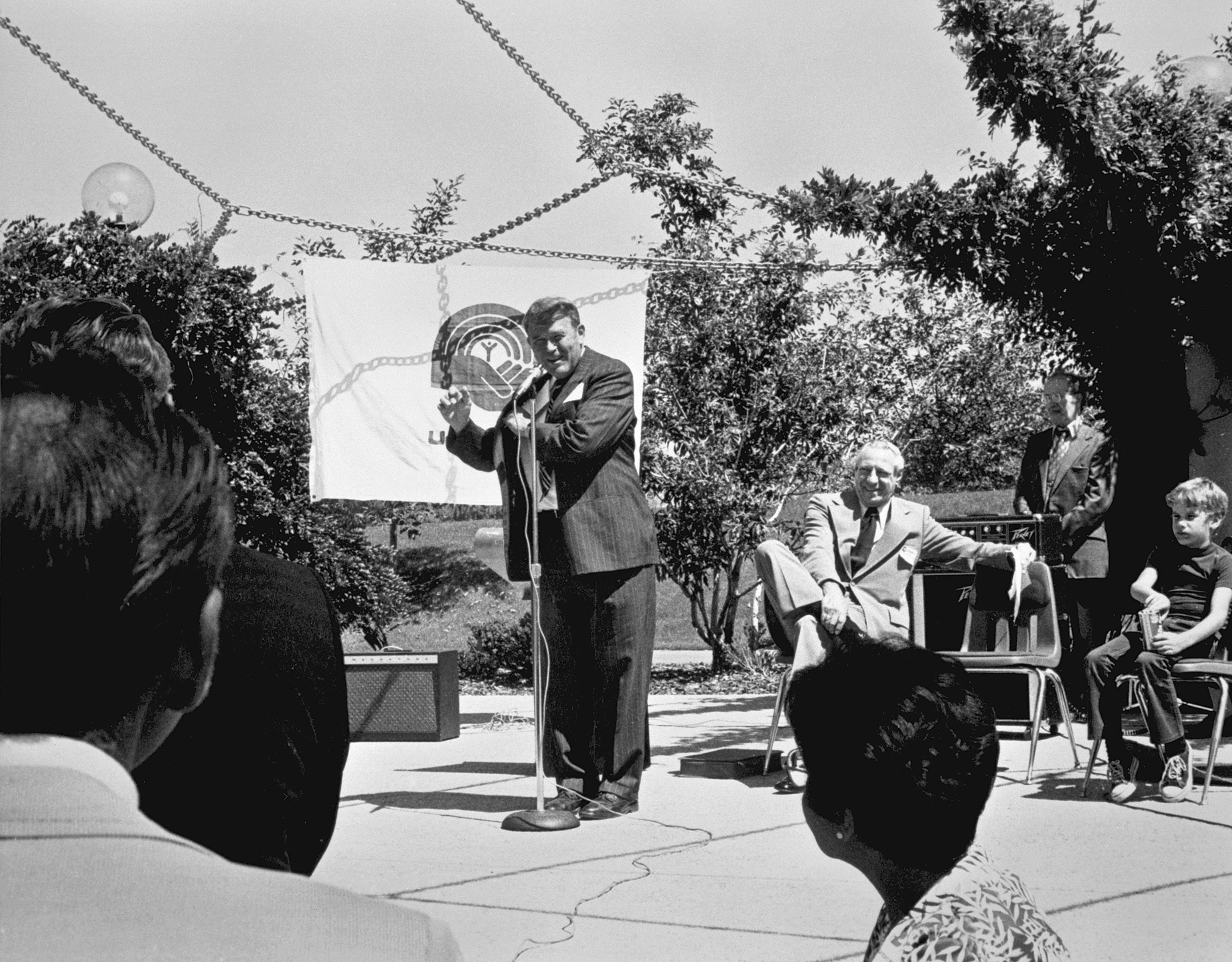
 

“So while we hope that the Soviets see this nuclear problem as we do and see the benefits to both sides of a rational approach we do have to hedge against the possibility that the Soviets may see it differently.”


“Our objective, then, is to take the precautions to protect our deterrent capability in any way that will be consistent with arms control talks, whether they are successful or whether they fail.”


“These are the considerations that led this Administration to modify the Sentinel ballistic missile defense of the Johnson Administration into the Safeguard System. Safeguard is planned and configured not only to do a particular job if needed, but to do it in a way that helps maintain balance and introduce stability into strategic nuclear equations.”


Referring to critics who argue that the system may be needed at some time, but not now, Packard says “The fact is that we do not need it now. If we do need it by 1976 we just have to start now. If we could be assured that we would not need this protection before 1978 we could indeed fall back to an R&D position. But I cannot recommend that we take that kind of a chance with the security of our country.”


In answer to critics who say there are better ways to protect our deterrent forces, Packard says the time scale will not allow it: “Five years for the first two sites; seven years at the earliest for the full system.”


Cost has been another factor of contention. In response Packard says “Some of the $2.1 billion for Phase I has already been spent and the balance will be spent over the next five years.”


“The Phase I program then that we are recommending will cost the country about $500 million a year over the next five years. The question then is can we afford to spend one-half of one percent of this nation’s budget on a defense which might, and it just might, determine the survival of America?”


“Many of the opponents base the opposition to Safeguard on their belief, or their feeling, that the domestic problems of America are more important than the problems of defense. I have no quarrel with the proposition that domestic problems of the country are important. And I might even go so far as to say that if we do not solve these troublesome domestic problems, we’ll not need to defend America because there won’t be much worthwhile to defend.


“But I hasten to assure you that I am really not that pessimistic. I believe and am sure that our domestic problems can and will be solved. This country has ample resources in people and knowledge and understanding and the money to provide for defense that will keep the peace and also to resolve these social problems.”


Packard says the President recommended Safeguard because he thought it was right. He recommended Safeguard because he wanted to enter Arms Control talks with the Russians from a position of strength. He recommended Safeguard because he believes America must be strong in the future as it has been strong in the past. He deserves your support and my support in this decision.


Box 1, Folder 39 – Department of Defense


May 14, 1969, Department of Defense Seminar, Leadership of Non-Government Organizations [NGOs]

Packard appears to be giving some introductory comments to a group gathered for the day. Not clear who the group might be, but appears to be non-governmental.


5/14/69, Handwritten notes by Packard outlining points he wished to bring out in speech. Notes are fragmented and brief.


Packard says he has been here for four months and is just beginning to learn.

He speaks of a “Report on DOD to stakeholders,” service to people – nearly 80 billion, nearly 9% GNP, about half to support personnel, half goes to equipment and services.


Probably 20-25% of people in U.S. dependent on DOD.


Money from taxes


DOD is here to do the job people of America want it to do. We are responsible to President as Commander in Chief. President through the political process is responsible to you.”


Viet Nam first priority


What we are asked to do determines spending.


Strategy – Russia


Safeguard System designed to [be] deterrent.


Pleased to have you here. Better indicate how DOD can serve your needs.


Box 1, Folder 40 – Department of Defense


May 16, 1969, Acquisition of Major Weapons Systems, Etc. The audience appears to be managers from within the DOD.


5/16/69, Typewritten text of Packard’s speech


Packard tells the managers that on May 3rd and 4th Secretary Laird and he held “an informal weekend meeting” to discuss problems facing the Department of Defense. Packard explained that the idea was not to arrive at solutions so much as to define the problems so that all had a clear idea with what needed to be done and could work together on common objectives. [example of HP management practice, MBO]


Packard says he expects, as a result of this weekend discussion, they will be able to “move ahead to the clarification of some of our Department policies, because everyone with a management responsibility can do his job well only if he knows what is expected of him.” He adds “that it is desirable for every manager to have clear understanding of his objectives, and then be free as possible to use his knowledge, initiative and understanding to implement those policies as effectively as possible in his own way. I believe from this approach it is easy to get good motivation and enthusiasm, which, of course, are important elements in any organization.”


Packard says that the objectives towards which they are trying to move are contained in written policies, guidelines and directives; and are further “communicated by listening to people in the organization discussing their problems and their approaches to the solution of those problems.”


Toward that end Packard introduces three speakers: Dr. John Foster, Director of Research and Engineering, Secretary Moot, comptroller, and Secretary Shillito, Installations and Logistics.  Packard says each will give a short presentation on their role as related to major weapons systems acquisition. He reminds the people that they will continue to direct their attention to problems in this area and in develop some Department-wide policies for future guidance in acquiring weapons systems in the future.


Packard’s text does not include information on the remarks of the three speakers.


In closing, Packard says he hopes “that we will find time to discuss some of these matters directly with you.” And he says he would like to have their reaction “as to the benefit of a film like this in helping you understand our common objectives of better management in the Defense Department.”


Box 1, Folder 41 – Department of Defense


May 17, 1969, Armed Forces Day, World Affairs Council, Los Angeles.


5/17/69, Copy of transcript of Packard’s speech as prepared by the DOD Public Affairs Office.


Packard speaks of some of the troubled areas of the world – war in Vietnam, Mideast crisis unresolved, Czechoslovakia, North Korea belligerence, unrest at home. He feels we have slipped into a mood of confusion and uncertainty which has generated militancy among minorities, radicalism among students and which has affected the faculties and leadership of our universities and churches.


“Those very institutions which should be the stabilizing influences in our society, centers of rational thought and moral strength, are in danger of becoming emotional instead of rational, demoralizing instead of stabilizing.”


Packard is concerned that much of the vitriol is directed at the military establishment and the men and women in uniform who we are honoring here today.” He spends considerable time explaining that the military does the job that is asked of it by the people. He points out it is not the proper purpose of the Defense Department to make policy for America, and says “The armed services role is to carry out the orders of their Commander-in-Chief, the President of the United States, and in the final analysis the President is responsible to the will of the people.”


He moves on to a discussion of strategic problems – the first being our relationship with the Soviet Union. He says we have worked out a balance of destruction capability, but Russia seems to be going beyond this with the development and deployment of  their strategic forces. “But,” he says, “we must also take such action to make sure there can be no advantage for either side in starting a nuclear war….”


Packard describes the Safeguard Missile system which is being considered by Congress and which he recommends.


5/17/69, Typewritten text of Packard’s speech.


Box 1, Folder 42 – Department of Defense


May 22, 1969, Aerospace Industries Association, Williamsburg, VA


5/22/69. Copy of typewritten speech


Packard lists three problems facing the Department of Defense. “The first problem is to determine the tasks that are to be performed by the Department of Defense. The second problem is to determine the forces that are required to accomplish

these tasks. The third problem is to procure and operate these forces in the most efficient manner.”


Concerning the first problem – defining the DOD tasks, Packard says there are two questions involved: Do we have the military force structure adequate to support United States commitments around the world? And, secondly, what military budget level will the people of the United States support over the next few years?


Packard says the National Security Council will make decisions on the military tasks which must be performed to support United States interests in the world – taking into account costs for various alternatives. He says they are working within the DOD to develop better procedures on which to build budgets for the future.


On the second major problem – the determination of forces necessary to meet the national objectives – Packard says they will be encouraging the services to “apply system analysis and cost effective procedures, realizing that all problems are not solved by analytical procedures alone.”


The third problem area concerned the need to procure and operate Defense resources in the most efficient manner possible. He says they will be “taking a very hard look at whether we need all this gadgetry when we go into a new development…” He questions the reliability of complex systems and says that “A tank with its gun out of order is not a tank at all.”


Packard says they do not have all plans worked out but he can tell the direction they are going. “We expect to have all future contracts for weapons systems include realistic achievement milestones which must be met before production is started.” And on another point he says “Neither the DOD or the Congress will continue to tolerate cost overruns which relate to unrealistic pricing at the time of award, or to inadequate management of the job during the contract.”


He closes with “I hope you will agree with me that we should not and can not settle for less.”


5/22/69, Press release issued by the DOD Public Affairs Office describing speech.


Box 1, Folder 43 – Department of Defense


June 9, 1969, The Advertising Council, Washington D. C.


6/9/69,  Copy of typewritten speech with some notations written by Packard


Packard’s talk is a request for support of the Safeguard ballistic missile system. He says the general public supports the Safeguard by a large margin. This will be “an important factor in the congressional vote, but the issue certainly is not settled. The issue is becoming somewhat obscured, in fact, by an unfortunate emotionalism which is found in one segment of the public. The emotion is not related to the Safeguard issue; it apparently is just a dislike on the part of some persons of things military.”


Packard says he would like to “separate the Safeguard from this emotionalism and examine the basic issues reasonable and simply and then suggest that you people make up your own minds.”


When Packard joined the Nixon Administration he says he “…helped review and resolve a number of pending defense problems, among them the problem of our strategic nuclear weapons and policies and their relation to the weapons and policies of the Soviet Union. Nuclear planning is not pleasant, but I can think of no more important matter for the future of mankind than the avoidance of nuclear war – and avoidance of nuclear war is the heart of the Safeguard issue.”


Packard describes the situation where both the Soviets and the U.S. have sufficient deterrent forces – either one could respond to an attack with such force that the attacker would be destroyed. However, the Soviets are continuing to install big, accurate missiles, well suited for an attack on our Minuteman ICBMs, but ill-suited for a policy of deterrence only.


“Since we cannot tolerate any significant doubt of the ability of our weapons to deter, we must find some way to give our weapons more protection.” After considering and discarding several options, which  Packard explores, he says President Nixon recommended the Safeguard system to Congress. The plan is to install the system at two locations over the next five years, work out the bugs and then decide if further expansion seems necessary.


“The defense of bombers and missiles will show the Soviets that they cannot reduce the survivability of our deterrent weapons and thereby raise the risk of thermonuclear war. It should induce them to abandon any hopes they may have of achieving a low-risk, first-strike capability.”


“America’s long-range nuclear retaliatory weapons are truly vital to us. If their effectiveness were ever to be questioned seriously by a potential enemy, the lives of most of us could be in jeopardy. This is why a decision to offer extra protection to our deterrent should be made calmly and rationally. This is the way that President Nixon made his decision. I hope that the public will address the issues in the same way. And I hope that the final vote by the Congress will be made only on the merits of this issue, the issue of deterrence of nuclear war, of control of nuclear weapons – of the avoidance of nuclear holocaust.


“Sober examination will show, I am confident, that what the President is asking is simply that we use the best technology available in the most effective and economic way to meet a real and most serious challenge.


“We must be able to deploy Safeguard as, and if, it is needed. Safeguard is an essential response to a risk which our country and our people cannot and need not accept.


“I have outlined the problem and the available solutions. I have given you my views. I urge you to make up your own minds. If I can help by answering any questions here this morning, I will be pleased to do so now.”


6/9/69, Press release issued by the DOD Public Affairs Office covering Packard’s speech.


5/28/69, Letter to Packard from Robert Keim, President of The Advertising Council, inviting him to attend and speak at the June 9 affair. A copy of the program is attached.


Box 1, Folder 44 – Department of Defense


July 25, 1969, Vietnam and the Nixon Administration, The Bohemian Grove.


7/25/69, Typewritten text of Packard’s speech with handwritten notations by him.


Packard says he is pleased to have “the opportunity to report to you today on some of the problems I have been wrestling with since the first of the year….”

He says that some people may be concerned that he may leave the private sector permanently. He assures everyone that this will not be true, adding that “These past six months in Washington have only served to reinforce the convictions of my prior experience – that the strength of America resides in the private sector. If there is any hope for this country it resides in the private sector.”


Packard says he wants to talk mainly about Vietnam, but first wants to make a few comments about the ABM. “The ABM issue is not just a simple issue of what should be done for the defense of our country. It has become a symbol – a symbol of the times. It is a measure of the attitudes and the emotions of the whole American society.”


Packard tells how one of his first assignments upon coming to Washington was to write a Department of Defense position on the ABM issue so a recommendation could be made to the President….After evaluating the matter as objectively as he could, Packard says he came to the conclusion that “…an ABM system is both technically feasible and necessary for the defense of our country.”


He says he is amazed at the level of controversy created by the ABM program, and is “most troubled by the attitude of some in our scientific community.” Saying that he has had, and still has, much respect for scientists – “this respect is shaken when I see some of our respected scientists take positions on the ABM issue that seem to be guided by their emotions or based on political judgements [sic] which lie outside their expertise rather than on objective scientific analysis.”


After “listening carefully to all that has been said on the ABM issue,” and after “having had the benefit of all of the information that has come through our intelligence channels during the last six months,” Packard says “I am even more convinced now than I was four months ago that the President’s decision on the SAFEGUARD system is precisely the right decision for the security of our country.”


That said, Packard moves on to the “troublesome question of Vietnam.”


THE COST OF VIETNAM

Packard describes the high cost of  this war –the “tragic loss…of more than 37,000 fine young Americans killed in action  and of tens of thousands of others who have suffered serious injury….”


“In dollars, the price is approaching $100 billion.”


And Packard points out how the Vietnam War contributes to pressing domestic problems – inflation, lack of money for schools, hospitals, housing.


“We also pay a price for Vietnam in the profound and bitter division of our people about the war. The conflict is a serious obstacle to the national unity President Nixon called for in his Inaugural Address.”


“Then, too, Vietnam has had an effect on the strategic balance between the United States and the Soviet Union. Diverting nearly one-third of our defense dollars to Vietnam is one cause of the current situation in which the Soviet Union is now outspending us in strategic offensive programs by a factor of 3 to 2 and in strategic defensive programs by a factor of 3 to 1….”


Packard says President Nixon wants to end the war – but “High as the costs of Vietnam are, they are not nearly as heavy a price as we would pay if we were to cut and run as some advocate.”


THE OPTIONS OPEN TO THE UNITED STATES


“One option for solving the Vietnam problem is through negotiations….Unfortunately, however, the Paris talks remain unproductive.”


Consequently, Packard explains, “the Nixon Administration felt it necessary to consider alternative courses.”


Packard says some have asked why a military war should not be an alternative. He says this alternative would “certainly require fighting the war on the territory of North Vietnam as well as in Laos and Cambodia. It would probably require defeating the main forces of the enemy in their territory, on the ground, carrying out the slow process of stifling guerilla warfare. And it could require occupation of conquered territory by American forces for many years.”


“The alternative which the President has chosen in case the Peace talks fail is a change in the role of the United States in the war, a change that has been given the name of “Vietnamization.”


VIETNAMIZATION OF THE WAR

 Packard explains that “Vietnamization” means “shifting responsibility for military operations from American to south Vietnamese forces as the latter increase their capability to defend their country.”


But Packard says “The United States is not going to leave south Vietnam in the lurch.” He says the reduction in American personnel is a process of replacement, not withdrawal. “The reduction in American troop strength contemplates that south Vietnam can be defended against the Communists.”


“The President laid down three conditions which govern decisions on reductions of U. S. troop levels in Vietnam —


“The ability of the south Vietnamese to defend themselves in areas where we are now defending them.


“the progress of the talks in Paris,


“the level of enemy activity.”


IMPROVEMENT IN THE SOUTH VIETNAMESE FORCES

Packard sees that we face these facts as of mid-1969:


“1. General Abrams has done an outstanding job in dealing with communist main force efforts and in exacting from them a high price in casualties and captured supplies and weapons for their continuing harassment, terror, and sabotage.


“2.  South Vietnamese forces continue to improve their combat effectiveness, but problems with their leadership and morale persist in many areas. Desertions especially continue to be a serious problem.


“3. Urban areas are generally secure though not immune from sporadic mortar attacks and sappers.


“4. Government control of rural areas is improving, but many villages are still under Viet Cong control, and many more are still subject to attacks which are often directed at assassination of village leaders.


“5. Communist losses in manpower and materiel are severe, and are increasing

on a relative basis, but do not appear to be at a decisive level.


“6. President Thieu’s government in Saigon appears to be in satisfactory control, but it presently lacks the desired broad base of political and popular support.


“7. The war is costing Russia and China in the range of two billion dollars a year.


THE PARIS NEGOTIATIONS

Packard says “I reveal no state secret when I say that there has been no visible progress in Paris despite 26 official meetings and a series of efforts by the United States to move the talks off dead center.”


THE DIRECTION OF OUR POLICY

Packard summarizes the policy of the Nixon Administration. “We hold firmly to one objective: permitting the people of south Vietnam freely to determine their own destiny. We want peace as speedily as possible, but we cannot acquiesce in a peace which denies this opportunity to the South Vietnamese.”


“At the same time we are striving to lower the level of hostilities and to raise the level of the combat capabilities of the south Vietnamese. …We shall continue our efforts to reduce the size of American forces in Vietnam by shifting to the South Vietnamese a greater share of responsibility for the fighting.”


THE EXPECTATIONS AND THE RISKS

“Will our objectives be attained?“ Packard asks. “It takes two sides to make peace, and, given the intractable attitude of the other side at Paris, I cannot be confident that progress there will soon be forthcoming. We can, I am confident, continue to reduce the American combat role in the war.”


“No policy that we might adopt toward Vietnam is free of risk. The plan we are following has risks but they are fewer in our judgment than those involved in any other course we might pursue at this time.”


“I know how leaders in Hanoi think the war in Vietnam will end. They expect the same outcome as that of their war with the French – victory by default because the other side became weary of going on when no end was in sight.


“The outcome of the war has become a matter of will – The will of the South Vietnamese to assume full responsibility for their country, to fight through a dwindling war, and to build their nation on a strong base of social and political justice.


“Though attainment of our objective depends primarily on the will of the south Vietnamese, it depends, too, on the will of the American people, We must not falter or grow weary as Hanoi hopes and expects before our job is done.”


7/25/69, Copy of typewritten text of Packard’s speech without notations.


Box 1, Folder 45 – Department of Defense


July 29, 1969, Defense Supply Agency, Cameron Station, Alexandria, VA


7/29/69,  Typewritten text of Packard’s speech, written in outline format. He is speaking to a group of about 300 military and civilian personnel from the Agency. Dress uniform and black tie were in order.


Packard congratulates the audience on their achievements over the past 8½ years, and he enumerates a list of these – millions of items in the military “catalogue,”  billions of dollars of sales, on time deliveries, Vietnam buildup.


Packard talks about the need for good management, particularly with some 58,000 employees – and he recommends “management by objective.” [reference to HP management by objective, MBO,  practices.]


On the subject of major weapons systems he says the process of development needs to be more complete before production is begun. Check points need to be established, cost vs. performance trade-offs analyzed, more emphasis on reliability.


For the future he sees:


No more year to year budget increases

Must be an efficient, well planned program to meet needs of future.


He closes saying they have his full support and he offers to be of help at any time.


7/29/69, Notes of speech handwritten by Packard.

7/11/69, Letter to Packard from Lt. General Earl Hedlund giving details on the dinner meeting.

Undated, Typewritten sheet titled, BACKGROUND INFORMATION ON THE DEFDENSE SUPPLY AGENCY.


Box 1. Folder 46 – Department of Defense


September 17, 1969, Criticism, Dissent – and the Defense of Our Nation

Loyola University, Los Angeles, CA  The event was in commemoration of Citizenship Day and Constitution Week


9/17/69, Typewritten text of speech, with some handwritten notes by Packard.


Packard talks about the many things that the dissatisfied and impatient youth of the day want – rid society of evil and injustice, establish peace, eliminate slums, end poverty, end ethnic and racial discrimination, cure disease, and “strike down hundreds of other wrongs.”


Packard says their “impulses are generally noble, and the commitment to the well-being of their fellow man is admirable. Though they will not achieve all they hope to do, they will remove many of the blemishes of the social and political order which have been tolerated for too long. Some are over zealous, but there is nothing wrong with this that living a little longer will not solve.”


“The young people that I know best,” Packard says, “…are those in our armed forces. I cannot praise them too highly. And he adds that “No one, whatever his feelings about why or how we are fighting in Southeast Asia, should feel anything but pride and gratitude toward the gallant young Americans there. And it may not be amiss to note that there, white and black Americans set an example for the home front by living and working and fighting together in harmony, in mutual respect and trust.”


Packard says the nation’s young people such as these people in uniform receive too little notice. “There is, on the other hand, a surfeit of publicity for the nihilistic minority whose aim is destruction and whose tactics are threats, violence, and disorder. These tactics have no place in the United States where the constitution guarantees orderly procedures for peaceful change. Above all, they have no place on the university campus where reason – not violence – ought to dwell.”


While he is less disturbed by the “antics” of some disruptive youths, Packard says he is concerned “about certain currents of public opinion that in the long term could have more serious consequences for the nation. There is a danger that national defense will be neglected in the future, and this danger is heightened by irresponsible attacks on the nation’s military forces.”


“The campaign against the military has had repercussions on the campus – notable in protest against the ROTC. At Loyola, which boasts one of the best ROTC units in the Air Force, the relationship between the university and the military has been exemplary. At some other universities, our experience has been far different. In a few, the climate has become so inhospitable that we have had to terminate ROTC programs.”


Packard says he views such developments with dismay. “The ROTC furnishes about half of the new officers commissioned each year. Without it, we would be deprived of the leavening influence that these young men fresh from civilian educational institutions bring to the armed forces. And without it, an important link between the military and the schools of the nation would be broken.”


Reading the newspapers and periodicals of the day Packard says it would be easy to get the impression that the military does nothing right. He admits that mistakes have been made, but says that “with 3.5 million military people and over a million civilians, there will always be cases where people make mistakes. Unfortunately, it is only the mistakes that make the headlines, and mistakes are fair game for Congressional hearings. The Pentagon has also done a lot of things right, and, in order to give some balance to the discussion, these are the things I would like to talk to you about.


“I submit that the Department of Defense should be judged in terms of its essential function – providing the armed strength to keep the nation and its citizens secure against all external threats – to protect our citizens and vital interests – and to meet our obligations to support our friends throughout the world.”


Packard notes that “Our critics…have complained about an excess amount of strength. I submit to you it is infinitely better to have a little too much than not quite enough.”


In response to criticism  of the military that its “strength is being used for the wrong purposes  (as in Vietnam some would say),“ he points out that “the use to which our military strength is put is not determined by the Department of Defense, but rather by the White House and on Capitol Hill.”


Saying that his purpose tonight “is not to refute the critics. Rather, I want to point out a few of the positive things about the Defense Department that the critics seem to miss. I limit myself to five things that we’re doing right.


“First, we are progressing in our efforts to train and equip the forces of South Vietnam to assume greater combat responsibility, which permit reduction of American forces in southeast Asia….As a result, the replacement of American troops is under way.


“This is a break from the policy of the past that dictated a constant increase in American forces in the theater of combat and assumption by the United States of the major responsibility for the conduct of the war.”


“Second we are progressing in our effort to bring the Defense budget under better control. As a result of painstaking review of that budget, Secretary Laird has announced preparations for cuts during the current fiscal year which will reduce spending by more than $4 billion below the level recommended by President Johnson.”


“Third, we are doing a number of things to improve the procurement system for major weapons….We are proceeding to make sure that we have eliminated as many technical uncertainties as possible before full-scale development is begun, and that development is complete before production is started.”


“Fourth, we are progressing in reforming the management of manpower in the Department of Defense. We are keenly aware of the fact that people are our most important asset.


“We have given particular attention to the problems of ROTC an have worked closely with the universities and colleges of the nation to rectify any shortcomings in the present program.”


“Fifth, we are progressing in using the resources of the Defense Department in a vigorous campaign against such evils as poverty, ignorance, and discrimination. Secretary Laird has given direction and emphasis to such activities by creating within the Department of Defense the Domestic Action Council which stimulates and guides this aspect of our work….We have done much to eliminate discrimination in housing. We run one of the nation’s largest school systems in non military subjects and probably the biggest occupational skill training program in the world. In securing the goods we need, we give special attention to procurement from small business firms and minority enterprise. In addition, we have begun to make our facilities available to disadvantaged youth of nearby communities for learning and recreation.”


“Our Constitution, the signing of which we are gathered here to commemorate, reflected the cautious attitude of eighteenth-century America toward military power. It established civilian control over the military forces and sought thereby to guarantee that the military would always be the servants of the American people.


“No military leader of our country would want it any other way. The subordination of military to civilian authority is fully recognized and wholeheartedly supported by those who wear the uniform.


“On the other hand, those who framed the Constitution recognized that the system of government which it established required military power if it was to endure. They selected, after all, as their presiding officer at the Constitutional Convention, the man who had been commander in chief of the armed forces in the Revolutionary War.”


“The proudest responsibility of the armed forces is to support and defend the Constitution of the United States. They will continue to discharge this responsibility with fidelity. And this vast country shall remain one nation under this Constitution as long as our armed forces discharge this responsibility with the trust and confidence of the people whose freedom they guard.”


9/17/69, Copy of a News Release issued by the Department of Defense Public Affairs Office, covering the speech.

9/17/69, Copy of the program for the dinner event.

9/17/69, Copy of the invitation to the dinner.

4/30/69, Letter to Packard from John C. Cosgrove expressing delight that Packard has accepted the invitation to speak at the Citizenship Day Dinner.

9/30/69, Letter to Packard from George E. Lacy S. J., Vice-President-University Relations, thanking Packard for participating in their event.

10/1/69, Letter to Packard from Donald P. Merrifield, S. J., expressing appreciation for his talk.


Box 1. Folder 47 – Department of Defense


September 23, 1969, 10th Annual Joint Communications-Electronics Conference.

9/23/69, Typewritten text of Packard’s speech. He is apparently speaking to a group of people responsible for the Command, Control and Communications system used by DOD among others.


Packard emphasizes the importance of the command control and communications functions to the capability of the military forces. “…in the last two decades they have become critical elements – when we face warning times measured in minutes in a world-wide theater, the survival of the nation can depend on how well you have done your job.


“With the advance of technology and the demanding requirements which are derived from our world-wide strategic situation, our command control-communications systems are forced to larger and more complex configurations. This in turn adds a new demanding requirement on the management, the planning, the procurement, and the operation of these systems. It is therefore appropriate that we review today some of the things we can do to achieve better management.”


Packard starts with planning – “…we have to know what we want to do….The answer to this question, of course, depends on our world-wide strategy – what do we need to be prepared to do around the world. “


To “come to closer grips” with this problem Packard says they have embarked on “an agency-wide study which is now nearing completion.”


“Good planning is the first step in good management. We must plan for systems that will be adequate to support our future force deployment and strategy. The studies I have outlined should help toward that end. We must also plan for systems which can be built and operated within the resources we will have available. We must design systems which meet the expected requirements but at the same time are not too complex and therefore too expensive to procure, operate and maintain.”


Packard says he feels we have done a good job developing the capabilities of our systems, but he is not so sure that “we have placed as much emphasis on cost and financial controls of this widely interspersed activity, and accordingly we plan to make some changes which we hope will bring this aspect of management into better focus.”


Packard outlines some steps they are taking to improve this situation. “First we plan to place more emphasis on the all important question of the design concept before we implement actual development. Is the proposed system adequate for the job but not too complex. Have we resolved the technical uncertainties, have we properly assessed the needs of the user. Above all, have we made realistic cost estimates before we make the decision to go ahead.


“… when we decide to go ahead with full-scale development and production have we laid out a plan under which we have development complete – or at least far enough along that the major problems are known and uncertainties eliminated before we begin production.”


“The second step in management is organization to get the job done. Organization with divided responsibility is a sure deterrent to success. Over-organization is often worse than under-organization. I have seen much more of the former than of the latter since I have been here.


“The third step in good management is motivation, and this is affected by the way a program is organized. Clear delegation of responsibility allows personal identification with success – and personal recognition for good performance – one of the strongest motivating actions available to management.


“The fourth step in good management is evaluation – evaluation of performance – did we in fact do what we set out to do – are we meeting our targets and do we know where we stand on a program in time to do something about it.”


In closing Packard urges each person present to follow the precepts of good management: “…if you are working together (good organization) toward a common objective (good planning) with a high level of enthusiasm (motivation), I am sure the evaluation of your performance by your superiors as well as the Congress and the public at large will come out with a high mark.”


Box 1, Folder 48 – Department of Defense


September 25, 1969, Secretary’s briefing, Pentagon


9/25/69, Typewritten copy of speech.


Packard gives a basic lecture on management: Planning, Organization, Motivation and Evaluation.


After going through each of these, which he calls “management by the book,”

he talks about a book titled “The Peter Principle” by Dr. Lawrence J. Peter. “In this book Dr. Peter defines a hierarchy as ‘an organization whose members or employees are arranged in order of rank, grade, or class’ Packard says “This seems to have something to do with the DOD.”


Packard quotes “The Peter Principle” which states: ‘In a hierarchy, every employee tends to rise to his highest level of incompetence.’ And Peter’s corollary which is: ‘In time, every post in a hierarchy tends to be occupied by an employee who is incompetent to carry out his duties.’  Packard says “I don’t believe the DOD yet approaches the point of no return in this matter, but there are some symptoms which trouble me. Dr. Peter calls these symptoms ‘non-medical indices of Final Placement.’


“For instance, I have noticed a trend toward ‘Rigor Cartis’ – which is ‘an abnormal interest in charts with dwindling concern for realities that the charts represent.’


“There is a serious infection of ‘Codophilia, initial and digital – speaking in letters and numbers instead of words.’


“Then I have observed considerable of the ‘John Q. Diversion’\– undue reliance on public opinion.’


“And an excessive amount of ‘Papyromania– compulsive accumulation of papers.’


“There is a certain amount of ‘Professional Automatism – obsessive concern with rituals and a disregard of results.’


“I find some evidence also of  ‘Computerized Incompetence – incompetent application of computer techniques, or the inherent incompetence of a computer.’


“On the third floor E Ring, and in certain other areas, one can find evidence of ‘Tabulatory Gigantism’– obsession with large size desks.


“But despite the evidence of a limited intrusion of these various symptoms, I am glad to report to you that we have not yet achieved Success – either individually or collectively – Success is “final placement at the level of incompetence.”


“The challenge we all face, working together in the world’s largest hierarchy is to prove that The Peter Principle is not the inevitable result of people working in a hierarchy. That is our plan, our objective, and in the final analysis we will all be evaluated individually and collectively on our accomplishments against this objective.”


Box 1, Folder 49 – Department of Defense


October 15, 1969, Defense Supply Association, Washington D. C.


10/15/69, Typewritten text of speech


Commenting on the current  anti-war demonstrations Packard says he is “skeptical about the usefulness of today’s demonstrations. I think they are more likely to retard than to advance the day when Americans are no longer in combat. For, in my opinion, they encourage the enemy to hang on in the hope that we will pull out of Vietnam so abruptly that we will leave chaos in our wake.


“…Our country is now well along the road toward transferring to the south Vietnamese the heavy responsibility in military and other fields which we have been carrying.


“As fast as the South Vietnamese can be readied to assume the burdens which Americans have carried in their country, Americans will be phased out. And this replacement is being carried out at the fastest, practicable rate.”


“The main forces of the enemy have been weakened. The Viet Cong infrastructure has been badly shattered and demoralized. Steady progress has been made in pacifying the countryside, in establishing stable local government, and in equipping the forces needed for local security.”


“Of all the policies which the United States might pursue, Vietnamization offers the best prospect of rapid reduction of the burden which the United States has assumed in Vietnam without sacrificing what we have been fighting for.


“Concerned as we in the Defense Department are about Vietnam, we are also looking beyond it. In the most thorough, searching, and comprehensive assessment ever undertaken, the national Security Council is considering our defense needs for the future to support our foreign policy objectives.


“Some of the main lines of post-Vietnam policy have been sketched by the President. We shall continue, in collaboration with our NATO allies, to provide a military shield for the areas of Europe included in this Alliance. We shall maintain a strong interest in the development of free, stable, and prosperous nations in Asia by doing more to encourage Asian nations to develop the capacity to defend themselves without reliance on American troops. We shall maintain a strong offensive and defensive posture in order to provide deterrence to nuclear war.”


Packard turns to the budget and describes the ways they are reducing the cost of national defense. “We are planning reductions of more than $8 billion in obligations and $4 million in outlays in the Defense budget of the current fiscal year.” He describes the actions they are taking to achieve these savings: “…we are cancelling (sic) work on projects that are not of the greatest urgency;…laying up many aging vessels;…cutting manpower;… looking hard at our bases,…with a view to closing out some of them. And we have introduced tighter control over the development and production of new weapons systems.


“In short, we are tightening our belt in all areas where reduction will not adversely affect the military capability needed for the future.”


“…we are striving to ask no greater part of the taxpayers’ dollar than we really need. For these reasons, we are striving for more effective utilization of the resources available to us.”


To this end Packard stresses the need for “the efficient management of logistics” which is “of prime importance in the effective utilization of our resources. The Defense Supply Agency has a major responsibility in this field….As of June 1969, DSA was managing nearly 2 million of the 4 million Defense-used items.


“Still another important phase of integrated management has been the establishment of the Defense Coordinated Procurement program, under which one Defense component performs the Defense-wide consolidated purchase function for an assigned common-use commodity.”


“Taken together, over the past several years, these integrated management and procurement programs have saved literally hundreds of millions of dollars in decreased operating and procurement cost.”


Packard says he is “…impressed with the scope of the job being done by the Defense Contract Administration Services.  DCAS now administers over 65% of all DoD contracts over $10,000 and is represented in almost all major U.S. cities.”


“Secretary Laird and I do feel…that responsibilities for managing programs should be decentralized to the greatest extent practicable. The majority of our program managers have the tools necessary to do their job well, and qualified people are available to get the job done.“


“In connection with our efforts to improve controls over Defense spending, we have been concerned about cost overruns.” He describes the various reasons for cost overruns, says they are difficult to avoid in some programs,…“But we must do better than we have done in the past.”


To improve the “cost-estimating and decision-making processes, in connection with new systems in particular, and to improve the efficiency of the logistics function, in general…we have established a Defense Systems Acquisition Review Council at the Assistant Secretary level….” He says this function will advise “the Secretary of the current status of each major system and its readiness to proceed to the next phase of effort in its life cycle.”


In addition, Packard says “Secretary Laird has also appointed a Blue Ribbon Defense Panel, headed by Mr. Gilbert W. Fitzhugh, Chairman of the Board of the Metropolitan Life Insurance Company. The Panel is studying organization and management on DoD, research and development, procurement, and related matters. We expect from this Panel valuable counsel that will result in better organization and more efficient operation.”


Packard says “We will continue the DoD  Cost Reduction program which has been producing over $1 billion in audited savings annually.”


“Since the beginning of the present Administration, the DoD has been critically reviewing the rationale and the progress of all major programs. Several cancellations have resulted, such as the Manned Orbiting Laboratory and production of the Cheyenne helicopter; and other programs, such as ammunition purchases, have been reduced.”


“Along with the above actions, we established the Joint Logistics Review Board. This Board is charged with reviewing worldwide logistic support to our armed forces during the Vietnam era to identify strengths and weaknesses and to make appropriated recommendations for improvement. We are looking to the findings and recommendations of this Board to assist in the long-term improvement of our logistics systems in the light of the lessons Vietnam has taught us.”


Packard refers to the area of logistical support of forces in Vietnam, and quotes General Westmoreland on the subject:


“Never before in the history of warfare have men created such a responsive logistical system….Not once have the fighting troops been restricted in their operations against the enemy for want of essential supplies.”


Packard talks about the most difficult period being during the first year of buildup “when 200,000 men were deployed concurrently with the construction of the logistical base.”…He describes the shipping and construction challenges that had to be met, the storage facilities that had to be built; and on top of  this “ Our forces have…enjoyed the highest quality of personnel supplies such as food, clothing, and medical equipment ever provided during wartime.”


“As we carry out the reverse process of reducing our presence in Vietnam, we face a new and very complex set of logistical problems. One type of problem is that of removing substantial quantities of materiel and equipment which we shall not be leaving behind. The other type of problem is that of helping the South Vietnamese to build up their own logistical capacity so that in this field, as in combat activities, they will no longer rely so heavily on the United States.”


“I have mentioned in the course of these remarks several reasons which the Department of Defense has for pride in its accomplishments. One of the reasons for doing so is my conviction that the public is often given an unbalanced account of Defense activities – an account that emphasizes shortcomings and underplays or ignores accomplishments.


“Accomplishments are produced by people. Sometimes those at the pinnacle of large organizations seem to forget this obvious truth to the detriment of morale throughout the organization.


“Secretary Laird and I have set as one of our top priority objectives for the Defense Department a recognition of the importance of people. The work of the Department will be well done only if those in it, military and civilian, feel pride in themselves and their jobs. The Defense Department will be effective in the performance of its mission only if the public has faith in the competence and integrity of the Department’s personnel.


“We are proud of the people in Defense, and we do not intend to let their reputations be sullied. Any type of wrongdoing on the part of any Defense personnel will not be tolerated or ignored. In justice to the people of this nation and to the overwhelming majority of our military and civilian employees, we shall see to it that appropriate measures are taken to deal promptly with the few whose conduct violates the law or the standards of performance that the public has a right to expect.


“The present management of the Defense Department has been in office for only nine months. It has, I think, made some improvements. It will be a long time before I expect to find my “in basket” cleaned out of problems that beset this mammoth and complex organization. But we have made a start on a course that will provide benefits in terms of increased security in terms of increased security at minimum cost in the years ahead.”


10/15/69, Press release issued by the DOD Public Affairs office giving text of Packard’s speech.

10/13/69, Program for the 22nd Annual Convention, Defense Supply Association, Oct. 13, 14, 15,1969.

Undated news release announcing the forthcoming convention.

8/11/69, Copy of letter to Packard from Lt. Gen. A. T. McNamara inviting Packard to be the Principal Speaker at the Annual Banquet on Oct. 15, 1969.8/26/69, Copy of letter from Packard to Lt. Gen. A. T. McNamara, accepting offer to speak at the convention.

10/6/69, Letter to Packard from Lt. Gen. A. T. McNamara giving details on banquet.

10/7/69, Memorandum to Colonel Ray B. Furlong, Military Assistant to the Deputy Secretary giving details on the banquet.

Undated, chart of head table assignments.


Box 1, Folder 50 – Department of Defense


October 17, 1969, DoD Seminar for Leadership of National Organizations, Fort Myer, VA


10/17/69, Typewritten text of Packard’s speech.


Packard refers to “the activities of the so-called moratorium on the 15th of October,” and in this speech he gives his reaction to these events. He does not describe the events of Oct. 15, presuming that his audience is familiar with them; but it is clear they reflected dissent of the Vietnam War.


“Let me say first that the democratic system provides and guarantees the opportunity for such an expression of opinion. It is the function of our Government to assure that our critics as well as our supporters retain this right. At the same time, the democratic process can only be served by a legal and responsible expression of opinion. The activities of the 15th of October were largely legal; however, responsibility implies both the obligation to be informed and also a recognition of the consequences of this public expression of dissent.”


Packard says “Participation in the activities of October 15 has been interpreted as a vote of non-support for the President’s program for Vietnam. However, it is clear to me that many of those who participated would be active supporters of the President if they had the opportunity to be adequately informed.”


To do this Packard summarizes the situation, covering “the situation presented to the President in January, the plans developed since then, and our prospects for the future.


“When the Nixon Administration assumed office in January, the Paris talks had made little headway. They remain stalemated today. At Paris, the North Vietnamese can endlessly block our efforts to end the war through negotiation by deflecting all proposals. For this reason, the President decided at an early point in his Administration that we could not leave all our eggs in the negotiation basket.


“Today, there is an alternative course of action that at the same time complements our efforts at Paris. This program is Vietnamization.”


Packard describes Vietnamization as “Not merely modernizing the South Vietnam’s armed forces, but the positive goal of Vietnamizing the war, of increasing Vietnamese responsibility for all aspects of the war and handling of their own affairs.”


“We must stay with this job until the people in South Vietnam can provide for themselves conditions of reasonable security in which to farm their fields, raise and educate their children, elect their local leaders, live their lives in their own way under their own traditions – that is what we mean when we say determine freely their own destiny.”


Looking at  the progress of Vietnamization, Packard points to achievements in the economy: “…in the past three years, South Vietnam has trebled its funding of imports,  while the amount spent by the Agency for International Development  for this purpose has dropped by a third, …and [South Vietnam] is moving toward restoration of self-sufficiency in rice production.”


“In the field of local security, the police force has been expanded and its training strengthened. Partly for this reason, the Viet Cong infrastructure is being weakened and rooted out in many areas.


“In the political field, self-government has been brought this year to more than 700 villages and hamlets in recently pacified areas, bringing the total with self-government to about 8 out of every 10. There has been a notable increase in the number of citizens willing to seek local office and hence to face the threat of Viet Cong terrorism which has taken such a toll of local officials in past years.”


“The troop redeployments [of U.S. forces] so far announced have not been made possible by any progress in Paris or by any convincing evidence that Hanoi wants to reduce the level of combat. They have been made possible principally by the improved capability of South Vietnamese military forces.”


“The President has set a simple objective in Vietnam – permitting the people of South Vietnam to determine freely their own destiny. I cannot imagine how those who participated in the so-called moratorium activities on October 15 can take exception to that objective. It is incomprehensible to me that a group can exercise its right of self-determination to state that this very same right is unworthy of our interest and determination in South Vietnam.


“As I mentioned at the outset, our citizens must not only be informed of the policies of their government – they must have an appreciation for the effects of their expressions of dissent on the likelihood that these policies will be successful.


“The negotiations in Paris offer the best chance for the most rapid conclusion of the war. It is already clear that the demonstrations of October 15 have been interpreted by the enemy as a refutation of the President’s policies to achieve peace. Clearly any expression of dissent which has this result places a grave responsibility on the shoulders of those who are identified with it.


“The events of October 15 raise some very serious questions for this nation that in fact go far beyond the question of Vietnam. Two in particular should be pondered by those who did not participate and also by the vast majority of those who did participate. This vast majority were good American citizens, I am sure, trying to be helpful.


“Is the street demonstration the best method to use to influence foreign policy decisions of the Government? Will this method really contribute toward the common goal of a speedy attainment of peace in Vietnam? These are troublesome questions that remain to be answered.”


Packard states that “There is no person in the nation who is working harder for peace than the President of the United States. He bears the ultimate responsibility for establishing a policy to achieve this goal. This policy carries weight to the extent that it is undergirded by the will of a nation united in its commitment to the values given expression through this policy. Our society in the United States, with all its defects – and any institution devised by man must have its defects – is nonetheless the exemplar among nations offering man his best hope of fulfilling his great promise.”


Packard says the “Critics must recognize the responsibility that goes with the right to criticize. They must weigh the effects of their words both at home and in countries around the world. They must ask themselves if street demonstrations really contribute to the common goal of a speedy attainment of peace in Vietnam.


“I believe that the events of October 15 have given the North Vietnamese the incentive to continue to stall in Paris. If this is true, the cause of peace has not been advanced, and this would be a great tragedy.


“America is at the cross-roads in this fall of 1969. It is time for every man, woman and child in America who believes in our tradition of freedom, of democracy, of honor, to stand up and be counted – to stand up so President Nixon can see them – so their fellow Americans can see them – so the world can see them.”


10/16/69, Memorandum for Packard from Daniel Z. Henkin giving details on the luncheon arrangements.

5/14/69, Program and list of attendees at United States Armed Forces Day Report to the Leaders of the Non-Governmental National Organizations held on May 14. Packard is listed as making Opening Remarks.

1982 – Packard Speeches

Box 4, Folder 34 – General Speeches


January 11, 1982, Financial Analysts Federation, San Francisco, CA


This Technology Conference subtitled  The Second Industrial Revolution: Innovation Through Technology, was sponsored by the Financial Analysts Federation and co-sponsored by the Security Analysts of San Francisco. Packard was the Keynote Speaker on Jan. 11, 1982.


1/11/82, Copy of typewritten text of Packard’s speech.


Packard says he is going to concentrate his comments on the electronics industry – “because, of course, electronics is where I’ve had most of my experience.” And he adds that, “I’m not going to make any comments about what I think the economy is going to do in 1982.”


He says it “might be interesting” if he spends a few minutes reminiscing about some of the early days in this industry, “because I have the impression,” he says, “that a lot of you young people think that this combination of technology and risk capital is something that has happened just in the last few years and it’s a completely new phenomenon in the economy.” He proceeds to describe the lengthy list of early inventors as well as others who contributed to the electronic industry.


Packard tells how the San Francisco Bay Area was involved in the early days of electronics, or “wireless, as it was called then,” he says. Packard mentions that “A good deal of the fundamental technical work in the field of wireless had been done in Europe with Hertz and Maxell and, of course, Marconi. There were some people here in the San Francisco area that were working in this field and the early transmitters consisted of spark devices and various sources of detectors, which were not capable of transmitting voice.


“A  young man by the name of Cy Elwell, who graduated from Stanford about 1905, was engaged by some venture capitalists at that time to look into new patents and new ideas in this field of wireless telegraphy. He looked at these ideas and concluded they were not very attractive, but in the course of this he ran into a patent taken out by a man from Denmark for something called a Poulsen arc.” Packard relates how Mr. Elwell went to Denmark, obtained a license to manufacture these arcs in the U.S., and returned to San Francisco. Packard says he brought two of the arc devices to the Bay Area, adding that David Starr Jordan, then president of Stanford, was one of the investors who contributed funds needed to make this move. “and from that,” Packard says, “came the Federal Telegraph Company.”


“The Federal Telegraph Company was established in Palo Alto about 1908. They undertook to build these Poulsen arcs and provided the basic technology that was used in World War II for all the naval transmission, the long range wireless.” Packard tells how Elwell “set up a transmitter in Sacramento and got some Chinese people to talk to their friends in China over this new wireless device. It so intrigued the people he got a lot of money from the Chinese community to support this development.


“The interesting thing about this Poulsen arc is that it provided what was really the first fundamental break-through in what has become the electronics field and it provided a basis not only for the development of a very important industry – some new technology in communication – but also, as happened in many of the subsequent basic developments that have come along in our industry, there was a wide range of supplemental developments….Some of you may recall that there was a very large tower down in Palo alto, close to the airport. That tower was erected by the Federal Telegraph Company in the early days as part of the development of this type of transmission.”


Packard tells of Lee DeForest who was working for the Federal Telegraph Company at the time he invented the vacuum tube. “…the vacuum tube,” Packard says, “was the fundamental technical breakthrough which has made the electronics industry possible. The point I want to make about it is that although this vacuum tube was invented in 1912, it was really not until 1918 and 1919 and the beginning of the 1920s that the vacuum tube was developed to the point of being a practical device. The Poulsen arc, although it was much less capable of producing high-frequency waves, continued to be built into the 1920s.


“…although Lee DeForest came up with the basic idea, [for the vacuum tube], he did not have at that time the capability of building a very good tube and it was the work done by Irving Langmer and Dr.Hall at General Electric and some people at the Bell Telephone Laboratories. The earliest development and application of the vacuum tube was not made by the Federal Telegraph Company, but rather by some of the larger companies in the East, and indeed, the most important early developments were the application of these vacuum tubes to the telephone repeaters.


“AT&T and the Western Electric Company were able to develop some very reliable vacuum tubes that were useful in long distance repeaters. By the early 1920s that were able to build vacuum tubes which could serve for radio transmitters and for radio receivers and from that beginning came the radio industry of the 1920s.


“It’s interesting to note that in the late 1920s the Federal Telegraph Company was still in existence in Palo alto and a young man named Charlie Litton was hired to work on vacuum tubes. His role was to get around the patents that had been taken out by some of the eastern companies so the Federal Telegraph Company would be able to manufacture the tube which they – actually Lee Deforest – had originally invented. I cite this to show you that for progress in this industry it takes not simply a new idea or a basic technical breakthrough; quite often infrastructure and other technology need to be developed to make these things possible.


Packard points out that in the early stages of development the wireless industry became international. The Federal Telegraph Company, which had been established by Cy Elwell in 1908, eventually became the International Telephone and Telegraph Company, with much of its business in Europe. “They built the Poulsen  arcs for the Eiffel Tower transmitter and they also developed a number of associate activities in Europe. So the whole history of radio and electronics from the very early days has been an international activity.


Packard says “The early ‘20s were a period of great activity because of the exciting development of this new radio industry and a good many of the companies were originally here in the Bay Area. The dynamic speaker was developed by a fellow named Jensen and that company was established in Oakland. There was a man named Halster who developed a radio direction finder. There was a good deal of activity, but the people found that San Francisco was not a good base for manufacturing and servicing a national market and the electronics industry moved to a large degree to the East, a good many of these firms to Chicago.


“I recall when we [at HP] were first getting started in the late 1930s Chicago was really the heart of the radio industry. Not only the firms that had moved from San Francisco, but there were new companies like Motorola getting started and there was a great deal of activity in terms of new organizations. A great many of the firms which started in those days and were very active in the 1920s – a good many of them in this area – have not continued. There was a Remler Company, which was active in making radios here in San Francisco. Heintz and Kaufman, an organization developed by a very ingenious man named Ralph Heintz, who made some important contributions to aircraft radio in the 1920s, had a very important firm here in South San Francisco in the 1930s and early 1940s, which has gone out of business.”


“It was…,” Packard says, “the middle of the 1930s when electronics came into its own.” And he tells about Fred Terman who came to Stanford in the mid 1930s as an associate professor.


“Although his professional education was in chemical engineering – he got his degree in that field from MIT – he had been interested in amateur radio as a youngster. Herb Hoover, Jr. was also there on the campus and they had quite a little activity in the radio field. Fred Terman undertook to write a textbook in 1932 and 1933 and I met him first in 1933 when I was a junior at Stanford. I had been active in the amateur radio club there and they had a station which was right next to Fred Terman’s laboratory. And he took an interest in his students. One day he stopped me and it turned out that he had gone down and looked up the record I had in every course I had taken, he knew a little bit about my involvement in athletics and he said he thought I had taken all the courses I really needed to take in the regular program; wouldn’t I like to take his graduate course in my senior year, which of course, I was delighted to do.


“Fred Terman had written a textbook called Radio Engineering and he had a unique ability to make all these complex mathematical formulas that were developed for this complex industry —  he had a knack for making these look very simple so even a fellow like me could understand them. And, during this course he arranged for us to visit some of the industries in this area. I remember visiting Charlie Litton’s laboratory in Redwood City in the spring of 1934. We visited, I think, Itel McCullough, Heintz and Kaufman, and we came up to San Francisco where a young man named Philo Farnsworth was working on the development of an electronic camera for television. I was intrigued by the fact that these young people were able to go out and do these things on their own and to a very large degree without very much venture capital. Philo Farnsworth was an exception because the thing that he was working on required a long period of development which had to be financed. But Charlie Litton, the Heintz and Kaufman people, and these other organizations were largely doing this on a do-it-yourself basis and developing their own resources as they went along.”


Packard tells how, during World War II, when the center of gravity of the electronics industry moved to the East coast. “Fred Terman went back to the radio research laboratory at Harvard and all of the concentration of electronics then was Chicago and eastward and in fact some of us who remained out here got together to organize what we called the West Coast Electronics Manufacturers Association. The original purpose was to go back and convince some of the people in Washington that they ought to give us some business out here on the West coast. I don’t know that we were terribly successful, but we did achieve some success.”


Packard says that the war period didn’t involve a great deal of innovation, “because everything was dictated from the government.”


He says “Many of us were worried about what was going to happen after World War II with the center of electronics and industry moving out to the East coast, but fortunately Fred Terman decided to come back to Stanford. When he came back, he brought a group of young people who had been working with him at the radio research laboratory, and he endeavored to build up a very strong center of electronics research and development and a center of electronics education. One of the things which made this possible was the involvement of the Office of Naval Research. “


Packard says the ONR was impressed with the contribution technology made to the success of the war, and “They undertook a program to try to identify important areas of technology, centers where these areas of technology could be developed, and then would provide funding.


“Stanford,” Packard says, “was fortunate to be a recipient of the funding for some very important work that followed. It began with some continuing work in vacuum tubes – the traveling wave tube and the backward wave oscillator which some of you will recall – and later on, the beginnings of solid-state technology. From that base they built up a very strong activity here around the Stanford community. Similar things were happening in other parts of the country – there were some similar programs developed at MIT and Cal Tech – but I think the effort here at Stanford under Fred Terman’s leadership was probably the most significant and the most impressive in the field of electronics anywhere in the country. This also provided a basis for attracting a large number of very bright people to this program. In addition to providing an excellent technical education, Fred Terman was a great advocate of innovation. He gave a lot of encouragement to a number of young people who left his laboratory and went out to establish their own businesses.”


Packard says he thinks “…one of the most important things about this electronics industry of ours is that it has now reached the point where it is influencing and building a very wide range of activities around our economy. In the early days the vacuum tube and radio work built a whole new radio industry. Following that, there was the television industry. There was a good deal of talk about industrial electronics over the years and many of us tried to do some things in this area, but it never amounted to very much. And the whole business of computers, digital computers, came along in this period, but it was not really practical until you had the transistor. They built some computers with vacuum tubes which had some capability. But now this technology has reached the place where it has a tremendous amount of versatility. It’s useful not only in maintaining the basic communication and telecommunication activity that’s necessary – radio and television – but we now see a tremendous range of activities in industrial electronics, all kinds of things we can now do that couldn’t be done before. And with the data processing aspect of the business, we now have a field which is very much broader in base than anything we had in the past.


“The development of LSI is, of course, the thing that has really made this possible and made it move ahead at a very exciting pace, but there have been a number of other aspects of this field that I think we ought to keep in mind. It is always the basic breakthroughs like the transistor or the vacuum tube that provide opportunities for entrepreneurs in this area. As a matter of fact, I suspect that most of the breakthroughs have been based upon deviations from these particular areas.”


Packard says that,  as he looks back on successful products at HP, he sees many cases where “…what appears to be a rather insignificant development in technology provides the basis for a new product which is really distinctive. I recall two or three cases that might be cited as examples. We were involved in microwave work in the early 1950s and we were working on instrumentation to make measurements in coaxial transmission lines. One of the professors – I think it was Dr. Spangenberg over at Stanford, — came up with the idea that mathematically a transmission line, instead of being an outer cylinder with a conductor, could be a pair of parallel planes in the center conductor, and that made it possible to have access to the center conductor of measuring devices and to have a different geometrical configuration with which to work. From that very simple idea we developed a series of standing wave devices and a microwave oscillator which went on the market in the early 1950s, and we just discontinued it this year. I think this is a good example of how a very little unique idea in technology can provide the basis for a very important contribution in new products.”


Packard says “you have a real advantage if you can find something where you can get a little step ahead of the other fellow and not just get on a me too basis.” He gives an example:


“ In the late 1940s we commissioned a couple of young fellows at Stanford to try to develop some new circuitry to make counters for radioactivity. Here the thought was that if we could make a counter that would respond to radioactivity in better ways it would provide a basis for us to get into the nuclear instrument business. Well, these fellows came up with a very good technique of counting pulses and as we looked at it, we finally concluded that here was a way to make a frequency measurement device with which we could actually count the number of cycles up to a range of 10 megacycles and we then put on the market the first high-frequency counter which was immensely successful. I think this is an important lesson in this field.


“When we put that first high-frequency electric counter on the market, it provided such an improved capability that the fact that it wasn’t very reliable was not a tremendous handicap. We did have a terrible problem keeping these devices running. We had to send people all over the country, and in those days we weren’t quite as sophisticated as we’ve become. We didn’t always have the development completely done before we put something on the market. I’m sure none of you fellows ever make that mistake these days. But this capability was so unique and so important that people would put up with a device that wasn’t always that reliable.


“Some of you may recall that when I was in Washington [as Deputy Secretary of Defense, 1969-1972], I spent a good deal of time trying to find ways to do a better job of development and procurement of new weapons systems….One of the conclusions I came to was that they were trying to put things into production before they were completely developed. I went down and looked at one project Lockheed was doing which the Navy was supervising, and I concluded there was no way they could meet the schedule, so I told the Navy to go back and work out a schedule to stretch out this development time. Well, the follows came back in a briefing in a typical manner and they started telling me about how important it was to get this thing done on time. I finally had to stop the whole damn thing and say, ‘We didn’t come here to decide whether we’re going to do this, we came here to decide how we’re going to do it.’ And so they did actually delay this program for a whole year and it came out very well; it would have been impossible otherwise. That optimism seems to me to be built into a lot of these programs.”


Packard says he wants to comment about the “overall situation” in the electronics industry. He says he noted that in the [printed] program for the meeting it was indicated that  technology and venture capital are the two magic ingredients of a successful business, and he suggests that “you have left out one of the most important – management. Many firms start out with excellent technology, with all the money they need, but they fail because they have been unable to develop the necessary things to complete the program — the manufacturing capability, the marketing capability, the ability to build quality into their product and, above all, the ability to attract and motivate their people….I think if you look at any successful business, money and technology are two important elements, but so are the management ability, the understanding of the problem and its larger aspects.”


“One of the deans of venture capital of the 1950s is General George Doriot. I suppose you fellows will look at his record and say he wasn’t all that successful and he certainly didn’t bat a thousand by any means. But he did have some interesting ideas about how venture capital should deal with entrepreneurship. One comment he made was, ‘We’re not just finances, we’re really doctors of child health and we have to treat our companies as children.’ He also pointed out that early success was very dangerous because it’s likely to make the entrepreneur go out and buy a 12-cylinder Cadillac and go skiing in the summer and swimming in the winter. I think there’s something to this, that the real entrepreneur and his contributions are something that his whole life is involved in and although money may be a motivation – it is a motivation – the real contributions come from those people who are dedicated.


Commenting on the “current situation” Packard says that he sees “this industry as having built up from a rather small base to an area of very wide involvement. The industry has been dependent on some very basic technology: the Poulsen arc which I cited was in the early days the basic technology that provided a foundation on which the early radio business was built; then the vacuum tube; and now the transistor.


“But what’s happened is that this base has now broadened so that we don’t have a single industry, a single area of the economy to deal with We have a tremendous range of opportunity. The transistor has been known about since 1948, the integrated circuit since about 1958; so both of these devices have been with us for 20 or 30 years. I think despite that, and I’m sure you people all recognize this, there are still a great many very interesting areas of development that are not absolutely fundamentally new ideas, but they provide an expansion of this whole technology.


“As I look at the field today, I think the opportunities for the electronic industry to continue without a breakthrough into an entirely new kind of technology are certainly going to be very exciting for at least the next 20 years. I think we have enough to work on for that time although it’s a little risky to make these projections and it’s also risky to say that you won’t find some completely new technology to replace the transistor and the integrated circuit. I don’t know of anybody who sees that unless maybe the genetic engineering people are going to help us out and find some way to do something different in that area. But I think we do have a continuing area of challenge and excitement and I would even put it this way: I’ve been in this business for over 40 years and I think the opportunities today are just as good as at any time that I was involved over these past four decades. I just wish I was young enough to start all over again, but I’m too tired to do that.”


“There is one thing that I am somewhat concerned about: that is the question of whether we are supporting a sufficient amount of basic research and development to keep this industry going. A good deal of the basic research and development on which all of us have built our businesses came from the Bell Telephone Laboratories. And, incidentally, I think the agreement on this antitrust suit is all right. I’m not sure the telecommunications industry is going to be better off for that, but at least it will preserve the Bell Laboratories as an important source of technology for us. Unfortunately, most of us who have been small companies have not had the ability or the resources to do very much in the way of fundamental research and development.


But I think there’s a growing concern about the need to do more of this and one way to do it, of course, is to develop more support for research and development at universities which is being done. Our company is looking for ways in which we can support basic research and universities around the country. For example, we’re supporting some increased activity at the University of California. I would encourage both you people who are involved in your individual businesses and you people who are involved in the venture capital business that this is a good place to put a little seed money to make sure we have a continuing basis of fundamental technology on which to build our future.”


Commenting on the Japanese situation Packard says he thinks “…there is going to be some real competition from the Japanese….the Japanese came into this industry and were able to establish a position in transistors, radios, and phonograph equipment and things like that, partly because they had lower manufacturing costs and were able to move in and achieve the market in that sense. Since that time, they have begun to make some inroads into some areas where we had a rather distinctive position, and I think they will be very serious competition in the future. They have a real dedication to hard work and they’re graduating more engineers in Japan now than we are graduating here in the United States. I think we’ll get a payoff of we do indeed increase our support to the technical education of research and development programs at our universities that will also serve to increase the number of highly educated young people we have coming to our ranks in the future. There really is a double payoff in the support of universities for all of us.


“The Japanese also intend to have a little longer term view, they have a more cooperative relationship with their government and they’re not motivated by having to show a profit quarter by quarter. I know it’s difficult to give you advice on that because I’ve said many times over that it’s just as easy to make a profit today as it is to make a profit tomorrow. I’ve seen many cases of firms who keep working on things and they think they’re going to get their yields up or get their production better next year, but manana never comes. There is a very difficult balance here in keeping a discipline to be profitable in the short term and at the same time not jeopardize your opportunity by failing to do some of the things that need to be done for the long term.


“I hope you people in the venture capital side of the business and the people in the operating side of the business will try to work together to find a better balance in supporting the long term performance of these various companies and not put too much emphasis on quarter-to-quarter performance. I know my words are not going to have very much effect on what you do in this regard, but I’m going to pass them onto you anyway.”


I think I’ll conclude the remarks with that. I think there’s a lot of life in this industry that’s going to go on for a long time and I have been asked to respond to a few questions. I’ll take the remaining minute or two to do that. It’s been good fun to be with you. I’ve rambled along, but I hope some of the things I’ve said will be of interest to you and it’s been a great pleasure to be with you this morning. Thank you very much.”


5/12/82, Note from Mary Anne Easley to Margaret Paull attaching several pages of handwritten notes made by Packard for his speech

1/10-14/82, Copy of the printed program for the conference


10/30/81, Copy of a letter to Packard from Samuel B. Jones, President of  the Financial Analysts Federation, inviting him to be the keynote speaker at their Technology Conference on January 11, 1982. He attaches a brief description of the program.

111/11/81, Letter to Packard from Phillip A. Lamoreaux, of the F.A. F. and program chairman, discussing arrangements for the conference

11/27/81 Letter to Packard from David A. Duncan, Phillip A. Lamoreaux and Clifford H. Higgerson, all of  F. A. F., giving details about the conference

12/16/81, Letter to Packard from Harry A. Hansen of the F. A. F. asking permission to record his talk

12/23/81, Copy of a Speaker Registration and Release for Recording form signed by Packard

1/14/82, Letter to Packard from Richard A. Holman, publisher of The Wall Street Transcript, asking for a copy of Packard’s comments

1/19/82, Letter to Packard from Ronald L. Nieddziela of the Wisconsin Investment Board, asking for a copy of his address

1/21/82, Letter to Packard from Malcolm Clissold asking for a copy of Packard’s address

1/27/82, Letter to Packard from Harry A. Hansen of the F. A.. F. thanking him for appearing as Keynote Speaker at their conference

2/12/82, Letter to Margaret Paull from Phillip A. Lamoreaux, saying that a tape of Packard’s speech is on the way . He also comments that paid attendance at the conference was over 550 – in excess of the 300 they expected.


Box 4, Folder 35 – General Speeches


September 13, 1982, Electronics: From a Great Past to a Great Future, Speech on receiving the John Fritz Award from the Founders Society, Anaheim, CA


9/13/82, Typewritten text of Packard’s speech


Packard says he is “greatly” honored to receive the John Fritz Award and to have the honor and pleasure to be at the Wescon/82 Electronics Exhibition and convention.


“What pleases me most,” he says, “is to have the opportunity to walk through the exhibits and look over the technical program and feel again, as I have many times over the last forty years, the high enthusiasm and unlimited optimism of the young men and women in this great electronics industry.”


Packard tells of his attendance at his first electronics show in 1940. “It was sponsored by the IRE  [International Radio Engineers] in those days, and the entire exhibit was held in the Commodore Hotel ballroom in New York City. I took three of the first Hewlett-Packard instruments with me on the train. It took two full days and three nights to get there in those days. Our exhibit consisted of a single table about 4 feet by 8 feet. I spent the entire week demonstrating our new products to potential customers and looking over the competition….”


Packard says he attended every national electronics exhibit held over the next twenty-eight years. He adds that he might still being doing so, but upon returning the HP in 1972, after three years with the government, he says he has “not been able to catch up with the technology or the market development since that time.


“As I look back over the years I have been associated with this great industry, I see several very important characteristics that make this industry unique among all of the industries in our economy.”


One characteristic he sees is “…the continuing development of new technology….At the beginning of this century, the technology built around the spark gap and Poulsen Arc created wireless telegraphy and telephony. Then came technology built around the vacuum tube which created the modern telephone system, radio broadcasting, talking pictures, television and radar – in fact, everything encompassed by the word electronics before about 1960. And then followed solid-state technology, which has expanded electronics into every aspect of our economy – indeed into nearly every aspect of our entire society.”


Packard sees another “dynamic characteristic” of the U.S. electronics industry – “its unusual dedication to innovation.” He says “There is a sort of naive enthusiasm about the people in this industry. Nothing is impossible. I remember beginning 40 years ago, how hard we worked every year to have some exciting new products ready for the next national convention and show. When we arrived to show our new instruments, we found that our competitors had been working hard, too. We sometimes found we were a little ahead, sometimes a little behind; whichever, we left the show resolved to go back to our shop and show those so and so’s how to do it next year.”


“High technology and enthusiastic innovation. Those are hallmarks of our industry, and I want to spend a little time today talking about technology and innovation in our electronics industry.


Packard tells how it took over ten years for the vacuum tube to become a practical device after Lee DeForest invented it in 1908. “…by the 1920s vacuum tubes were widely used in telephone equipment, and radio broadcasting was growing rapidly. For the next three decades all electronic technology was centered on the vacuum tube. There were many new kinds of circuitry. The negative feedback principle became widely used in the 1930s. The first Hewlett-Packard instruments were innovative applications of negative feedback.


“It became recognized that the high-frequency limit of vacuum tubes was caused by the transit time of electrons between the cathodes, grid and plate. Then the brilliant innovation of Russ Varian put the transit time effects to work and the Klystron became the first of a new family of tubes that made microwave electronics possible.”


“During World War II electronics grew by leaps and bounds. Radar and the proximity fuse greatly expanded the capability of our military forces. Radio countermeasures were developed, and these electronic developments played a decisive role in the Allied victory over Germany and Japan. In Great Britain basic contributions to the development of radar were made. Germany and Japan developed good radar and electronic communication equipment as well.


“After the war an important series of events took place which determined that the leadership role of the United States in electronics would continue right up to the present time.”


Packard says that several “influential people” in Washing D. C. were impressed with the degree of cooperation between industry, universities and the government that was shown during World War II. “The Office of Naval Research was chartered to provide continuing Federal support for electronics as well as in other fields at several major universities, including Stanford. Dr. Frederick Terman, who became Dean of Engineering at Stanford, realized that cooperation with industry would also be an important element for successful electronic research and development. This became the foundation on which the amazing growth of electronics in Silicon Valley was built. There were a number of similar developments around other universities in other parts of the country, although none was as successful or as well-known as the Stanford-Silicon Valley connection.”


“As this teamwork relationship was being developed, the transistor was invented at Bell Laboratories. This occurred in 1948, and again, as in the case of the vacuum tube, it required about ten years for the transistor to be developed to the point it would replace the vacuum tube as the active element in electronic equipment.


“By 1960 transistors began to replace vacuum tubes in most electronic equipment, and by 1970 solid-state technology had progressed to the era of integrated circuits, which are the centerpiece of electronic technology today.


‘From the very beginning of electronics in 1920, the Bell Telephone Laboratories has been by far the single most important contributor to the development of our industry. Reliable repeaters were needed for long telephone lines, and so reliable vacuum tubes were developed. Stable repeaters were needed and that requirement was the genesis of negative feedback.


“Co-axial cable and waveguide could transmit information at a high rate, and so the Bell Laboratories were in the forefront of microwave research and development. As a result of this capability in microwave electronics, the telephone company produced more than half of all United States radar equipment during World War II.


“As the use of telephones expanded, high-speed switching became a necessity, and this need catalyzed the development of the transistor. These are but a few of the important contributions made by the Bell Labs to electronics.


“I make note of these very major contributions of the Bell Labs not simply to recognize the great help they have given us, but to point out that the Bell Labs has provided a very important model of efficient research and development carried out over a long period of time. Other laboratories have had brilliant scientists, but few have had an environment with the close coupling to operating requirements that has been provided by the operating companies of the Bell System, and the close cooperation with equipment design and manufacture that Western Electric has provided. The Bell System has been a unique organization which has made a tremendous contribution to the development of our electronics industry.”


“As I look back over the years I have been involved with electronics, there is one thing which stands out above all else. The electronic industry has provided a unique opportunity for individual enterprise. Many of the most important inventions have been made by individuals, sometimes working alone, sometimes sponsored by a university or an industrial company.”


“There is hardly any other industry that has provided as great an opportunity for individual enterprise over such a long period of time. The automobile industry was one of individual enterprise in its earlier years – Ford, Olds, yes, even Packard – but no more. Other high-technology industries such as chemicals and drugs have not had as much opportunity for individual enterprise. Fortunately, the opportunity for an individual to be successful in electronics is just as great today as it was forty-three years ago when Bill Hewlett and I started out on our own.”


Packard sees the solid state technology as adequate to support at least twenty more years of innovative development. However, he adds that “…we do need a continuing influx of new basic knowledge about materials, alloys, surface effects and other things which will make it possible to expand and improve what we are already doing


“There is a great deal of concern about the state of research in the United States. None of the problems, which threaten the quality and quantity of basic research in the United States, has reached point of no return – but they could easily reach a state of real disaster unless something is done, and done soon.


“The first step is for all of us in industry to recognize that the future of our industry is inseparably dependent on maintaining the quality and quantity of basic research in the United States. To do this we must develop a much closer partnership between our industry, our universities and our large Federal research laboratories.


“During World War II, it was the partnership between our industry, universities and our Federal research laboratories that gave such great impetus to electronics. We did it before and we can do it again.”


Packard says many people in the electronics industry do recognize the need and he sees growing involvement of industry with universities and Federal laboratories. “…the need is not as much for money as it is for help on the political front. Congress and indeed some of the sponsoring agencies have a very confused idea about how a high-quality research laboratory should be organized and managed. I would encourage everyone in our industry to lean more about this very important research and development asset we have. To the extent we can help the federal laboratories do a better job, we will in the long run be helping ourselves.”


Packard turns to the matter of competition from the Japanese. “We must take the Japanese seriously,” he says. “They are bright, they work hard, and they will be serious competition in the future.


“There is nothing wrong with competition. This has always been a very competitive industry. It is mostly up to us to stay ahead, but I think we need a little help from the Federal Government.


“There are some things only our Federal Government can do to help our industry compete. First, they can put more pressure on the Japanese to reduce non-tariff trade barriers. Second, only the Federal Government can force a more realistic exchange ratio between the dollar and the yen, which has been a serious problem for every industry trading with Japan.


“The Japanese have an important advantage in the vigor and quality of their educational system. The United States educational system has seriously deteriorated in the last two decades. To bring the United States schools, colleges and universities back to a standard of excellence that is necessary to assure our technical leadership for the future, is a job for all of us. Money is needed, but also more leadership is needed. There are literally hundreds of ways people in our industry can help to bring our schools back up to the standards they had in years past.


“I would suggest that every individual in this audience can play at least a small part in the improvement of this country’s educational system, and I encourage each of you to do so.


“Finally, our industry needs a new commitment to excellence. We should not worry so much about how much money we can make next month. Instead, we should concentrate on how we an do a better job next month and every month thereafter – a better new product, better quality in all of our products, improved productivity. If we strive for excellence in everything we do over the long term, we won’t have to worry about making a profit and we won’t have to worry about staying ahead of the Japanese.


“It has been a great  experience to have been involved in the electronics field over these past forty-three years. The most satisfying thing about it all is that the opportunities for a young person looking forward to a future in electronics are just as attractive, perhaps even more so today, than they were for Bill Hewlett and me in 1939.”


9/13/82, Printed booklet titled John Fritz Medal, and containing a biography of David Packard

9/13/82, Typewritten pages titled History of the John Fritz Medal, and a list of past medal recipients


1/5/82,Letter to Packard from Betty J. Stillman of IEEE, saying they were sorry to hear he cannot make the May 23rd date, and asking that he suggest an alternate

1/13/82, Internal HP memo form Bud Eldon to Margaret Paull, saying the Executive Committee of Wescon would be honored to present the Award to Packard at their Awards Luncheon on September 13, 1982, and asking if Packard would be willing to give the keynote address.

1/25/82, Letter to Packard from W. Q. Nicholson, of the Wescon show, giving details of  the award luncheon

3/3/82, Letter to Packard from Alexander D. Korwek, Secretary of the Board of Award, saying they have not received the requested biography

3/5/82, Copy of a letter to John A. Zecca, Board of Award, from Margaret Paull, sending a biography and photograph

3/25/82, Letter to Packard  from Donald Christiansen, congratulating him on being selected to receive the John Fritz Award

9/6/82, Letter to Packard from Donald Rubendall of SFE Technologies, and saying that he hadn’t seen Packard since their trip to Israel, and inviting him to visit their plant during his visit to Los Angeles area for the John Fritz Award. A pencilled note, probably made by Margaret Paull, says “Rubendall called and told Packard’s schedule was “tight.”

June 1982, Copy of magazine Preview WESCON 1982, containing an article saying Packard will address the show luncheon as keynote speaker


Box 4, Folder 36 – General Speeches


September 15, 1982, Everett Area Chamber of Commerce, Everett, WA


Aided and abetted by Bill Kay, The HP GM of the Lake Stevens Division, The Everett Chamber of Commerce invited Packard to speak to their  annual fall meeting. Although correspondence mentions the possibility of recording his remarks, no transcription is available. The following notes are taken from some 3×5’ cards Packard wrote to outline ideas for his comments, and we have some quotations from a newspaper article describing Packard’s remarks.


9/15/82, 3×5’ outline notes made by Packard for his address.


“Pleased to be here. Not going to talk about the HP controversy – Opponents think it is a very attractive place to live

We want to build a plant here because we too think it is a very attractive area for our people to live. We both want it maintained as an attractive area to live in the future. Oregon example


“ History of electronics and U.S. leadership in innovation of electronics,  and some projections for future.


“Opportunity – 2 more decades with VLSI.


“HP role in electronics


“Problems

Level of R&D

Quality of education

Japanese competition – Smart – work hard, good educational system

The close and effective relationship between U. S. Federal Government, area universities and industry began to deteriorate in the 1960s.

Anti-Viet Nam and established environmental regulations, social policy regulations


“I recognized that legislation and regulation were done without knowledge of bad effects – economic – more money for less quality in education


“Business Round Table, California Round Table

  1. To encourage chief executive officers to look beyond our boundaries
  2. To establish higher business standards and self discipline
  3. To contribute positively to shape public policy


“Santa Clara County Manufacturing Group

Increase public understanding of industry

Recommend and support public policies to keep Santa Clara attractive

Educate industry leaders on local public policies

Loan executive talent


“I understand you are already working on improving relationships between business, education, labor and government – state and county basis.


“I am very confident about future

“People are concerned about problems

“Our industry has made a new commitment to excellence.

“About the future of electronics

We need some help and at least a better understanding from government.

“We need a continuing commitment to excellence


“I want HP to become a good citizen of your community. I can assure you every one of our employees will work very hard to prove to you that we are a good citizen.


9/16/82, Clipping from the Everett [?] Herald covering Packard’s remarks. These are the quotes and some of their comments they included:


The article states that Packard advocated an approach to problem solving that would warm a progressive Democrat’s heart.


The article says Packard stated that “business should work closely with government and universities to develop a cooperative relationship and better understanding on a broad array of issues.”


He said “the electronics industry grew up under a cooperative relationship with government and universities. But by the 1960s, business-government relations had deteriorated to an adversary mode.” He and his peers addressed that problem by creating the Business Roundtable, an organization of chief executive officers from giant U.S. corporations that became actively involved in the legislative process.


“Its important,” Packard said “for business involvement in political issues to start at the top of the company, in part so that chief executive officers can broaden their outlook.


“Business people,” the article continues to quote Packard, “do have a responsibility to the community beyond making a profit for their shareholders. Business involvement is needed at the local, state and national levels.”


Companies in California set up a California roundtable along the lines of its national counterpart and Packard was active in forming county organizations to fulfill a similar role, the article said.


On the new plant in Lake Stevens the article quotes Packard as saying “in the long run [local] people will be glad we decided to come up here”


9/15/82, Printed invitation to the 1982 Annual Meeting and Recognition Dinner of the Everett Area Chamber of Commerce

2/4/82, Letter to Packard from Bill Kay, General Manager of HP’s Lake Stevens plant, saying the Everett Chamber of Commerce is “enthusiastic” about the possibility of having Packard coming to speak to them

3/5/82, Letter to Packard from Bill Kay saying they are delighted Packard will speak to the C. of C. there in Everett

6/7/82, Letter to Packard from Paul Seely, General Manager of the Everett Chamber of Commerce, discussing a date for the annual meeting that is satisfactory to all parties

6/24/82, Letter to Margaret Paull, Packard’s secretary, talking about dates

8/25/82, Note from Margaret Paull to Packard saying Bill Kay had called with some suggestions on ideas for his speech

8/27/82, Letter to Packard from Paul Seely, C. of C. General Manager, discussing arrangements for the dinner, and adding that “Hewlett-Packard has given the business community a much needed boost in morale and your personal visit underscores our visions of a much brighter future.” He encloses some printed  information sheets and pamphlets about Everett and the Chamber.

8/31/82, Letter to Packard from Robert Humphrey, newspaper columnist in Everett, enclosing some historical data on the Everett area

9/7/82, Memo from Bob Kirkwood, HP Manager of Government Relations, with a suggested outline of ideas for Packard’s speech

9/24/82, Letter to Packard from Bill Kay, thanking him for coming to

Everett and speaking to the C. of C. meeting.

Undated, Handwritten note to Packard from Dennis Coleman, an HP employee in Lake Stevens, saying it is an “honor and a great benefit to have you come and speak to the community.”


Box 4, Folder 37 – General Speeches


October 14. 1982, 1982 Sylvanus Thayer Award, U. S. Military Academy, West Point, NY


10/14/82, Typewritten text of Packard’s remarks upon receiving the Sylvanus Thayer Award


Packard says, “…it is indeed flattering to be associated with Sylvanus Thayer, who was an engineer and who has been recognized as the ‘Father of Technology in the United States.’


“It is also most appropriate that the U.S. Military Academy, in memorializing Thayer, has recognized the close and important relationship between technology, engineering and military affairs. “

Packard reviews some of the history of the relationship between technology, engineering and military affairs – going back to the “Bronze Age.” He says “The ability to smelt ore to obtain copper and tin, and then to alloy the two to make bronze, affected many aspects of the civilization of that period. Nowhere was the effect more important than on military capability. Bronze made it possible to construct better offensive weapons, more effective body armor, and probably led to the development of the chariot.”


“Bronze made possible better spears and swords – the firepower of that era. It also made possible a very fundamental defense – body armor. And military mobility received a great boost with the invention of the chariot, which is thought to have been used in Mesopotamia as early as 3000

B. C., probably about the middle of the “Bronze Age.”


“And Packard tells of the contribution of engineering to the art of military capability: stone walls, battering rams, scaling devices, catapults.”


“When the “Bronze Age” gave way to the “Iron Age” about 3000 years ago, another quantum leap in military capability became possible. Then came the invention of gun powder and its military use, beginning about the 14th century, and another new family of military weapons.”


It takes years to realize all the military benefits from a major technological breakthrough, and those breakthroughs don’t come very often. One of the most important in recent times as the invention of the internal combustion engine, because from that technology have come the truck, the jeep, the tank, and the aeroplane.  Aeroplanes were first used extensively during World War I, with jets entering the picture at the end of World War II.”


Packard says he has been talking about how the military has benefited from technology. “The opposite also occurs,” he says, “where military requirements serve to catalyze technological developments.


“One of the most interesting cases I learned from Dr. Hans Merk, who was undersecretary of the Air force at the time he did this research “ And he tells the story of how, in the 18th century,  the British government offered a prize of 20,000 pounds for anyone who developed a way for sailors to determine longitude. John Harrison, a British craftsman, Packard relates, spent over 30 years developing an accurate chronometer that finally won him the prize.


Packard calls World war II the “epitome” of technology’s contribution to the military. “The era saw the development of radar, the proximity fuse, sonar, and finally the atom bomb. And in the 37 years since the war ended, all of the weapons based on the technology of that time continue to be improved.”


“Up until about ten years ago, the improvements in military weaponry did not include much new technology beyond that available at the end of the war, except solid state electronics technology which, though invented in 1948, began to be deployed in weapons of the 1960s. there were vast improvements in jet aircraft, nuclear weapons, and, of course, the whole development of space. Rockets, however, were developed by the Germans in the Second World War, and our space effort required great technical improvement but evolved few new basic scientific principles.


“Where do we stand today,” Packard asks, “in this relationship between engineering, technology, and military capability? I believe we are in the early stages of the application of a new technology that could bring about a watershed improvement in military capability. That technology is digital data processing. This technology came into existence without any particular pressure of military requirements. The first digital computers had limited military use, but shortly after they appeared, many important military applications became evident and are now already used.


“It is, however, the combination of solid state electronics and the digital computer which has given us what will be a new landmark breakthrough in military capability, perhaps comparable in importance to many of the giant steps of the past. We can now make smart weapons that have more than homing capability. They can now also have on board the capability to make complex decisions about what they are expected to do. The use of remotely piloted vehicles now becomes much more effective. As more computer capability is added to offensive weapons, electronic countermeasures will have to keep pace. By combining solid state electronics with digital data handling technology, we can build into the weapons of the future an entirely new combination of firepower, mobility, and deception.”


Packard says it will be some ten to twenty years for this new digital technology to be translated into better weapons. “It will be an exciting opportunity,” he says, “for all of you who are now attending this Academy, for this new military-technological revolution will be in full force as you enter your professional careers in the next few years.


Packard offers a suggestion to the members of his audience: “Even though you are not an engineer or a scientist, you must learn enough about how it works. You cannot be an expert in technology without a large investment of time. Some of you may become experts, but others will have different major responsibilities. A working understanding will help immeasurably for those of you who will work with the professional scientists and engineers of the future.


“Also, remember that military equipment alone is not sufficient to assure victory, whether in a battle or a war. Strategy and tactics are always important, often decisive. These must be tailored to the new weapons, not the old. Training is essential and will become increasingly important as weapons become more complex. Other intangibles are important, too. Between two equally matched and equipped forces, often the battle is won by the side with the best morale. Leadership and spirit prevail, and all of you here at West Point recognize that fact.


“Again, let me say I am greatly honored to receive this Award. And while I have had an interesting and very satisfying career, I envy you who are just starting. I am sure the opportunities to forge strong and continu9ng links between technology and m8litary capability will be even greater for all of you in the future than they have been for any of the great people who have plowed this important field since the dawn of history.


“Thank you.”


10/14/82, Printed program of the Award ceremony, containing a biography of Packard

10/14/82, Typewritten sheet containing criteria for the Thayer Award

10/14/82, Typewritten sheets listing Thayer Award Guests

3/5/82, Letter to Packard from George F. Dixon, Jr., President Association of Graduates, United States Military Academy, West Point, New York. Mr. Dixon informs Packard that he has been selected as the 1982 recipient of the Sylvanus Thayer Award. He lists past recipients and hopes Packard will agree to accept the award.

4/6/82, Copy of a letter from Packard to George F. Dixon, Jr. saying that he has discussed the matter with a James Q. Brett who will report to Mr. Dixon “in due course.”

4/30/82, Letter to Packard from George Dixon confirming their phone conversation of April 29 settling on October 14 as the date for the presentation of the award

6/18/82, Letter to Packard from General Winfield Scott (Retired), congratulating him on being selected to receive the Thayer Award, and he adds that it has been one of his objectives for some time to see this Award presented to Packard.

9/2/82, Copy of a letter from Margaret Paull (Packard’s secretary) to Col. Robert J. Lamb, (Ret.), enclosing a biography and a list of people to invite

9/13/82, Small typewritten note, no doubt from Margaret Paull to Packard, which says “I was talking to Dean & Virginia Rusk over the weekend…Dean sends you congratulations on the Sylvanus Thayer Award…says it’s a very prestigious honor!”

9/14/82, Letter to Packard from Edward W. Carter congratulating him on the honor

9/14/82, Letter to Packard from General A. C. Wedemeyer (Ret.) congratulating him on the award

9/14/82, Letter to Packard from Jack Guy, President Standard Oil Company of California offering congratulations

9/14/82, Letter to Packard from Richard G. Capen, Jr. of Knight Ridder Newspapers, Inc. saying they are sorry they cannot be at the award ceremony

9/15/82, Letter from Melvin R. Laird saying he is sorry to have to miss the award ceremony

9/15/82, Letter to Packard from Otto N. Miller offering congratulations

9/16/82, Letter to Packard from Charles E. Odegaard, President Emeritus, University of Washington, offering congratulations. He adds that “you will be interested to know that the presence of the Hewlett-Packard plant in Boise, Idaho has awakened some of the conservative-type politicians and state figures in Idaho to the desirability of improving support for education and the development of a more skilled population.”

9/16/82, Letter to Packard from Kenneth E. Hill, offering congratulations and regrets

9/17/82, Letter to Packard from Malcolm C. Todd M. D., sending regrets

9/22/82, Letter to Packard from Lauro F. Cavazos, Ph D., President Texas Tech University, sending congratulations and regrets

9/22/82, Letter to Packard from Jack R. Wheatley, offering congratulations

9/24/82, Letter to Packard from Steve Bechtel, sending congratulations and regrets

9/27/82, Handwritten letter to Packard from Phil Montgomery, sending congratulations and regrets

9/29/82, Letter to Packard from Lee L. Morgan, Chairman and CEO, Caterpillar Tractor Co., offering congratulations and regrets

10/4/82, Letter to Packard from James Q. Brett, Chairman of the Thayer Award Selection Committee saying they are delighted Packard was able to accept the nomination for the Award. He enclosed a biography of himself.

10/4/82, Letter to Packard from Joseph D. Matarazzo offering congratulations and regrets

10/4/82, Handwritten letter to Packard from Leonard Heaton offering congratulations and regrets

10/4/82, Letter to Packard from Charlie Kitto, sending congratulations and regrets. He adds “We certainly enjoyed being with you and Lucille (sic) last week.”

10/5/82, Letter to Packard from Ernest Arbuckle, sending congratulations and regrets

10/5/82, Note to Packard from Rene C. McPherson sending congratulations and regrets

10/5/82, Letter to Packard from James R. Ambrose sending congratulations and regrets

10/6/82, Letter to Packard from Robert J. Lamb sending copies of remarks at the presentation ceremony of some previous Thayer Award recipients

10/6/82, Letter to Packard from Eberhard Rechtin, President, The Aerospace Corporation, sending congratulations and regrets

10/7/82, Letter to Packard from Samuel M. Armacost, President, Bank of

America, sending congratulations and regrets

10/8/82, Letter to Packard from Francis D. Moore M. D. se ding congratulations and regrets

10/11/82, Letter to Packard from Eugene M. Farber, M. D., Chairman of the Department of Dermatology, Stanford University, offering congratulations and regrets

10/12/82, Handwritten note from Morris M. Doyle, offering congratulations and regrets

10/13/82, Handwritten note to Packard from Gloria and Bob Brown sending congratulations and regrets

10/27/82, Copy of a letter from Packard to George F. Dixon, of the West Point Association of Graduates, saying “You once wrote me ‘your experience here on 14 October, at the true birthplace of our nation’s military education, will be one which you will always remember.’ “You were entirely right!,” Packard continues. “Mrs. Packard and I thoroughly enjoyed our visit. I was especially pleased to be in the company of the fine young cadets – those young men and women who will carry on the leadership of our country in the future.


“The sword arrived safely this morning and I will treasure it. Please express my sincere thanks to the Association of Graduates for selecting me for the Sylvanus Thayer Award.”

10/28/82, Copy of a letter from Packard to Lt. Gen. Willard W. Scott, Jr. thanking him for the “wonderful day” he and Mrs. Packard enjoyed.

11/29/82, Note to Packard from Justin Dart offering congratulations

12/6/82, Letter to Packard from Charles E. Odegaard, saying he was pleased to receive a copy of Packard’s remarks

12/15/82, Letter to Packard from Alexander M. Haig, Jr. adding his congratulations after seeing an article on the Award in the West Point Association of Graduates magazine

12/21/82, Letter to Packard from Myron DuBain, offering congratulations


9/11/80, copy of remarks made by a previous Award recipient, Rev. Theodore M. Hesburgh

10/10/79, Copy of remarks by another Award recipient, Clare Booth Luce

March, 1982, Copy of an article titled The Dual Track Curriculum, by LTC William R. Calhoun Jr.


3/5/82, Copy of the biography submitted by Packard for the Award


Box 4, Folder 38 – General Speeches


November 8, 1982, Army Science Board, Presidio, San Francisco, CA


11/8/82, Outline of remarks, handwritten by Packard


“Little I can say to such a distinguished group.


“Status of science and technology in U.S.

“Federal Laboratories

“Technology transfer


“Concern about U.S. leadership in science and technology


“After World War II we had dominant position: electronics, aviation, rockets and space (Soviets), computers and data products.


“Europe and Japan began to catch up in 1960s.


“Changes  – late 1960s into 1970s

Education

Less emphasis on technology and move on humanities.

Equal opportunity – minorities, education, more graduates – in some ways quality suffered.


Military

Viet Nam syndrome, cut back in military spending, Mansfield amendment, more controls on federal R & D programs.


Social

More money on medical research, health and environment.


Energy

End of low cost energy

Much effort on alternate energy sources

Opposition to nuclear power

Ten fold increase in price of oil


“Where do we stand today?


Still leaders in science and technology in most field, electronics, computers, biological engineering, agriculture, aviation.


Rate of increases in R. & D  higher in Japan and some European countries – more patents, more engineering graduates etc.


The U.S. has lost some of its momentum in science and technology.

This is not all bad – e.g. high energy physics, nuclear energy, e.g. breeder reactor.

The U.S. must maintain a substantial lead!


“Military – Technology more important in future

Equipping the Army 1990-2000

Lasers, robotics, simulation, artificial intelligence, air defense, BMD, armor/anti-armor

All military services have made great progress in applying technology in last two decades.


1980s could be even more important; VLSI will add great capability, directed energy, space, etc.


The Army has a great challenge & a great opportunity.


Two things are required: Keeping ahead on our technological base – and having both the technology and the ingenuity to use it to advantage.


The real shortfall is the time it takes to get new technology weapons to the forces.


“Two things the Army can do to help maintain leadership in our technological base.

Make better use of the Army Laboratories

Develop better involvement with university research


“There have been many studies of DOD laboratories.

Personnel and salary policies do not attract, keep and motivate the best technical people

There are not enough centers of excellence in scientific discipline essential to the Army.

The laboratories are not as closely coupled to the Army command people as they should be,

Facilities and equipment are often out of date and unsuited to today’s latest technology.

“I would encourage the Army Science Board to address the Army Laboratories problems

“Much basic research comes from our university laboratories and they are the main source of our scientists and engineers. The Army could selectively support more R & D or universities and perhaps shift ROTC emphasis more into technical and engineering areas.


“Again, this is an area where the Army Science Board could help in the development and utilization of technology, not only for the Army but for our entire country. We must keep up technological base but we must get it to field faster.  30%/year


“I know you have a task force on improving the acquisition process. I spent time on this problem 1979-71 – Defense Systems Management College at Fort Belvoir.


“The procurement process is still too highly structured to enable new and innovative technology to be evaluated and brought into the force structure. I still believe the prototype procedure still has much to offer and I believe that more discretionary money for the Army laboratories and more Discretionary money for some of the commands to try out new ideas in the field might do a great deal to get advanced technology weapons into the field faster.

“Finally, a word about technology transfer. I believe we are overly worried about this problem and we could easily do ourselves more damage than the Soviets if we continue this over zealous posture.


“Most basic scientific knowledge is available on a world wide basis. The Soviet Academics do excellent scientific work. In fact, the idea for a new weapon that could become very important, and is now highly classified by us, came from a Soviet publication.


“Historically, communication between scientists has been very important in developing and confirming new ideas. In my experience most progress in the electronics field has come when several people in different places are working on a new idea and exchanging their views.


“There is no way we can stop this kind of exchange at the Soviet borders, or even at the borders of the U.S. without very tight security on every research and development activity, and this certainly would be deadening to progress.


“On the other hand, the Soviets are not very good at putting new ideas into production. For that reason they seek to buy turnkey plants, manpower processes, tooling – all of which can and should be controlled.


“There is really not much to be gained in controlling the sale of non-military end products. If U.S. companies are prohibited, European or Japanese have to be prohibited also, and even then if it is a commercial product dummy fronts are easily set up to obtain the device.


“The pipeline case is a good example of how not to do it. The U.S. lost a lot of jobs, U.S. business lost credibility in Europe and no damage was done to the Soviets.


I Believe the policies followed during the so-called ‘détente’ were much more sensible. If we put all of our efforts on staying ahead by  [     ?     ] our own technology, improving our ability to get new weapons to the forces we would be far ahead.”


9/30/82, Letter to Packard from Amoretta M. Hoeber, Principal Deputy Assistant Secretary of the Army, saying she is pleased Packard has agreed to speak to the Army Science Board, and discusses arrangements for the meeting. Enclosures list recent activities of the Board and Board membership.

1981 – Packard Speeches

Box 4, Folder 32 – General Speeches


November 4, 1981, Data Processing Management Association, San Francisco, CA


11/4/81, Typewritten text of speech


Packard says he would like to make some observations about the future of this [electronics] industry. A future that he says is “tremendous.”


“One of the things I think that we ought to continually remind ourselves is that this industry really has only two basic assets. The most important, of course, is people….the success in the future is going to be very highly dependent on whether the industry is going to be able to attract and develop enough people to do all the jobs that are going to need to be done.


“The other important ingredient in the future, of course, is knowledge and as I look back on what has happened in this industry we find that it’s been some breakthroughs in basic knowledge that provided the foundation on which we could move ahead and in a very rapid way. Of course, the most recent examples – two or three very simple ones – when we were able to move from core memories to solid-state memories, that opened up a whole new ball game of things that you could do….And then, of course, the more fundamental step from individual core corners to the large scale integrated circuits was another breakthrough.


Packard stresses the importance of maintaining good relationships with colleges and universities. “I feel very strongly about this matter because the success of our company was to a very large degree dependent on and determined by the close relationship we had with Stanford University in the early days. That relationship provided two things for us. It provided some new ideas and over the years there sere several instruments that we were able to develop and put on the market because the ideas were generated in the laboratories at Stanford University. The very first one, of course, was the audio-oscillator that Bill Hewlett developed which was the beginning of our company. The other thing that our relationship with Stanford University has done for our business is to provide us a continual supply of bright, young people to come into our business and help build it.


“There has been a good deal of concern in recent years about whether this country is keeping up in its level of research and development and, of course, when we talk about research and development we generally talk about a wide range of things and very seldom are we talking about the same thing. But I think the important element that we need to put more emphasis on is on the field of basic research. Most of our companies, and I say this without intending to be deprecating in any way, but most of our companies develop very little new knowledge. We’re generally users of knowledge, not creators of knowledge. And I think that’s got to be changed. There are some companies that have been creators of knowledge. Of course, the Bell Telephone Laboratories is probably the best example and I feed, since talking about that, as a matter of fact, I’m going to testify this Friday against the government and it will be a very serious disaster to this industry for the telephone company to be broken up because the Bell Labs, as you know, have been the source of a great deal of  knowledge that has benefited all of our companies and the entire electronic industry.”


“Now, the other aspect …is people. And here again, the colleges and universities and schools of all levels are important to us…. Our company has found over the years that if we can develop a close relationship with a number of colleges and universities, we have an opportunity to attract the best people and we also have an opportunity to influence the content and the direction of the courses and I think industry and education working together are going to be a very important element for us to work on to determine our future.”


Packard switches to a discussion of productivity, actually, productivity and reliability “because,” as he says, “they kind of go together. …Our industry has an exceedingly good record in this regard and it’s really because we have had increasing technology….I think that our contribution to productivity and reliability has been very, very important. There’s no question but that computers are going to be more and more pervasive in every aspect of our society and you know that better than I and this, of course, is the thing that makes it so exciting. But it means that for these devices to be effective they’re going to have to be reliable; they’re going to have to be inexpensive and, fortunately, the industry is moving in that direction and I think generating some very, very good progress.


“The question of reliability of course is one that is extremely important. One criticism has been made of our industry – at least some parts of our industry – that we tend to have too short a range in our outlook. This, of course, is encouraged by the investment community that’s looking at your quarterly reports and if your earnings are up a little but, well, the price of your stock goes up and if the earnings are down a little bit….It’s a very bad incentive. We really ought to be thinking about things four or five years out or ten years out. I think most of the companies do that, but I would encourage you to keep that on the agenda and to encourage everyone who’s involved in this business to forget about what’s going to happen next quarter; let’s think about what’s going to be happening the next five or ten years because it’s these long-term commitments that are important.


“Now of course, all of this has something to do with the current worry about Japanese competition and I thought I might say a word or two about that….I might say that our company has had a joint venture in Japan for some 15 years now and we have a little familiarity with the Japanese management practices and some of the things they’re doing. Matter of fact, I’m kind of amused by the current emphasis and enthusiasm about the Japanese management approach because when we joined forces with our Japanese partner, we didn’t really understand very much about Japanese culture and we insisted that we were going to run this joint venture our way, not their way. And fortunately they thought well enough of us or were intimidated or something and they agreed to do so….And it worked out quite well and after a few years our Japanese partner decided that, well, maybe they ought to pick up some of the principles that we had introduced in our joint venture and use those in the parent Japanese company.”


“I do not think that the Japanese threat is anywhere near as bad as a great many people would make it out to be. The real concern came from their invasion in the LSI business, particularly some memory chips and the problem really was that our own industry here kind of fell down on the job. Our companies had a policy to buy American components even at some price differential up to 10 percent or so. If the quality isn’t good, we can’t afford to buy them at any price and in this case there were certain components where the Japanese quality was simply so much better than the American quality that we had no choice but to buy Japanese components in that area….I’ve been doing my best to talk to all of my friends in the LSI very sensitive about it and working very hard and I don’t think that aspect of it is going to continue.”


“Well, you can judge I’m really very optimistic about the future for this industry. I’m kind of jealous that here you fellows are only 30 years along in a course of a long life time and I’m sort of at the end of my professional career….”


“Let me just close by passing on a comment that my father made to me early in my life that I’ve remembered and used on many occasions: You men and women have made a tremendous contribution in your industry and just remember that good work deserves still more good work. Thank you very much.”


11/2-4/81, Copy of printed program for the conference

5/12/81, Internal HP memo to Packard from Roy Verley saying that the Data Processing Management Association would like to nominate Packard as one seven candidates for their annual ‘Distinguished Information Sciences Award.’ Verley mentions that Paul Ely thinks it would be advantageous from a marketing stand point.

5/19/81, Copy of a note from Packard to Verley saying he is not anxious for any more awards, but if he and Ely think he could be of help he would be willing to be nominated.

6/29/81, Copy of a letter to Donald E. Price from Lane Webster of HP Public Relations submitting a nomination form.

7/29/81, Letter to Packard from Roger Fenwick President of the DPMA informing him that he has been selected as the recipient of DPMA’s Distinguished Information Sciences Award for 1981

7/29/81, Letter to Packard from Edward J. Palmer Executive Director of the DPMA congratulating him on being selected as the 1981 recipient of the Distinguished Information Sciences Award, and giving information on the conference.

8/19/81, Copy of a letter from Packard to Roger Fenwick thanking him for the selection.

8/25/81, Copy of a letter from Lane Webster of HP to Roger Fenwick sending the required registration form

8/20/81, Memo from Roy Verley to Packard offering to help with Packard’s speech if need be

9/18/81,Copy of a memo from Packard to Roy Verley suggesting they give him a short memo listing a few subjects they think would be of interest to the Data Processing Management Association people

10/13/81, Memo from Roy Verley to Packard telling him that the Business Computer Group is about to release 20 new products that are designed to simplify computer use to the extent that everyone in the office can use computers. He adds that DPMA staff has told him that many of their membership are ‘old line computer gurus’ and are resisting the decentralization of data processing and fear the advance of minicomputers.

10/22/81, Copy of an HP memo from Betty Gerard to the Public Relations staff giving information about the conference

10/30/81, Letter to Packard from John Diebold of  ‘The Diebold Group, Inc., congratulating him on the award


Box 4, Folder 33 – General Speeches


November 18, 1981, County Supervisors Association of California, Fresno, CA


11/18/81, Typewritten text of Packard’s speech


No written text of Packard’s luncheon speech was retained. He was invited by Quentin Kopp, President of the Association, to speak at their 87th Annual Meeting. In his invitation to Packard, Kopp mentions ‘pressures’ which California counties are facing, such as affordable housing, efficient transportation, jobs need for skilled workers, health care, capital financing,  and he suggests Packard talk about ways ‘the public and private sectors can forge new alliances to meet these challenges.’


The Sacramento Newsletter, commenting on the meeting quotes Packard as saying “Let’s work together to solve our problems, “ and they add that he called for greater involvement by business in helping to solve economic and social problems, & recommended generous use of “good old common sense.”


The Fresno Bee newspaper says that Packard called for “greater involvement by business leaders in helping to solve government problems,” and a better public-private dialogue leading to “something seriously lacking – good old common sense.”


The paper adds that, when talking to reporters after the luncheon, he said “Fresno has a lot of qualities his company looks for as a place to do business,” but he added that, “we’re trying to limit our expansion in California.”


11/18-20/81, Copy of the program for the meeting

8/18/81, Letter to Packard from Quentin Kopp, President of the County Supervisors Association and Denny Valentine, Executive Director. They invite Packard to speak at the annual meeting of their association.

8/25/81, Copy of a letter from Packard to Quentin Kopp and Denny Valentine saying he accepts their invitation

10/28/81, Letter to all speakers at the meeting from Peggy Brownlow, PR Director, asking for an outline or a copy of remarks they plan to give at the meeting

11/13/81, Internal HP memo from Dave Kirby to Packard discussing members of his staff who will accompany him to Fresno

11/17/81, Internal HP memo from LaJune Bush to Packard giving information on public-private relationships

11/19/81, Clipping from The Fresno Bee newspaper referred to above

11/30/81, Copy of the Sacramento Newsletter referred to above

Undated, unnamed newspaper column clipping mentioning a humorous problem involving Packard at the County Supervisors Association meeting when a photographer was trying to take his picture but someone else was inadvertently blocking the view

Box 4, Folder 34 – General Speeches

6/24/81, Letter to Packard from James W. Glanville, Chairman of The John Fritz Medal Board of Award, informing Packard he has been selected to receive this award and asking that he select which of the member engineering societies he would like to make the presentation.

7/10/81, Copy of a letter from Packard to James W. Glanville saying he feels “humble” and “pleased” to have been selected to receive the John Fritz Award. Packard suggest he receive the Award from the Institute of Electrical and Electronics Engineers “since that is my profession.”

7/2/81, Letter to Packard from Eric Herz of the IEEE saying that they are pleased to hear that he has been selected to receive the John Fritz Award, and expressing the hope that he will ask the IEEE to make the presentation.

7/10/81, Copy of a letter from Packard to Eric Herz  saying it would be “most appropriate” for the IEEE to make the presentation – and the date of May 23, 1982, at the week of ‘ELECTRO’ in Boston would be appropriate.

7/20/81, Letter to Packard from John A. Zecca, of the Board of Award, asking for a biography

7/22/81, Letter to Packard from James W. Glanville saying they have noted his request to have the IEEE present the award

8/21/81, Another letter to Packard from John A. Zecca following up on the request for a biography

9/17/81, Copy of the program from the 1981 annual meeting

1980 – Packard Speeches

Box 4,  Folder 29 – General Speeches


January 3-4 1980 – Productivity and Technical Change, an address given at a conference on the Postwar Changes in the American Economy, sponsored by the National Bureau of Economic Research, Inc., Key Biscayne, FL


1/3/80, Copy of text of Packard’s speech


“In the two decades that reached from the mid-1940s to the mid-1960s,” Packard says, “the United States had a healthy economy , characterized by rapid economic growth and low inflation, and propelled by great technical progress.  This technical progress helped generate annual increases in productivity in excess of 3 percent, and was a major contributor to the overall well-being of the economy.”


Packard also points to the economies of Europe and Japan which recovered from the destruction of World War II, “and by 1965,” he says “were achieving annual productivity increases even larger than those in the U.S. ; in the case of Japan alone, productivity was increasing at annual rates of from 6 to 8 percent.


“Since about 1970, the rates of improvement in productivity have declined in the major industrial countries of the world, with corresponding declines in the health of their economies from the robust decades following the war. This serious deterioration in the well-being of the free world economy has been of great concern to businessmen, economists, and people in government at many levels. It is difficult to find much to be said that has not already been said about the subject. Yet the problem is so important that it is imperative that the search for answers continue and that action which will improve the situation be identified and undertaken.”


Packard says that “It seems to be generally agreed among both economic scholars, managers and government executives that improvement in productivity would be helpful in reducing inflation and promoting economic growth.


And he says that the productivity of a business enterprise is influenced primarily by management and technological innovation.


Looking at each of these, he says “Management plays a major role in determining the structure of the organization, influences the quality of supervision, provides training for the workers and works to motivate employees. There can be significant improvement in productivity from management-directed activity, as shown by the range of productivity that can be measured between well managed and poorly managed enterprises.


“While productivity gains can be made by management leadership that encourages people to work harder and work smarter, technology is the base of most major gains in productivity.


“The use of better tools, better equipment and better manufacturing processes is the only way productivity can be improved once management’s contribution has been optimized. Even with the handicap of poor management practices, better tools, equipment and processes will usually improve productivity.”


[The reason] “industrial productivity has been higher in Europe and Japan since the war, is at least in part,” he says, “because new plants employing the most modern equipment were built to replace those destroyed during the war, while plants in the United States continued to operate with older, less productive equipment. Also, many of the industries in these countries were playing a catch-up game.


“Inflation, coupled with the government’s traditional fiscal and tax policies, have made the replacement of older equipment more and more expensive and difficult, although the investment tax credit allowance is a step forward. It is one of the few incentives left to industry to improve productivity through new equipment.


“A more liberal depreciation policy would also help in the more rapid replacement of older equipment, although to be effective, management would have to place less emphasis on short-term profits.


“Nearly every enterprise could improve its productivity by the more extensive use of the newer and more productive equipment that is already available, but the greatest contribution clearly must come from the acceleration of the discovery and the innovative application of new technology.


“Technology is an important contributor to productivity in areas beyond development of better, more effective equipment and processes. Technology makes its most dramatic contribution to productivity in the creation of entirely new products from which new business enterprises and entirely new industries develop.”


Packard points to several examples of new industries created in the United States: “Automobiles, aircraft, plastics and chemicals, electronics, communications, and computers are just a few,” he says.


“The creation of a new industry based on technology requires the innovative application of scientific knowledge to do something that is useful and that needs to be done.


“The process can involve innovative application of old technology, but the most dramatic examples come from the discovery of new technology. A recent example is the invention of the transistor and related solid-state electronics technology, followed by the development of large-scale integrated circuits.


“This new technology has made possible the modern computer industry. Thousands of new products and new business enterprises have been generated in this multibillion-dollar industry in which again the United States was, and still is, in the lead.


“Computers have made a considerable contribution to increased productivity throughout industry, although there may be some debate about just how much . The industry itself has achieved productivity gains estimated at 35% per year reflected in lower prices and increased performance.


To achieve such large gains, Packard says two ingredients are necessary. “One is the discovery of new scientific knowledge. The other is the creation of the proper environment, the incentives and the resources to encourage the innovative application of the new technology to something useful that needs to be done. Both ingredients are necessary to support a productive research and development endeavor.


“We often discuss research and development without considering that a very wide range of activities is involved. Research is generally considered to be the search for new knowledge, but more often it involves gaining a better understanding of what is already generally known. Development generally means practical application of scientific knowledge to produce new tools, new processes, and new products. Here, sometimes, research in terms of a search for new knowledge is also needed, and this no clear line can be drawn between research and development, and indeed they are often linked together.”


Packard says there has been considerable discussion recently about whether the United States is falling behind in research and development, but the discussion does not always made a distinction between the discovery of new basic knowledge and the whole host of other activities that goes on under the heading of R & D.


“The number of patents issued is often used as an index of the level of R & D, but only a few patents involve new basic knowledge. Most patents involve the use of existing technologies. The number of patents issues may be a general indication of the country’s scientific and engineering activity, but this is not a good indication of the level or quality of basic research.”


Packard feels “The United States should consider new and more effective ways to increase the level of research and development in domestic industry with particular emphasis on how to encourage a higher level of basic research by industry. We should also lo9ok for ways to improve effectiveness of established and continuing federally supported research and development.


“One suggestion to encourage an increase in the level of R & D by industry is to allow a federal tax credit for R & D. There is not doubt that the establishment of such a tax credit would encourage management to increase the level of funding and activity. However, unless this credit were established only for increases in R&D above previous levels, we would find that the credit would be used to pay for a great deal of work that would have been done anyway.


“Since a substantial part of the cost of R & D is in the instrumentation and equipment required, the investment credit might be increased by an additional percentage, say 10 to 20 percent of cost for machinery and equipment used in research and development. Faster write-off of equipment and facilities used for R & D would also help. There would be some definition problems here, as there would be for tax credits for total or incremental R & D expenditures, but I believe they would be less troublesome.”


“I believe the entire Department of Energy program for support for R & D would be e-examined to make sure all promising areas of basic research are adequately funded. Here the program should be patterned after the brilliant Office of Naval Research program established in 1946. This ONR program deserves a great deal of credit for keeping the United States ahead of the world in many areas of technology. Federal support, through the ONR, made it possible for Stanford University to create an outstanding program in electronics in the two decades after the war….Stanford could not have made these important contributions in electronic research and education without the finding provided by ONR. The ‘Silicon Valley’ could not have happened without this federal support to Stanford University.


“Federal funding of R & D should emphasize basic research, since it has been shown that adequate finding of basic research in all promising areas of technology will have a high payoff over the long run. Development, on the other hand, will be done better by the private business sector.


“The imaginative application of scientific knowledge to create new products, new business enterprises and new industries is called innovation. The economic and social climate of the United States has fostered innovation from the early days of the Republic. Yankee ingenuity it was called in the 19th century. The combination of pioneering attitudes, unlimited risk capital, incentives to innovate and new technical knowledge have always made up the magic formula for the development of new products and the building of new industries, as well as productivity improvement in the old.


“Serious questions are being raised as to whether pioneering attitudes are disappearing in the United States. Societal attitudes that advocate no growth, claim big is bad, and express increasing dissatisfaction with the material side of life, probably combine to foster the idea that increasing productivity should not have a high priority on the list of human endeavors. The availability of risk capital has been reduced by federal tax policy, and other government policies have reduced incentives and established formidable hurdles in the path of technical innovation.


“The changes in federal tax policy in 1970, which increased the capital-gains tax, effectively dried up sources of risk capital for the establishment of new technical enterprises in the United States.


“A Small Business Administration study showed that new capital acquired by small firms through public offerings of equity dropped from a level in 1969 of 548 offerings, which raised nearly 1.5 billion dollars, to 4 offerings in 1975, which raised 16 million dollars.


“Fortunately, the capital-gains tax rate was reduced last year, and venture capital is again becoming available for new and small business enterprises, where a great deal of innovation takes place.”


Packard turns to stock options and says that “During the late 1950s and early 1960s when a great many new electronics companies were being established, the availability of stock options caused many scientists and engineers to leave older established firms and cast their lot with newly formed firms. If the firm became successful, the rewards were great, for then the stock option was exercised, the stock had considerable value. The gain was not taxed until the stock was sold.


“The recipient could either hold the stock in the hope of further gain or sell it and pay the tax  from time to time as funds were needed.”


“Congress, in an action to prevent what it thought was a tax loophole, made stock options taxable when exercised, and the recipient usually had to sell the stock to pay the tax. To compound the problem,  an SEC

regulation prevented the person from selling the stock for a considerable time after it was received if the person involved had a management role.


“In effect stock options as incentives for technical people to follow their pioneering spirit were largely eliminated. There is now an effort to restore the stock-option incentive, and to do so would restore an important stimulus for technical people to undertake risky, but potentially profitable ventures in newly established enterprises.”


Next, Packard turns to the area of government regulations since 1070, and the negative effect the growth of this added paper work has had on the ability of engineers to design better production equipment and methods.


“In many cases,” he says, “technical people have been required to spend much of their time dealing with regulatory problems instead of doing the kind of engineering and scientific work that would otherwise contribute to productivity improvement.


“Government regulations, in fact, may be the largest and most important factor in the decline of productivity in the United States. Regulations have been a serious problem in every aspect of industrial expansion. The nuclear power industry may represent the worst of this situation.


“It should require from four to five years to design, build and bring on line a new power plant, but regulatory procedures have extended the time required three fold. It now takes from twelve to fifteen years to bring a new plant on line. We may reach the point where it will be impossible to build a nuclear power plant or anything else in the United States because of excessive regulation.


“Regulatory procedures are causing costly delays in even the most non-controversial projects. I am involved in building an aquarium on the shore of Monterey Bay. Although everyone thinks it is a great idea, it is taking a full year to get approvals from all of the agencies involved. Ten years ago, only a month or so would have been required. It is impossible to keep architects and engineers working productively in this kind of a situation.


“Regulations have seriously reduced the productivity of new product development in every industry. The introduction of new drugs has become much more expensive and time consuming, and even in the development of electronic instruments, which have few health and safety problems, the regulatory agencies involved have increased development time and cost.


“The impact of government regulation on small or newly forming enterprises is even more serious. The OSHA code book contains some 28,000 regulations, and OSHA is only  one of many, many regulatory agencies. It is utterly impossible for an individual entrepreneur starting a new business to know understand and deal with all of these regulatory matters and still have any time or energy left to deal with the mainstream work of his enterprise. It is not surprising that fewer new technically oriented firms are being started today. What is surprising is that there are any.


“We need to find a way to apply more common sense judgment to matters of regulations that we can continue to preserve and protect all the important things in our society…things like the environment, individual dignity and the freedom to innovate and produce.


“From my experience I have concluded that there is a significant decline in productivity because of the changes in societal attitudes I have already alluded to, and also changes in managerial attitudes and policies.


“Specifically, if management people developed a better appreciation of the influence of technology on productivity, basic research would receive more support in the private sector. If management people put more emphasis on long-term performance instead of quarter-to-quarter or even year-to-year results, better decisions that affect productivity would be made.


“In conclusion, there are a number of things the federal government can do to improve the productivity of our economy. The government can and should give a higher priority to increasing productivity in every action that is taken which has a significant impact on the economy. This applies to tax policy, regulatory policy, regulatory policy and policies that affect federal support of R & D.


“I believe the private sector can and should do a better job as well. I believe productivity would improve if managers place more emphasis on long-term performance, as I mentioned earlier.


“If both the federal government and the private business sector gave productivity a higher priority among all of their other concerns, this would also influence the attitude of the general public. It would help bring about a general realization that there can be no improvement in the economic well-being of the average individual without an improvement in the overall productivity of our economy.


“To the extent the importance of productivity improvement to the welfare of the individual is understood and accepted, I am convinced a better climate for productivity will be established.”


1/3/80, Copy of typewritten text of speech, double spaced and all capitals for easier reading at podium. Many handwritten notations by Packard. (These were incorporated in the text above.)

1/3/80, Two copies of a printed booklet containing Packard’s speech

1/3/80, Earlier draft of Packard’s speech in his handwriting

1/3/80, Earlier typewritten draft of speech

1/30/80, Copy of letter sent to conference participants from Martin Feldstein of NBER,  with a ‘summary of our discussions at Key Biscayne’

1/3-4/80, Copy of typewritten program for the conference

3/15/79, Letter to Packard from Martin Feldstein giving the results of research on the effects of inflation on the taxation of corporate income.

9/14/79, Copy of an internal HP memo to Packard from Austin Marx, HP Economist, discussing U. S. competitiveness in world markets.

8/23/79, Letter to Packard inviting him to present a paper on the above subject. Attached to this letter is a copy of  a statement [in 1939] by Dorothy Thompson on the ‘Signs of Decay,’ [in a democracy] for which she credits Plato.

10/4/79, Letter to Packard from Martin Feldstein saying he is delighted that Packard is willing to participate in the conference

10/12/79, Letter to Packard from Martin Feldstein discussing plans for the conference

10/18/79, Letter to Packard from Martin Feldstein enclosing a copyright form for his signature. The agreement dated 10/30/79 is attached.

11/15/79, Letter to Packard from Martin Feldstein asking that he bring a copy of his speech for NBER use

12/7/79, Copy of a memo to all conference participants from Maureen Kay of NBER, discussing handling of expenses

1/10/80, Letter to Packard from Martin Feldstein thanking him for participating in their conference and presenting his ‘stimulating’ address

2/19/80, Note from Martin Feldstein sending him a paperweight which was made up for the NBER in commemoration of their sixtieth anniversary

3/4/80, Copy of a letter to Martin Feldstein from Packard thanking him for his note of Feb. 19

3/21/80, Copy of a memo to authors of papers given at the NBER conference asking that they return the copies of each manuscript sent for review

8/19/80, Letter to Packard from Martin Feldstein discussing copies of the publication NBER prepared resulting from the conference

1/6/81, Letter to Packard from Martin Feldstein enclosing an advance copy of the volume of papers presented at the conference

1/28/81, Letter to Packard from Charles E. McLure, Jr. of the NBER saying they are sending 100 copies of their publication, even though Packard didn’t order any

10/30/81, Letter to Packard from Martin Feldstein thanking him for HP’s contribution to the Bureau


1/79 Copy of a paper  prepared by the Bureau  titled ‘Inflation and the Taxation of Capital Income in the Corporate Sector’

1/79, Copy of an address, titled ‘The Comparative Advantage of Government’ given by George P. Shultz at the conference in Key Biscayne

December 1979, Copy of demographic tables concerning population size and composition

Box 4, Folder 30 – General Speeches


May 19, 1980, Challenges of the Decade of the 80s, The 1980 National Computer Conference, Anaheim, CA


5/19/80, Typewritten text of speech, all in capitals, double spaced, with several handwritten notations by Packard


Packard says he would like to make a few comments about some of the trends he sees in the computer business. He says these include “technology, incentives for innovation, people, capital and productivity.”


“One of the positive trends in this industry,” he says, “…has been the increasing number of participants. I remember computer conferences in the late 1950s when the papers and exhibits were dominated by a small number of firms. Perhaps it would be more accurate to say those conferences were dominated by one firm and included a small number of others.”


Packard notes that there are people from over a hundred organizations at this conference, and ever 400 exhibitors. “This is a good trend, and I believe it will continue. I do not see shake out in the industry in the next decade, rather I see an increasing number of participants.”


In giving reasons why he predicts this trend, he says, “…first, I believe both the hardware and software are becoming easier to deal with…High level languages are making computers more friendly to the users and many more people are now writing their own programs. Add to this the fact that computers are invading every facet of our economy, in fact, every facet of our society.


“For example, I see that at this conference you will be discussing computers in the laboratory, the factory, the office and the home. Applications include the library, the hospital, and postal service, solar energy and process control, and I note from your program that the movies, TV sporting events, and the performing arts are now coming under computer control.


“These factors combine to make it more possible today than it was ten years ago for a new or small enterprise to find an important area, make a useful contribution and build a successful business in the computer industry.”


Although he says the U.S. has been able to maintain world leadership in computers and computer technology, he says he believes this leadership will be challenged in the next decade.


“Japan, with industry and government working together unlike the U.S., has made a commitment to become a world leader in computers. Japan in recent years has become very competitive in many industries including some areas of high technology. They have made a strong commitment to quality in products and during the last several years they have become very competitive in IC and other electronic products used in computers. Our company is buying substantial amounts of components from Japan simply because they are substantially better in quality and reliability. If U.S. industry does not keep a high commitment to quality and reliability, Japanese computers could be real competitors in the decade ahead.”


Packard sees the U. S. challenged by computer manufacturers in Europe as well. “…but the Soviet computer industry will not be a major competitor except in the Soviet market…. The Peoples Republic of China also desperately wants to develop a modern computer capability. China is a long way behind, and during the next decade it will be a potential customer, not a potential competitor. “


Packard says it is important that the U.S. maintain its position of leadership in the computer industry and he mentions some matters which he says will be important if the U.S. is to do so.


“In addition to quality and product reliability, continuing world leadership by the U.S. computer industry will be dependent on continuing U.S. world leadership in the basic technology we use. The U.S. has been the world leader in computer science, solid state electronics, large scale integrated circuits, memory technology, and in many other areas of essential technology needed to develop, manufacture and apply the best computers.


“Japan and several other countries are increasing their R. & D in the fields of computer technology, and if they gain a significant advantage in any area of technology important to future computer development, it could become a serious matter for our industry.


“Much of the basic research in this country is being done in the laboratories of a few of the larger companies, notably the Bell Labs and IBM. It is to the credit of these organizations that they have made the technology they have generated available to the industry on reasonable terms. There has been good research at other, smaller firms and at a number of university laboratories. But I believe it is essential for this industry to make a larger commitment to more basic research.”


Packard says “…it is important for every computer firm to maintain a high level of research and development in its own laboratories. Smaller firms can seldom justify doing much basic research, but what they do is sometimes very important. They can often be more innovative in taking advantage of technology that is already available – development rather than basic research.”


Packard encourages “…every firm to try to find some good university program where work is being done in technology relevant to your company’s interest and help accelerate this work with more financial support. Even small firms can help support basic research at universities and can sometimes get a head start on important new technology in this way.”


“Some have suggested that the industry should ask for help from the federal government for more support of research and development with grants, more research contracts or other direct funding.


While more federal funding might be helpful, I would much prefer to see computer companies commit more funds to support increased research and development in their own laboratories or at university laboratories with the close collaboration of their technical people.”


Packard says some people have suggested tax credits as a way of encouraging more R. & D., but he says “I believe they would be very difficult to administer so as not to pay for much research and development that would have been done anyway.


“One interesting argument for tax credits is that they would help those firms which already have a high level of R. & D. since such firms create more new jobs, have the most export business, and thus help with the balance of payments – thus it would be in the national interest to give them more help.”


But Packard says “I firmly believe that more research and development funded by the industry, and under its close supervision, would be the best course to take. I can think of no better insurance for maintaining world wide leadership than increased investment in research and development made and supervised by people in the industry.


Continuing to look at ways for the United States to maintain its position of leadership in innovation and productivity in the computer industry, Packard says that  “An industry environment that nurtures creativity and productivity is essential.


“The industry has generally enjoyed such an environment over the last several decades. There have been relatively few government controls or restraints on us.


“Little air pollution, water pollution or noise pollution are generated; product safety problems are not difficult and governmental regulation of the industry has been minimal, although production of semi-conductors and PC boards has been made more difficult and expensive by environmental controls. There has been some anti-trust activity against some larger companies, which, in my view has been hardly justified.”


Packard points out that as the industry becomes larger and more pervasive in society, governmental interest is likely to increase. “I think,” he says, “you should be careful not to invite more governmental involvement in your industry by asking the government for more help with your problems. With the possible exception of help in matters like trade agreements where government-to-government negotiation is necessary, it is better not to have the government involved. The federal government almost always has its price for its help, and the benefits are often not worth the price.


“Despite this warning, as the industry continues to grow in the decade ahead, it will also become more mature and will have to pay more attention to its relationships with the government. I am sure there will be pressures for more legislation and regulatory action that will impact on us, sometimes in negative ways. Chief Executive Officers will have to take more time in dealing with the government at the federal, state and local levels as the 1980s unfold. They must not back away from doing so. The Chief Executive Officer is always more effective than a lower level executive in dealing with your senator or your congressman Because the time to influence legislation is while it is being considered, you must become involved early in any proposed legislation that will affect your company or the industry.”


“The Business Roundtable is an organization composed only of Chief Executive Officers and has been very effective in dealing with Federal legislation and regulation. The California Roundtable has been organized here in this State to deal more effectively with the State Government, and similar organizations are being established in other states.”


“Dealing with new legislation and governmental relations problems will take more time in the decade of the 1980s than they have taken in the past, and they must be given a high priority.


“I would encourage everyone in the computer business to take a more active part in working with government people on legislation and regulations at all levels.


“Your efforts should not be directed at getting the government to solve your problems, for if they can solve them at all, it will be in a way you won’t like. Your efforts in working with the government should be to preserve the environment which will allow you the freedom of action to continue into the decade of the 1980s the great progress this industry has produced in the 1960s and 1970s.”


Packard talks about the need for technically qualified people, saying, “…the availability of enough highly educated, skilled and motivated people will be an important determinant of progress in the decade ahead. There has been great competition among the firms in this industry for scientists, engineers, technicians – technical people of all kinds. The colleges and universities have not been graduating as many people as we can use. There will be a more difficult problem in the next decade.


“Demographic changes will reduce the number of young people aged eighteen to twenty-four by an estimated 21 per cent between 1981 and 1995.


“If educated and skilled people are to be available to the industry at a level adequate to support continuing growth, something will have to be done to educate a larger share of young people in the disciplines needed.


“Many firms are already working on this problem by increasing in-house education and training, but colleges and universities will continue to be the main source for the people we will need. I believe the industry should undertake to increase its support of those universities and colleges which are educating the kind of people the industry needs. For us, to increase our support of the kind of higher education on which we are so dependent is a high priority in self interest.”


Packard suggests individual firms and industry associations make college and university support a high priority, and he gives a rule of thumb amount of at least one percent of pre-tax earnings, adding that “…industry growth will be limited in the decade of the 1980s unless enough of the right kind of people are available.”


“It is not enough to provide more resources for colleges and universities to educate more young people in the disciplines we will need. More needs to be done also to encourage the brightest and best young people to choose an educational program that has potential benefit for our industry.


“Career patterns are often set at an early age and, furthermore, if pre-college education is not adequate, young people will not qualify for the kind of an education they need to be future contributors to our industry.


“For this reason, whatever you can do to stimulate the interest of young people at the high school level in computer and computer-related science could be of great benefit to your  industry in the years ahead. Young people seem to have an innate interest in computers and computer-related activities and whatever the industry can do to stimulate that interest could have a very large pay-off in the future.”


Saying that, while the computer industry has not been especially capital intensive in the past, equipment is becoming more expensive, and he sees capital requirements as likely to increase at a moderate rate.


“Risk capital has been an important factor in stimulating innovation by making it possible for an entrepreneur with a new idea to obtain the necessary funds. Also, stock options have stimulated innovation by making it possible for a person without capital to gain substantial reward for creative work.”


“Stock options were made very much less valuable when the law was changed to make the stock gain taxable when the option was exercised rather than when the stock was sold.


“The capital gains tax was reduced last year and more risk capital is becoming available. A return to the previous rules on stock options would help maintain a better environment for innovation. I believe the Congress is receptive to a change in the tax law, and I encourage you to make your voices heard on any changes in the tax laws that will encourage capital formation and provide more reward for innovation. These are immensely important matters for this industry.”


Packard says he believes the computer industry “…is in a position to make very large contributions to improvements in productivity throughout business and industry in the decade ahead.


“As I look at the application of computers in the affairs of my company, from computer aided design through factory and office management, to world wide communications, and in many other areas, it is clear that my company is vastly more productive today in every facet of its business because of the computers we are using. Moreover, we are doing many important jobs that simply could not be done without computers.


“I am sure the great improvements in productivity we have achieved within our company with computers, and I might add, largely our own computers, accurately mirrors what is going on today throughout industry and business. I clearly see productivity improvement from computers continuing at an accelerated pace throughout the next decade.


“I believe also,” he says, that productivity within the industry will continue at a high rate. I have already mentioned the importance of new technology, highly educated and motivated people, an environment that nurtures innovation and adequate capital, including risk capital.


“These are the ingredients of productivity wherever they are found, and I am sure they will abound in this industry throughout the decade of the 1980s.


“In conclusion, I want to repeat that I am very bullish on the future of the computer industry. You all can be very proud of what you have done since the pioneering efforts of Atanasoff, Eckert, and Mauchly [See 5/15/80 below]. In thinking about the great progress you have made, I am reminded of an old adage my father used to quote to me when I was a young man in high school in the 1920s, over fifty years ago. He would always tell me when he thought I had done a good job on some project, ‘Good work deserves still more good work,’ I commend that adage to this great industry as a guide for the decade of the 1980s”


3/17/80, Internal HP memo from Ross Snyder to Margaret Paull (Packard’s secretary), suggesting he may wish to fly down to Los Angeles in a company plane with a group of HP computer people.

3/24/80, Memo to Packard from Ross Snyder telling him the conference people would like to know the title of Packard’s speech.

3/31/80, Letter to Packard from Herbert B. Safford, General Chairman 1980 National Computer Conference, inviting him to speak to their conference on the morning of May 19, 1980.

4/10/80, Copy of a letter to Herbert B. Safford form Ross Snyder, giving the title of Packard’s speech as ‘Challenges of the Decade of the 80s’

5/12/80, Internal HP memo from Ross Snyder to HP representatives who will be at the conference, giving answers to questions they may get from the press

5/12/80, Copy of  a memo from Ross Snyder to HP representatives at the conference giving travel details

5/15/80, HP memo to Packard from Ross Snyder giving some comments on the draft of his speech

5/15/80, Memo to Packard from Ross Snyder cautioning him on his reference to Atanasoff, Eckert, and Mauchly. Snyder’s comments are hereby quoted:


‘Here are my reasons for suggesting that you omit any reference to the invention of the first electronic computer, and instead refer to ‘the pioneering efforts of Atanasoff, Eckert and Mauchly.”


‘My advisers are Larry Curran, news editor of Electronics, David Gardner and Linda Flato of Datamation, all of whom reported on the Atanasoff law suit.


‘In late 1973 Judge Roy Larsen of the U. S. Federal District Court issued a decision in the Honeywell/Univac case, after ten or twelve years of litigation. The decision was not appealed. The court concluded that Atanasoff, in the winter of 1937-38, constructed an electronic computer incorporating the stored program and binary logic, as well as sequential computation. The court also accepted evidence that Mauchly visited Atanasoff’s laboratory in the years before Mauchly and Eckert designed ENIAC. The computer establishment, my advisers say, gradually has begun to credit Atanasoff, without wanting to subtract from the extraordinary accomplishments of Mauchly and Eckert. More and more, when references are made to the first electronic computers, all three names are being mentioned.’


5/22/80, Letter to Packard from Robert J. Baumann asking for a copy of his speech

5/28/80, Letter to Packard from Norman G. Einspruch asking for a copy of his speech

5/28/80, Letter to Packard from William C. Coker, taking issue with some of Packard’s comments

6/6/80, Copy of a letter from Packard to William C. Coker saying  “The purpose of my comments about semiconductor components quality was to stir up our industry a bit. I think, as a matter of fact, they are already stirred up and probably the situation is improving.’

6/?/80, Letter to Packard from Gene Chao, Ph.D.,Tektronix, asking for a copy of the speech

6/3/80, Letter to Packard from R. L. Simpson, Alberta Solicitor General, asking for a copy of the speech

6/4/80, Letter to Packard from Curtis W. Garrett, asking for a copy of the speech

6/13/80, Letter to Packard from Herbert B. Safford thanking him for speaking at the conference


5/22/80, Page from San Jose Mercury News reviewing Packard’s speech

6/80, Copy of ‘afips’ ?? newsletter which covers the conference

2/1/81, Page from San Jose Mercury News with article about Packard’s speech


Box 4, Folder 31 – General Speeches


December 1, 1980, American Institute of Aeronautics and Astronautics, Seattle, WA


Packard was invited to address this group and talk about any subject of his choice. When pressed for a title for their publicity purposes he suggested “Why don’t you use a title ‘Observations on the National Scene,’ that will give me the opportunity to talk about either politics, electronics, or some thing else.”


12/1/80, Handwritten notes for his speech, much of it in outline format, written by Packard. No typewritten transcription of the actual speech was made.


Packard says he is going to share some speculations about the coming Regan [Reagan] Administration, and review some trends in the national scene going back to 1965.


“The outcome of the election of 1980 indicates some basic changes in political scene from 1965 – 1970; basic changes in our society.


“The outcome was determined by a more active role by conservatives – perception of failure of liberal programs.


“Regan as President will have more leeway in what he can do – constrained by economic climate.


“The economic climate cannot be changed much unless the political climate can be changed.


“Tax cut – personal, capital formation. Increased Defense spending – balanced budget. 1980 will have been a watershed election for our country.


“Bring more experienced people to Administration. Have to achieve a better balance among political and social factions – whether or not remains to be seen.


“Trends in political scene – traditional, conservative, liberals.


“Something new began to develop about 1965 – activism, civil rights, environmental concern”


“In 1970s limited resources concept – small is beautiful – Viet Nam was a catalyst. Activism on campus, Europe, Japan, Red Guard, cultural revolution in PRC.


“One important factor: President Reagan: people want change,


“1979 – 62% –  Americans [felt we] should get used to the fact that our wealth is limited; we are not likely to become better off.


1970 – 30%” –  Traditional American attitude: American Dream, life will be better if not for me certainly for my children.”


“President Carter elected because people want change. The Senate outcome perhaps a better indicator.


“Not just honesty – a real feeling that there is something wrong with what has been going on – a new approach is needed.


“Daniel Yankelovitch –  public attitude survey firm.


“Industrial Vision

Egalitarian Vision

Quality of Life Vision


“We are moving toward better balance between these three sectors of society.


Industrial Vision

Traditional American conservatism

Protestant Ethic

Hard work – achievement, enterprise

A person gets ahead by effort and ability – not entitlement

Great wealth  – more for everybody


“Egalitarian Vision

Traditional American Liberalism

Government solves problems

High level social justice

People deserve benefits by entitlement rather than earning

Socialism and Communism (not Communists)


Quality of Life Vision

Downgrade material wealth

The ‘good life,’ leisure

Physical and psychological fitness

Better with less

Ranks professional and affluent people

You may recognize sons and daughters


“These three divisions [are] over simplifications


“Activities in 1965:President Kennedy, Johnson, Viet Nam


“By 1968 – Country badly fractionated: Nixon, Humphrey, Wallace


“Nixon came to office – hostile Congress, hostile press

Had to solve Viet Nam

Had to build base for future


“My personal experience:

“Reduced Defense [budget] – 3 billion – 6 weeks


“1969 Balanced budget


“Nixon Doctrine

Cooperation with allies

Confrontation to Negotiation

Strength to deter aggression


“Moved to increase domestic programs [as] percent of Federal budget


[Packard writes out this chart:]


“[Budget Item-billions]           1970                                        1972


Defense                                   40.8                                         33.8

Human Relations                    36.9                                         42.0

EPA                                        262M                                      2.143

Water pollution                       252M                                      2.0

Aid to Transportation            24                                            38                                (non highway)

Model Cities                           86                                            450

Open space land                     43                                            100

Child Care                               300                                          900

Income security                      40                                            60

Grants to States                      6                                              11


“Here we had a President, certainly considered conservative; most closely Industrial Vision when it came to domestic programs, looking very much like Egalitarian or Quality of Life


“Many of these things done by Congress.


“Nixon recognized that he had to build a constituency to be re-elected. He acted in response to the attitude reflected in society.


“How impartial imperative for self-survival is.


Cabinet meeting fall of 1971, not rendering judgment on President Nixon.


“Gov. Regan man on a platform very much like Nixon – first term – what will he do – be able to do.


“1972, Nixon won – He was perceived to be strong in international affairs. He could get substantial support from liberals.


“McGovern was too radical for even those troubled times.


“Watergate – Lost years for America


“Ford – Period of healing


“Carter badly beat Ford, but people wanted a change


“Honesty Regan and inept Senate clearly a change in public attitude.


“A swing toward conservatism, a disillusion with liberal programs.


“The trend was supported by more active business ‘think tanks, AEI vs. Brookings, Business Roundtable


“Business activity in State races


“Regan will come into office with a much better political climate.


“The hold-over members of both houses will have read the handwriting on the wall. A honeymoon of six months or perhaps more.

“Want to be on board if it works


“Want to say they gave him a chance of it does not.


No one thinks we can turn the clock back to the good old days.


“Best we can hope for is a better balance among the three political segments a better balance in the decade of the 1980s between the Industrial Vision, the Egalitarian Vision and the Quality of Life Vision.


“Each of us can help if we take a more active role in the political process whenever we have the chance.


“I for one continue to be optimistic about the future. I terms of my company, I see the opportunities we have ahead to be as good if not even better than the opportunities we had in the past. When I sit with your Board [Boeing Company Board of Directors] and see the new programs you are working on here at Boeing my optimism for the future is further confirmed, and other Boards.


“Business and industry in America has not been helped by our Federal Government in recent years. My optimism about the future of America has been reinforced by the outcome of the 1980 election.


“Let’s hope and pray President Regan has the wisdom and ability to lead our country in a new direction in the decade of the 1980s.


November, 1980, Copy of AIAA  flyer announcing the forthcoming dinner meeting where Packard will speak

6/24/80, Letter to Packard from Jerome C. Baer, American Institute of Aeronautics and Astronautics, inviting Packard to speak to their membership

7/28/80, Copy of a letter to J. C. Baer, at Boeing, saying he will be able to attend the dinner and speak to the group

10/16/80, Copy of a letter from Packard to J. C. Baer. In response to a phone call from Baer asking for the title of Packard’s address, Packard says he doesn’t have one yet, but suggests ‘Observations on the National Scene,’ as a general area for discussion.

11/10/80, Letter to Packard from J.C. Baer offering to help in travel arrangements.

12/3/80, Letter to Packard from J. C. Baer thanking Packard for speaking to their group.

1979 – Packard Speeches

Box 4, Folder 9 – General Speeches

9/79, Letter to Packard from Vincent dePaul Draddy, inviting him to the Awards Dinner on December 4, 1979. A handwritten note on the letter says “Can’t do.”

Box 4, Folder 24 – General Speeches


June 5, 1979, Annual Brotherhood Award Dinner, National Conference of Christians and Jews, Santa Clara County Council, San Jose, CA


Packard was the Guest Speaker at the dinner program which honored Dr. Frederick Terman and Mr. P.Anthony Ridder


6/5/79, Typewritten text of Packard’s speech


Packard says he was considering what to say at this affair and his mind wandered back to the fall of 1930 when he enrolled as a freshman at Stanford. He had decided he wanted to be an engineer, but didn’t have a clear idea what a career in engineering might entail. He thought he would probably be working for GE building power plants.


In Stanford he took a course in American History and was “thrilled” about the stories of frontier life, and the “Great Western Migration.” He particularly liked the spirit of self reliance that helped people overcome almost insurmountable obstacles.


Packard recalls “a sense of disappointment in realizing that the westward movement in America had ended – there were no more frontiers to conquer.”


Packard first met Fred Terman when he was in his Junior year. Terman was, he says, “a young Professor at Stanford who had been developing a new program in radio engineering. It was radio engineering at that time; that was the title of the textbook he had just completed. Only a few years later the field became known as electronics.”


Packard recalls that “This course opened a new vista for me, not only in terms of the academic content but during the course, the class visited several electronics companies in the Bay Area including some laboratories that were involved in what were to become new frontiers in this newly developing field of electronics.”


Packard graduated in 1934, and did indeed start to work with General Electric Company in Schenectady, New York. He says that electronics “did not have a high priority at General Electric in 1938, and it did not take much persuasion on the part of Fred Terman to convince me I should leave GE and come back to start the Hewlett-Packard Company in Palo Alto in 1939 with my old class mate, Bill Hewlett.”


Much of the local electronics industry moved East during World War II and Packard says that the Santa Clara Valley did not share fully in the development of this new frontier. Terman, himself, moved to Boston to “operate the radio research laboratory for the war effort.”


“Many of us who remained here,” he says, “were worried that Fred Terman would not return to Stanford after the war, but he did, and his leadership at Stanford has had a profound influence on the progress and prosperity of our community as well.”


Speaking of the growth and development of the character of Santa Clara Valley, Packard says “We were fortunate to have a system of strong local school boards working to meet the expanding needs of elementary and secondary education during the late 1940s and 1950s.


“We were blessed with a strong system of junior colleges to further broaden and improve our educational system in vocational areas which helped the development of industry and in other areas which contributed to the quality of life.


“And our community has been blessed during the last four decades with increasing individual involvement in private charity. Organizations such as the National Conference, in events such as the one we are attending here tonight, have focused attention of individual citizens on problems of our community and provided substance to deal with them.


“The new frontier of electronics that has been such an important part of Dr. Terman’s life and the life of so many others in Santa Clara County has brought us great prosperity. Most of the firms producing products here export these products out of the State, many out of the country as well. The electronics industry alone will bring into Santa Clara County over ten billion dollars a year, and this will largely go to 600,000 employees and their families. A large share of the wages and salaries these employees receive is spent right here to support the thousands of merchants and service activities that make up the economy of Santa Clara County.”


Blessed as this area may be, Packard sees some problems as well. “We still have areas of poverty in a sea of affluence. We have crowded highways in periods of peak traffic. Housing is expensive, as is nearly everything else.”


Packard says he does not know what the future will bring, but he says “…I am fully convinced the young people of today will …go a long way together in the next fifty years. There will be new problems, new challenges – yes, new frontiers to conquer.


“I have the honor now of presenting the award to Dr. Frederick E. Terman. He has had a great deal to do with making electronics the great new frontier of the 20th century, not just in California but worldwide. As an author and teacher, Dr. Terman opened the door to electronics to hundreds of thousands of students all over the world. As Dean of Engineering at Stanford, he developed the finest Department of Electronics Engineering of any University in the country, and as provost of Stanford, he was the driving force in bringing Stanford to the forefront of all of the great universities of the world. And, as I am sure you realize, he had a key role in setting the stage for the great economic prosperity we enjoy in the Santa Clara Valley.”


6/5/79, Typewritten draft of Packard’s speech with several handwritten notations by him

6/5/79, One page typewritten text of the dinner program

4/79, Letter to Packard from C. Lester Hogan, Vice Chairman of the Board of Fairchild Camera and Instrument Division and Robert A. Fuhrman, President, Lockheed Missiles and Space Company. The letter asks Packard if he will serve as one of the Vice Chairman of the dinner to honor Terman and Ridder. Attached is a copy of the printed invitation for  the dinner

4/4/79, Letter to Packard from Patrick H. Peabody Chairman of the NCCJ Santa Clara county Region, suggesting they get together to discuss the extent of Packard’s participation on the event committee

5/14/79, Letter to Packard from Lillian Silberestein, Executive Director of the NCCJ, thanking him for agreeing to give the keynote address at the dinner. She encloses some background material about the NCCJ.

5/24/79, Letter to Packard from Lillian Silberstein, asking that Mr. and Mrs. Packard join them at the head table, and giving other details of the dinner arrangements.

Undated, Newspaper clipping from unnamed paper covering Packard’s address at the dinner


Box 4, Folder 25 – General Speeches


July 18, 1979, Statement Before the Energy Resources, Conservation and Development Commission of the State of California, representing the Santa Clara County Manufacturing Group


7/18/79, Copy of the typewritten text of Packard’s statement


Packard tells the Commission of the concerns of the high-technology industry for reliabile electric resources in the near future. He emphasizes that it is not the amount of power they need, it is the reliability.


He describes the size of the industry and the jobs that are involved – says that the industry and the jobs would be at risk if they do not have adequate power reserves. “It is our understanding,” he says, “ that the utilities collectively have set a reserve capacity minimum requirement of approximately 15%, and that your guidelines might be even lower.” With the projected rapid growth of the electronics industry in the county, Packard says the reserve capacity should be more like 25%.


Another point Packard addresses is conservation. “We understand…that you are counting heavily on conservation to provide additional available power for the growth of our industry. All of the member firms of the Santa Clara county Manufacturing Group are aware of the need for conservation, and all of them have instituted programs to conserve electric power and to minimize the waste of energy….”


“We are concerned, however, that there now may be an over-reliance on conservation to provide the needed power reserves for the future….The most effective conservation measures have already been taken.”


Given the projected growth of the electronic industry, and the fact that electric utilities take 5 to 15 years to bring a new generating facilitity on line, Packard says that the risks are extremely high.


“Unless it is your conscious desire that we plan for growth outside the state of California, we urge that you substantially increase the margin of reserve capacity in your planning process.”


“It is clear to me,” Packard says,… “that the present reserve capacity without Diablo Canyon [nuclear plant] is inadequate and that the electricity from the Diablo Canyon facility is needed now. We have no other alternatives for the near term. Though you may want to establish a policy providing other means of power generation for the long term, adequate power for the immediate future, 1980-1981, is critical.”


“In conclusion, let me say that it is the observation of the Santa Clara County Manufacturing Group that the current energy commission forecasts are unrealistic. Further, its policy of constraining economic growth and forcing conservation by means of a minimal electrical power reserve carries with it significant risks in terms of jobs and economic dislocation for a very important segment of the state’s industrial sector. I urge that you modify your policy; that you continue to emphasize conservation but raise the minimum electric power reserve to a more realistic level to avoid the major problems associated with power outages.”


“This state has many superior attributes. They continue to be an attraction to a great many people who want to live here. Accepting growth gracefully is not easy, but I believe it can be done without taking unnecessary risks. We must plan carefully to accommodate changing conditions, but, philosophically, I do not believe that we have to plan for a lower standard of living in order to protect the environment.


“Energy is a matter of great concern to the American people. Changes are inevitable, but those changes must be based on fact and not wishful thinking. I commend your commission for the professional work you have accomplished in providing a solid base for our planning process. It is the decisions that are made from this factual base that will be crucial to the future economy of the state of California. I urge that you establish a policy of safeguarding our future by providing a reserve electric-generating capacity safely in excess of minimum requirements.”


Box 4, Folder 26 – General Speeches


October 4, 1979, Forecasting the Energy Future, Peninsula Industrial and Business Association, Palo Alto, CA


Packard is asked to be the Keynote Speaker at a workshop about energy sponsored by the Peninsula Industrial and Business Association.


10/4/79, Handwritten text of Packard’s speech, written by him on yellow, lined,  writing pad paper.

10/4/79 Also included is a typewritten text of Packard’s speech which is somewhat different, but with the same message.


“Until about 10 years ago,” Packard says, “it was a relatively simple problem to forecast the Energy future for California. The energy situation in California had been outstanding for many decades. There had been good performance and good planning by the public utilities all up and down the State. Gas and electricity were cheap and reliable and industry had no reason to give the matter any concern. It was known that the State had nearly reached the limit of hydroelectric development, that out-of- state sources for gas and oil would increasingly be relied on in the future, but nuclear power would provide an ample back up at reasonable cost.


“There were some straws in the wind 10 years ago that indicated trouble ahead for energy but they did not engender much serious concern. There was increasing opposition to nuclear power but this was from the lunatic fringe elements of society. That situation has not changed except the opposition to nuclear power has become more vocal as well as more lunatic and has been a real deterrent to the expansion of nuclear power.


“I assume this subject will come in for some discussion and, frankly, I believe it is time for the energy using industries in this State to take a much stronger and more visible and active position in support of nuclear power. As I see the situation there will be a very serious energy problem in Northern California if the Diablo Canyon Plant does not go on line before the peak power demand period next year.


“Again, back to the situation ten years ago. During the time I was in Washington – from 1969 to 1972, there was no great concern about energy. There was a great deal of work being done in 1971 to find a solution to the Middle East problem but no one predicted at that time war would break out again, in fact the October War of 1973 was not widely predicted even a few months before it broke.


“There are two things that have happened over the past ten years that have made the energy problem a much more serious matter. The most serious and least controllable development is the change in the Mid-East. First the oil embargo, then Iran. And we now are living with an unstable, unpredictable and dangerous situation. We have the current situation of questionable reliability of supplies and uncontrollable prices.


“Worse yet, we should not, in our planning overlook the distinct probability of further political and possible military turmoil that could further restrict or even disrupt the flow of oil from the Mid-East.


“While the magnitude and the seriousness of the energy problem have greatly increased over the last ten years, our governments, Federal and State, have become actively involved. It is hard to find any evidence that government involvement has made the situation better. Indeed,  almost everything they have done has made it worse.


“Thus, the situation in which we find ourselves is that the Energy Future is at the mercy of developments in the Mid-East and at the mercy of political developments here at home. Actually, the energy future in the United States is also at the mercy of political developments in all of the major oil producing countries, including Canada and Mexico.


“Given these problems, there is little that can be said about the energy future that might not be overtaken by events tomorrow or in a year. Developments in the Mid-East, as you know, have been and will continue to be strongly influenced by what goes on in Washington. The Camp David Summit and the resulting Israeli-Egyptian accords are a step that had to be taken toward any long term solution. Whether the next step can be taken in a way which will not further weaken our relationship with Saudi Arabia is a very important matter bearing on our Energy Future.


“Even more important is the stability of the Saudi Government. Though not very well understood here at home is the fact of U.S. deteriorating military strength, world wide, vs. the Soviet Union. Unless this trend is reversed it is only a matter of time, say five years, until the Soviets are in a position to disrupt the flow of Mid-East oil. And the United States would have no way to deal with the situation short of the resort to nuclear arms – a course I do not consider to be acceptable to us or to the rest of the world.


Packard says he mentions this as a “possibility” not a “probability” – “the worst possible development in relation to our Energy Future.


“It has often been said that we do not have an Energy Crisis – we have instead a crisis of too much government in energy matters. The Energy Future will depend a great deal on whether and when our Federal and State governments realize they have very little ability to deal with the problem of producing and distributing energy, and turn this matter back to be resolved by the forces and incentives of a free market.


“I believe more of the general public is becoming disillusioned by the intervening hand of government, but they are not yet ready to let the private sector get on with the job. For that reason, the Energy Future in California will continue to be distorted and held back by the helpful hand of Big Brother in Washington or of Little Brother in Sacramento.


“On this point, a friend of mine recently asked Governor Brown why he continued to appoint so many ‘kooks,’ such as Jane Fonda and her like to important offices in Sacramento. The Governor’s response was – ‘After all there are so many ‘kooks’ in California and they deserve to be represented.’


Packard reemphasizes the point that it is not possible to forecast the future energy picture with any assurance that the forecast would be right – “except to the extent one can forecast the outcome of a very ominous world wide political military situation and an equally unpredictable domestic political situation.”


Packard turns to some specific aspects of the energy situation. “First, I strongly believe a safety factor should be included in projections for growth in electrical energy demand. The reason I say this is because the cost of an energy shortfall will be so high in terms of loss of production, driving industry from the State, and unnecessary inconveniences of all kinds that far overshadow the cost of a reasonable margin of reserve capacity in our systems….It is much easier to provide standby reserves of gas or oil at individual plant locations [than for electrical power.]


“Second, I do not believe we can possibly meet our energy needs without nuclear power. As I see it, we will have a very serious problem in Northern California if the Diablo Canyon plant does not go on stream in the near future. If I am wrong about this Mr. Shackelford [Bart Shackelford, President of Pacific Gas and Electric Co.] can set the record straight [when he speaks] this noon.”


“If the situation on nuclear power is as serious as it appears to be, I believe it is essential for all of us who are energy users to speak up. The utilities are not likely to carry the day against Governor Brown and his ‘kooks’ without help – and we users are the ones who will lose if the battle is lost.


“I do not believe we will have a shortage of natural gas in the foreseeable future if the government will get out of the way and let the free market forces come into play.


“Oil is another matter, and there will be a shortage for transportation, automobiles and airlines, and it will require strong action on every front —  conservation, coal conversion, alcohol and other substitutes —  as well as further progress on automobile fuel efficiency to avoid very serious problems in the future.


“Here, the development of tar sands and shale could help enormously. I understand the Canadian tar sands have oil equivalent to perhaps fifty years of current world wide oil consumption, and shale perhaps even more. These sources have a high monetary price and a high ecological price but they both should be given high priority against the potential risks to the world wide supply of conventional oil.


“Solar power, particularly if one includes biological products, wind etc. do have considerable potential over the longer term. I think current efforts to subsidize solar installations are misguided and will result in the installation of much unsatisfactory equipment. There is already a great deal of effort going into research and development of practical equipment and here again I believe we would be better off to rely on the market forces rather than government intervention to get the job done.


Adding to his previous mention of conservation, Packard says “It is certainly true that the cheapest energy we will ever have is the energy we have today. Some people believe that conservation could reduce by 30-40% our current use of energy. I do not believe this is realistic without the most stringent measures to induce conservation. Putting this matter in another way we could probably live on 30-40% less energy – yes, even 30-40% less oil and gasoline if we had to, but I don’t see any way to induce the American public to such drastic conservation. I don’t believe that even a large increase in price would do [it.] I don’t know what the price demand for oil and gasoline might be but it is probably 2 or 3 – 1 at least. I doubt that $3 a gallon gasoline would reduce consumption by more than 25%. And, of course, this is all speculative because it is not politically doable.


“I am afraid I have not done very well in saying anything new or useful about Forecasting the Energy Future. I make no special apology, however, for books have been written on this subject by people who have not said anything useful either.


“The subject of your workshop today is immensely important for the future welfare of your companies and our industries here on the Peninsula. We, as energy users, have a great stake in this issue. I believe we can have a considerable influence on the Energy Future if only we give it a very high priority and begin to work and speak out in a way that will counter all the anti energy these ‘kooks’ in California, who are working hard with a serious dedication against the future welfare of our companies, our employees and our customers.


“It is time to change from defensive actions to offensive actions and I commend to all of you the best defense is a good offense. And I suggest to each of you that [that] old adage applies to energy as well as to football.”


10/4/79, Copy of printed registration form for the PMA program

10/4/79, Copy of the printed program for the energy workshop

8/1/79, Letter to Packard from Flemming L. Nielsen, Chairman of the PMA Energy committee asking if Packard would speak to their group at a workshop on energy

8/13/79, Copy of a letter from Packard to Flemming L. Nielsen  saying he would be able to participate in the workshop

8/22/79, Letter to Packard from F. L. Nielsen, thanking him for agreeing to participate in their workshop

9/28/79, Note from HP manager Jack Beckett, attaching an article from The Energy Daily

9/24/79, Copy of a memorandum to all workshop participants from the Workshop Team, giving information about the workshop arrangements

9/27/79, Copy of a letter to Packard from Flemming L. Nielsen discussing arrangements for speakers at the workshop

9/28/79, Copy of a letter to HP manager Jack Beckett from Victor Calvo California Assemblyman, thanking him for information sent, and discussing opportunities to meet on energy problems

1979, Photocopies of several newspaper articles discussing energy issues apparently gathered by/for Packard


Box 4, Folder 27 – General Speeches


October 31, 1979, Engineers and Public Affairs, Founders Award Lecture, National Academy of Engineering, Washington D. C.


10/31/79, Typewritten text of Packard’s speech with several  notations handwritten by him


Packard was left to select whatever subject matter he wished for his address. He chose Engineers and Public Affairs so he could, he says, “discuss several issues which I believe are of great importance today; because they are responsible, at least to some degree, for the decline in productivity and in technical innovation in the United States….I want to discuss,” he says, “matters of public policy, governmental regulatory problems, actions of pressure groups and public attitudes toward various aspects of engineering work. This subject is of great importance not only to our profession, but also to the economic welfare of our country.


Packard feels that “a very large part of the economic progress made in the United States since the beginning of this century has been built on the contributions of engineering ingenuity and engineering productivity,” He  cites the automobile as an outstanding example; [plus], radio, television, electronics, communications and computers on the electrical side, [and] plastics, fibers, drugs, fertilizers and pesticides on the chemical side. The airplane and many other products which are commonplace today are [also] the products of engineering and science.”


“Similar developments were going on in other countries around the world, in Europe and in Japan in particular. And in some technical areas – for example, chemistry in Germany before world War II – engineers in other countries were more innovative and more productive than engineers in the United States.”


“Since World War II engineers and scientists in the United States have outperformed those in other countries around the world in almost every area of technology. From the end of the War until the mid-1960s, our technical leadership produced great economic progress because several other essential ingredients were present.”


The reason for this, Packard feels, was the ready availability of risk capital in the U. S. This provided the incentive needed to encourage adventurous investment and management. Also he says “There were few inhibiting governmental regulations. And economic growth had considerable virtue in the eyes of the public. These, indeed, were also the essential ingredients that had converted engineering innovation into great new industries earlier in the century, and in earlier centuries since the industrial revolution.


“Today, there is considerable concern, supported by evidence, that the United States is losing its dominant lead in engineering innovation and productivity, and that our economy is becoming stagnant….The decline has become devastating in some areas, such as nuclear power and the development of new drugs, and it is of serious concern in other areas.” Packard sees it likely that we will find “the United States second best in almost all areas of engineering innovation and productivity by the turn of the century.


Packard does not feel this has come about because engineers are less innovative or less productive. And there is no shortage of important and innovative engineering work to be done – new energy sources, new materials, computer technology, communications and transportation are areas he mentions as providing great opportunities for innovative engineering.


“I believe,” he says, “the decline we are seeing in engineering innovation and productivity an be attributed to several key developments. First, changes were made in tax policy a few years ago that reduced the availability of risk capital and reduced the incentive for adventurous management. This affected the establishment of new business concerns.


“Second, regulatory activity has diverted a great deal of engineering time and effort away from innovative work into activity that is essentially unproductive.


“And third, public opinion about the virtue of growth has changed, and public safety has become a more important issue that has fed back into the regulatory processes.”


“And speaking of regulations reminds Packard of the time back in 1939 when he and Bill Hewlett were starting the company. “There were,” he says, “considerable incentives in tax policy to plow earnings back into the business and look forward to capital gains in the long run. We had no regulatory problems to take up our time. My wife, in her spare time in the evenings, could easily fill out all the forms that were needed. Thus, Bill and I could direct whatever energy and engineering talent we might possess into the mainstream of our business – designing, building and selling new electronic instruments.”


“When I see all the impediments today, it seems to me a wonder that anyone tries to start a new business, particularly one engaged in new technology. The fact that Hewlett-Packard Company has grown from its beginning in 1939 to a worldwide firm employing over 50,000 people producing over two billion dollars’ worth of advanced technology products every year may have been in part the result of hard work and a little luck. But I assure you that a favorable environment for engineering innovation and engineering productivity had a great deal to do with such success as we have been able to achieve.”


Packard points out that the many companies which started in “Silicon Valley” depended greatly on teams of highly talented, highly motivated scientists and engineers. “They were attracted to these newly forming enterprises because there could be greater personal rewards than in a traditional job in an established concern. They could be paid in stock options which would become very valuable if their work were successful.


“This incentive for engineering innovation and engineering productivity that encouraged the establishment of new business ventures was all but destroyed in the early 1970s by two governmental actions: a change in federal tax policy that made stock options taxable when they were exercised rather than when the stock was sold, and an increase in the capital gains tax. Almost immediately, the rate of formation of new businesses built on engineering innovation began to fall off dramatically.


“The Congress, by these actions, thought it was closing some loopholes in Federal tax policy. In fact, it was closing a very important incentive to engineering innovation and productivity that was bringing very large economic benefits and, I might add, substantial tax revenue at the local and state as well as the federal level.”


“Fortunately, last year a number of people, mostly engineers who had been affected, took an active role with the Congress and succeeded in getting the capital gains tax rate reduced. Many of these same people have been working with the Congress to restore the value of stock options, and they are likely to be successful. If they are, they will have restored an important incentive to the creation of new technical businesses, and new jobs, to the stimulation of the economy and to the maintenance of U.S. technical leadership.”


Packard sees some other aspects of public policy that “have had a dampening effect on engineering innovation and productivity. Policies relating to education, equal opportunity, problems of poverty, and many other areas of social concern have shifted significantly. As one very important result, the concept of equal opportunity, with the rewards going to those who succeed, has been largely supplanted by a concept of equal results, where the regards of success must be shared with those who do not succeed.


“I agree that the disadvantaged need help in reducing their disadvantages, and I agree that the impoverished should be helped in raising themselves from the dark despair of poverty. But I firmly believe we must be much more careful to make sure that public policy, while attempting to improve the shortcomings of our society, does not at the same time destroy the strengths of our society. To me, engineering ingenuity and productivity are clearly two of our most important strengths. What we need is to find a way to apply more judgement and common sense to these matters of social concern so we do not have to pay such a high price for a little progress.


“The case of nuclear power is one of the most serious,” he says. “The engineering and construction work to design, build and bring on line a 1,000 megawatt nuclear power plant should take between four and five years. That is about the time required today in Korea, Taiwan and other countries where the regulatory process is reasonably straightforward (and where public protest is minimal or non-existent).


“This is not the case in this country,” he adds. [In this country] the complex maze of regulatory procedures and delays resulting from public protest have nearly tripled the time it takes to build such a plant in the United States. Instead of four or five years as it should be, it takes twelve to fifteen years to bring a new plant on line in the United States.


And Packard points to similar delays in obtaining regulatory approval for other engineering projects. “Coal-fired power plants, and even those using natural gas or oil, require at least twice the time that should be needed to do the necessary engineering and construction work.


An oil refinery is another type project Packard points to. “Fifteen years ago,” he says, “a major oil refinery was built in the United States in two years, from the authorization of the project until completion of construction. Today it would take at least two years after the project was authorized to get all the regulatory approvals, and a total of five or six years for a similar project


“Nor is this crippling over-regulation limited to major projects. Many companies in the course of their normal work now have 50% or more of their engineers dealing with regulatory problems instead of doing useful and innovative work. Seldom can one find an engineering activity today, from working on a bridge to constructing a new industrial plant, in which the engineers are spending less than 10% of their time dealing with unproductive and, to a large extent, unnecessary regulatory problems.


“Before 1960 there were few, if any, companies whose engineers spent as much as 10% of their time in such unproductive work. It’s no wonder engineering innovation is on the decline in the United States. Incentives and rewards for innovation have been reduced by public policy, and thousands of engineers have been condemned to useless, unproductive work by seemingly endless regulatory procedures.


Public attitudes have had a lot to do with this situation Packard agrees. “Public attitudes have affected public policies and engendered more stringent regulatory procedures.


“There are several ways in which public attitudes have changed during the last decade and a half. One change is in what people think is important. As economic well-being has increased, other things have become more important. Many young people are more interested in the quality of life, variously defined, rather than economic success. The preservation of the natural environment has become more important to many than, for example, the production of more electricity.


“A second way public attitudes have changed,” Packard believes, “is in the perception of what is an acceptable risk. This issue has become increasingly sensitive because we have discovered potential dangers from many situations and substances that were heretofore considered harmless. Of course, we knew two decades ago of a number of substances that were known to be dangerous to people after long exposure at a very low level. But the list of such potentially dangerous substances has been greatly increased by continuing research. We now have instruments that will make rather accurate measurements of materials that are present at very low levels of concentration, much below one part in a million. Thus, we must deal with contaminants we didn’t even know were present twenty years ago.


“The increasing concern about the quality of life is, of course, related to changing attitudes about acceptable risks. If a person is hungry enough, he is willing to risk his life to get enough to eat. If he is living a happy life secure from all of the traditional risks that threatened him a few decades ago, his concern will naturally turn toward those things which threatened him at a lower level of probability.


“These changes in public attitude began to appear in the mid-1960s and have been greatly accelerated in the decade of the 1970s. These public attitudes have been an important factor in the regulatory problem, for our legislators must respond to the attitudes and priorities of their constituents.


“Unfortunately, pressure groups have had a large influence in translating the changing concerns and changing priorities of our society into restrictive and regulatory legislation. This legislation has had the serious effect on engineering innovation and productivity that I have described.


“I would like to make it clear,” Packard emphasizes, “that I do not believe the widespread concern about damage to our natural environment is wrong; indeed, I share that concern. And I do not believe the change in what is considered to be an acceptable risk is wrong, either.


“What we need is a better way to deal with these matters. And what we need to ask is, how can our social concerns be accommodated without reducing or eliminating the ability of engineers to make in the future the kind of important contributions they have made in the past?


“our profession has a great deal at stake in these matters. They are far too important to be left to the politicians, the lawyers and the activists. In fact, the politicians, lawyers and activists have caused problems. So I am suggesting today that we, as engineers, must become more active in public affairs. We must draw inspiration from the good example of constructive changes that were made in Federal tax policy – changes, I am convinced, that would not have come about without the involvement of engineers from Silicon Valley. We must strive to make our voices heard on issues affecting our profession.


“I am convinced that most legislation is biased to some extent, at least in the direction of those who are more active in presenting their views. I also think a certain amount of bad legislation comes about simply because legislators aren’t always well informed. I don’t believe engineers have been anywhere nearly as active or as aggressive in the legislative process as they could be in support of what they know and what they believe. I am convinced more participation on your part would be welcome at both the state and federal level. In particular, I believe the time is right to obtain some reforms of these burdensome regulatory matters.


Packard describes his experience in California where, following his remarks similar to the above, panels of government legislators and regulators, met with several business executives and engineers in a day-long discussion about the energy question. “I noted,” he says, “with some surprise and a great deal of satisfaction, that the discussions were amicable and extremely constructive. There was no hostility, no defensiveness. Rather, there was a sincere desire on the part of everyone to fully understand the energy problem and to come to grips with it. Most important, the government people were outspoken in their desire to obtain more frequent input from the private sector, pointing out that such input was essential to the government’s decision making process.


Packard feels that most legislators, “particularly the effective ones, are very sensitive to the thoughts and opinions of the ‘people back home,’ their constituents. We should all take advantage of this opportunity to be heard, particularly by becoming acquainted with our elected representatives and familiar with their interests and concerns. Contrary to what some people believe, legislators are interested in what we think, especially if we are ale to offer some useful, factual information and some first-hand experience with the subject under consideration.


“Of course, public attitudes are constantly shifting, and increasing in their depth and complexity. In any case, we are not likely to turn the clock back to what some of us might recall ‘the good old days.’ Concern about preserving our environment will continue to be high in the public mind, and risks to health and safety that were tolerated at the beginning of this century will not be tolerated at the beginning of the next.


“I believe we engineers can influence public attitudes more effectively. To the extent we can recognize these changes and take them into consideration in our work, we can reduce to some extent the need for and the possibility of governmental intervention.


“The automotive industry provides a good example. It was known for more than ten years before Federal air pollution regulations were imposed on the industry that automobiles were a major source of smog. Engineering solutions were known that would have been more practical and less costly than those mandated by Congressional action. But little was done, and you all know the result of that inaction. I would hope our profession can find some way to take voluntary action on engineering matters that will become public issues in the future.


“But if we, as engineers are to operate more effectively in the public arena, we must exercise our right and our privilege to speak out. We must become better advocates in the future for the things we know and believe. We must become better advocates before our legislators, our public officials and the general public [do.]


“The United States became the most powerful and most influential nation in the world since World War II because our engineers became the most innovative and most productive engineers in the world, and we operated in an atmosphere that nurtured the conversion of engineering innovation into economic progress. We are beginning to lose this position of dominance. I believe we can help reverse this trend of more engineers give public affairs a higher priority in the work they do.”


10/31/79, Printed copy of Packard’s lecture prepared by the NAE

7/5/79, Letter to Packard from Courtland D. Perkins President, National Academy of Engineering telling Packard he has been selected to receive the 1979 Founder’s Award. He tells Packard they would like him to deliver a lecture on a subject of his choice, and he encloses copies of recent speeches given by other award recipients.

7/9/79, Copy of a letter from Packard to Courtland D. Perkins saying he is honored to be nominated for the Award, and will have a lecture prepared for the occasion.

8/20/79, Letter to Packard from George M. Low, President of Rensselaer Polytechnic Institute, and the previous year’s Award recipient, congratulating Packard on his nomination for the Award this year

8/79, Copy of a biographical sketch apparently prepared by NAE and sent to Packard for review

10/2/79, Letter to Ms. Margaret Paull, Packard’s Secretary, from Robert J. Burger of NAE, thanking her for giving them the title of Packard’s lecture

10/26/79, Internal HP memo to Packard from environmental engineer, Glenn Affleck giving examples of delays and added costs to HP dealing with governmental agencies on environmental matters. He attaches copies of letters exchanged with government representatives.

11/8/79, Letter to Packard from Luis W. Alvarez congratulating him on receiving the Award

11/20/79, Letter to Packard from Courtland D. Perkins of NAE thanking him for his “beautifully organized and delivered speech”

12/21/79, Letter to Packard from Harold Liebowitz, NAE, sending copies of several NAE publications

1/30/79, Copy of a letter from Courtland Perkins to professor Massonnet in Belgium giving permission to publish a translation of Packard’s speech to the 4000 members of their society


Box 4, Folder 28 – General Speeches


December 9-12, AEA Electronic Warfare Conference, Monterey; CA


12/10/79,  Typewritten text of Packard’s remarks at the opening of this conference.


Packard says his experience with electronic warfare is “spotty;”

first during World War II, when he worked on developing an anti-radar device for the Navy, and second when he was in the DOD from 1969 to 1972. “I have been involved ,” he says, “one way or another in a great many of the wrong things to do – in fact, at one time or another I have done most of them.”


Packard says he wants to talk about four points:


  1. Electronic warfare is an area where the United States has a decisive lead over any combination of potential enemies.
  2. Packard sees many “exciting” opportunities for electronic warfare in the future.
  3. It is important to develop new electronic equipment and get it to the military as quickly as possible – before it becomes obsolete.
  4. Military equipment must be reliable.


On the first point, regarding our lead over potential enemies, Packard says, “I am convinced we can stay ahead both in the development and production of the necessary hardware, and also I think we can continue to enjoy the support of the Congress and the general public in this very important facet of our national security.”


He says both the [Soviet Union] and [China]  are considerably behind the United States in electronic work. “The USSR has good technical people and they apply a great deal of common sense to development problems. Also, military equipment has the highest priority in both the USSR and the PRC. The PRC, however, is at least a decade behind the U.S. and the Western world in all aspects of electronic work.


“I am convinced we, at this time, have a decisive advantage in all aspects of military electronic capability over any possible combination of adversaries. It is absolutely essential that we keep this lead.”


On the future of electronics Packard says “…there are several exciting opportunities just over the horizon.

“Solid state devices have been extended into higher frequencies and without any doubt, millimeter waves will be used for many military applications in the future. Memory capacity has been expanding at a very rapid rate in recent years and will certainly continue to expand for some time in the future. This technical progress opens many interesting possibilities for electronic warfare, as does the increasing speed and power of LSI.


“Other types of transistors are becoming more powerful, and speed or frequency range is increasing.


“Not least of all, life and reliability of solid state devices are increasing. Without any doubt the future holds just as great a promise of progress as it did a decade or two decades ago.”


On the third point, rapid development of new devises, Packard poses the question “…how can we, you people who are here at this conference, continue to optimize the capability of our military forces with the latest and the best electronic equipment?


“I judge,” he says, “this is the theme of this conference, and I hope you can have a good give and take discussion while you are here together.


“Now I don’t believe the delays in getting new equipment are primarily due to any serious delays in perceiving the need or evaluating the threat. There may be some shortcomings in this area, but these are not in the ability of someone in the military to perceive the need or to evaluate the threat – rather the problem is how to get someone high enough in authority to decide that something must be done about the need and the threat and to get it done.


“The best way to get something done about an important need or an important threat is to get the problem to a high enough level for action with the fewest number of people.


“In the first lace, if an important requirement has to go through too many levels of approval before it gets to the final action point, much time will be wasted and the proposition that arrives at the point of action will have been modified considerably on the way – often to the extent the person who started it would not recognize it as his proposition when it gets all the way through the layers of bureaucracy.


“This was the basic premise of the so called ‘prototype’ program that we started when I was in the Pentagon. Here the idea was to limit the involvement of people trying to specify every detail of a new weapon before it was developed.

“ It was my thought that if you just gave the contractor a good description of what you wanted the performance to be, and assuming he had the experience and the capability, you would get a design with better balance between cost, performance, reliability, etc. than if you had an army of clowns in the military trying to specify all the details in advance and then have a corps of lawyers, who were usually less capable than clowns in these matters, write this all into a contract.


“From these remarks you should conclude that I believe a closer relationship, one based on confidence and a common understanding of objectives between the contractor and the department would go a long way toward more effective, more timely and less costly development programs.


“I realize there are budget problems, political problems and other problems, but I will repeat what I said eight or nine years ago, if contractors and the services would quit playing games with each other and with the Congress, our military establishment would be in much better shape.”


Packard turn to his fourth point, reliability. “As electronic equipment becomes more complex, it tends to be less reliable and more difficult to repair.


“Fortunately, solid state electronics and LSI can be more reliable than earlier vintage electronic equipment.


“But, as I am sure all of you here know, reliability can not be specified into being. It must be designed in and built in. Reliability is highly dependent on the attitude of the contractor, for it requires meticulous attention to detail – and experience is very important in designing and building highly reliable equipment.


“Here I think free and frank discussions between contractors and with the services might do more than a lot of the detailed military specifications to achieve improved reliability.


“Operational testing is important because reliability problems show up in operational testing that do not show up under laboratory testing. Extensive laboratory testing and operational testing will show up problems that need to be corrected. All of the reliability problems will never show up before a considerable number of products have been produced and used in operation.


“For this reason there should be more reliance placed on the performance of every contractor, in terms of the performance of the product, its cost and its reliability in actual operation.


“If we could find some contracting flexibility to enable the Department of Defense to select for the new job that contractor who had the best record on comparable jobs in the past, I think we would be miles ahead to terms of getting the best, the most reliable, and the lowest cost equipment for our forces whether it be electronic warfare or any other military equipment.”


12/10/79, Handwritten text of Packard’s speech written by him

12/9/79, Folder of handouts given to Conference attendees

12/9/79, Copy of Conference schedule

12/9/79, Copy of printed detailed program for the Conference

6/18/79, Letter to Packard from E. E. Ferrey, AEA President, inviting him to speak at the electronic warfare conference the AEA is sponsoring. He attaches a tentative program.

7/10/79, Copy of a letter from Packard to E. E. Ferrey, saying he would like to but cannot do it on December 11. He suggests December 10.

7/27/79, Letter to Packard from John J. Baumeister, AEA VP, confirming the December 10 date.

9/14/79, List of conference speakers.

9/26/79, Letter to Packard from John J. Baumeister, enclosing a copy of a brochure describing the conference.

10/19/79, Letter to Packard from John J. Baumeister enclosing a list of key issues to be discussed at the conference.

5/15/80, Letter to Packard from John J. Baumeister enclosing recommendations that resulted from the Conference.

12/79, Newspaper clipping from unnamed newspaper covering Packard’s speech, along with a photograph

1978 – Packard Speeches

Box 4, Folder 9 – General Speeches

2/17/78,Letter to Packard from James McDowell,  saying they were sorry he was unable to make the Awards dinner in December and enclosing  a program and their newsletter

5/31/78, Letter to Packard from Vincent Draddy saying that an invitation to attend the National Football Foundation Hall of Fame dedication is on its way to Packard and he hopes Packard will be able to attend.

8/15/78, Letter to Packard from William Spencer giving Packard some information on donations to the Hall of Fame endowment  fund received thus far

8/24/78, Copy of a letter from Packard to William Spencer, saying he cannot do anything this year but will consider the request in the future.

10/27/78, Letter to Packard from James L. McDowell of the Foundation, inviting him to the 21st Annual Foundation Dinner. A note written thereon says “no.”

11/1/78, Letter to Packard from Alfred Cinelli of the Northern California chapter of the Football Foundation, inviting Packard to the Nineteenth Annual Awards Dinner. A handwritten notation thereon says. ”no.”

Box 4, Folder 21 – General Speeches


September 21, 1978, 35th Anniversary of the American Electronics Association


9/21/78, Typewritten copy of Packard’s speech


Packard says that “The best tribute to the contribution that AEA has made to the electronics industry in America is the fact that it has steadily grown from a very modest beginning thirty-five years ago to become the largest and most effective trade association for the industry.


Packard traces the history back to its beginning in 1943, during the war, with 25 member firms – 13 in the north and 12 in the south. He says “It was organized as the West Coast Electronics Manufacturing Association to deal with the current problems of that time. All of the electronics firms at that time were involved in production for the war effort, and there were labor supply problems keeping employees from being drafted. Procurement problems were severe and the controls needed for the war production effort created many common problems for our young

industry.”


Packard says he doesn’t recall that those electronics companies in the north were as concerned about [controls] as those in the south…. ”electronics firms in the Bay Area had for the most part found a special niche for themselves.


“Most of the discussions that led to the formation of the Northern California Division of WCEMA reflected concern about day to day problems dealing with government regulations rather than how to get more business out of Washington.”


“The electronics industry did survive on the West Coast, but then there were problems of transition from a war time economy to a peace time economy. However, by 1950 there were 50 members, by 1955 over 200, and today nearly 1000 member firms and 200 associate members.”


Packard reviews what he calls the “unique” history of Bay Area electronics.


“Electronics began as wireless telegraphy with the transmission of a message a mile and a half through the air by Marconi in 1895. Interest in this new science spread rapidly and attracted the attention of several young men in San Francisco. Some of these wireless amateurs put a spark transmitter on the light ship, San Francisco, which was stationed off the Golden Gate, and a receiver in the Cliff House on the beach.  And, in 1899, only four years after Marconi’s demonstration of wireless, a message was sent from the light ship to shore announcing the arrival of the troop ship ‘Sherman’, bringing troops home to San Francisco from the Spanish American War.


“By 1904 the first major wireless station was built at Mare Island, and by 1908 there were Naval wireless stations all along the coast and up to Alaska.


“Somehow this new science attracted a group of unusually talented young men, often in their teens. In 1909 Henry Dickow started the San Francisco Radio Club. He was then 12 years old.


“The following year, 1910, another young man still in his teens, named Ralph Heintz, established the first wireless communication from an airplane to the ground.


“Later on we hear about Charlie Litton, age 11, with his own ham shack in 1915.


“And there was another young man, age 17, with a spark gap transmitter and a receiver consisting of a detecter and a one tube amplifier on the Stanford Campus in 1917. His name was Fred Terman.


“I have skipped an important chapter that involved another young man, just graduated from Stanford, named Cy Elwell. He was engaged to investigate some new developments in wireless and in the course of this investigation learned about the development of the Poulsen arc in Denmark. On his own he went to Denmark, obtained the rights for the arc along with several models. He returned to San Francisco, raised some money including, it is reported, $500 from David Starr Jordan, President of Stanford, and founded the Federal Telegraph company.


“The Poulsen arc made voice transmission by wireless possible, and the Federal Telegraph Company became a dominant factor in this young industry. Federal attracted many bright young men to its ranks including Leonard Fuller, Harold Elliott, Charlie Litton, Frederick Kolster and many others who became prominent as the Bay Area electronics industry developed.


“Lee de  Forest came to work for Federal in Palo Alto in July of 1911. His vacuum tube had been patented in 1907 but was not yet a practical device. He was provided with a laboratory in Palo Alto and some good technical support and demonstrated a vacuum tube amplifier in 1912 and an oscillator in 1913.”


Packard explains that it would be some time before the vacuum replaced the Poulsen arc for high power transmitters. Federal continued through World War I to produce arc transmitters. Their greatest achievement in this field came in 1918 when the Navy ordered two 1000 kw arcs for a wireless station in France.


“To give you an idea of the magnitude of  the magnitude of this job, the magnets for these arcs weighed 85 tons. You would be interested to know that the man who had the job of installing those transmitters is in the audience tonight. He is Harold Buttner.


“De Forest’s vacuum tube was first adopted by the telephone company and made cross country telephones a reality by 1915.


“In 1917 a man names Jensen invented the dynamic loud speaker and the Magnavox Company was founded that year in Oakland. Two years later Magnavox provided the first public address system used to address a mass audience. It was September 19, 1919 that President Wilson addressed an audience in San Diego, estimated to be 50,000 people, over Magnavox speakers.


“A man named Frederick Kolster joined Federal after the war and is credited with the development of the radio direction finder.


“In 1921 Ralph Heintz founded Heintz and Kaufman. This firm built several broadcasting stations in the early twenties and then went on to pioneer in the field of aircraft radio.


“As you can now judge, many of the roots of the Bay Area electronics industry were established at or around the Federal Telegraph Company. The University of California and Stanford also contributed in various ways from the very beginning.


“In 1924 when the radio industry was beginning to boom, a radio communication laboratory was established at Stanford and in 1925, Fred Terman was put in charge. From that time on Fred Terman’s influence on the development of the electronics industry has grown to exceed that of any other individual from those early days at Stanford until the present day.


“But the radio market was a national market, and some of the pioneering firms moved East, Magnavox to Chicago and Federal to New Jersey. GE and RCA and other Eastern firms became leaders in this new radio industry.


“In the early thirties a few electronics firms had survived this exodus to the East and a few new firms had been established.


“Charlie Litton decided not to go east in 1932 with Federal and started his own company in Redwood City that year.


“In 1934 Bill Eitel and Jack McCullough left Heintz and Kaufman to start Eimac. They were a success from the beginning making transmitting tubes for radio amateurs, but as I recall, they had only about 40 people in their company by 1940.


“Dalmo Victor, which had been founded in 1921 by a young man named Tim Moseley, then only 19 years old, stayed in San Francisco through the 1930s and built airborne radar antennas during the war. Alex Poniatoff, who was with Dalmo at this time, had a key role in the beginnings of Ampex.


“John Kaar, one of Fred Terman’s students, started a company in Palo Alto in 1936 to make two way radio equipment.


“A few years earlier Gerhard Fisher established a company to make radio frequency pipe locators.


“During the 1930s a man named Philo Farnsworth had a laboratory on Green Street in San Francisco where he developed an all electronic television camera.


“And it was in this environment that Bill Hewlett and I started the Hewlett-Packard Company in 1939.


“There was further exodus to the East during the next few years. Farnsworth moved East to exploit his new television equipment. Ralph Heintz went to Cleveland to establish the Jack Heintz Company. Charlie Litton was called back East to help ITT with a large plant to build magnetrons.


“And as a final blow to the Bay Area electronics industry, Fred Terman was called back to Harvard to establish the radio research laboratory for the war effort.


“And to top it off, Bill Hewlett was called into the service, and I was left to run the Company.


“But those who were left had ample challenge, and we developed a close personal relationship working together to do the best we could in our respective roles for the war effort.


“In a sense, WCEMA simply formalized an already existing close and personal relationship among the Bay Area electronics firms and enabled us to join forces more effectively with our counterparts in the south.


“It was not long after WCEMA was organized that the war ended, and we directed our attention to post war problems.


“Fortunately, Fred Terman returned to Stanford and strengthened the school of engineering in both research and teaching and his influence continued to increase in importance for us all.


“Russell Varian and his associates had invented the klystron at Stanford just before the war, but this work too was transferred to the Sperry Gyroscope Company in the East, but after the war Russ and his associates returned to California and established the Varian Associates in 1948.


“SRI was established in 1946 and had a large effort in electronics.


“And by 1948 Ampex had perfected the magnetic tape recorder.


“I don’t recall the immediate post war period as one of any great concern about the future, but one of great excitement with the return of all of this activity in electronics to the Bay Area.


“Our Company had reached a peak of about 200 employees during the war. We dropped back to just over 100 in 1947, but we spent the next few years trying to build for the future, and this was the goal we shared together with the other electronics firms around us.


“WCEMA was an important factor during the critical years after the War. The Association provided an excellent forum for communication and from which to deal with common problems.


“In the early 1950s the industry began to move ahead at an accelerated pace. There were 147 member companies in 1953, and twice that many ten years later.


“The story of our electronics industry in the last two decades is familiar to you – in fact, it is the story of you who are here tonight.”


Having chronicled the evolution of the electronics industry in the Bay Area, Packard looks at what he believes were the “key factors” that fostered  this phenomenal development.


“First and foremost,” he says, “we have been living and working in an era which has seen wave after wave of new electronic technology. First the Poulsen arc which made voice transmission possible. Then the vacuum tube which opened the door to the radio industry. Then there was television followed by new high frequency technology: the klystron, the magnetron and traveling wave tubes.


“Solid state electronics followed, and lasers, and now large scale integrated circuits.


“Somewhat in parallel, computer technology came along with its development both dependent on and supporting other electronics technology.


“New technology provided unusual opportunities for enterprising people to establish new business ventures in electronics. This is not a recent phenomenon – it began back at the turn of the century, but it has expanded to unpredicted levels in recent years.


“More often than not firms that had been founded on earlier technology were not able to adapt to new technology as it came along. It was not GE or Raytheon or Sperry that fully exploited the klystron development, rather it was a new firm founded by the inventor, Russ Varian.


“There were many firms which developed extensive experience in high fidelity recording and audio systems; yet it took a new team at Ampex to develop magnetic tape equipment. As solid state electronics came along, newly created firms often outperformed older established companies.


“The industry will not continue to expand and prosper for many years without new areas of electronics technology being discovered. In the long run, if new electronics technology dries up, the industry will become mature and it will lose much of its excitement and much of its opportunity.


“For this reason, I believe it is essential for the industry to make a much stronger commitment to basic research and development. No one can predict where the opportunities may be, but at the same time, we will never find out if we do not make the effort.


“If we are to remain competitive with Japanese and European electronics companies, we have to stay ahead in research and development. If we get in trouble in this area, it won’t help to ask Washington to bail us out. I hope the AEA keeps this issue high on its list of priorities.


“Another key factor in the successful growth of our industry has been the availability of high risk capital. This again is not a new factor for risk capital was available in the Bay Area for Cy Elwell to found the Federal Telegraph company. Even in the middle of the depression of the 1930s Philo Farnsworth found enough risk capital in San Francisco to finance his television research and development.


“Some of us started our companies on a shoestring, but that perhaps has been the exception, and anyway, it did not require much money to start a firm in 1939.


“In recent years the facilities necessary for solid state technology and large scale integrated circuits have become very expensive and the availability of risk capital in the future will be an important determinant in the establishment of new electronics companies.”


Packard says he is aware that the AEA has taken an active role regarding the tax debate in Washington, and he hopes this effort will continue. “…it is essential,” he says, “for electronics and other high technology industries that capital gains taxes be liberalized to increase the availability of risk capital.”


Packard talks about government rules and regulations and says that when WCEMA was founded they did have some problems with the bureaucracy, but “the Government people we dealt with in those days tried to be helpful. We had a common objective – to help win the war. Often the officials who called on us would go back and plead our case in Washington. There was none of the adversary attitude between business and government that has developed in recent years. We understood that there had to be allocations of manpower, materials and other resources. Fortunately, there was a level of wisdom in Washington in those days which understood that detailed decisions could not be made at that level without creating chaos in the economy. A limited number of critical materials were allocated, a relatively simple system of priorities established, but industry was given considerable latitude to get the job done in the most efficient way possible.”


“Working together we developed plans to build up our production to meet the needs as they actually developed, and the government provided a way for us to obtain the material and manpower. From then on until the war ended, there were no serious problems with electronic instruments.


“It is too bad the bureaucrats in Washington today have not learned that lesson. Even a small industry like ours could not be managed in detail from Washington in 1942, yet they are trying to do that today for our large energy related industries, and it simply results in chaos.


Packard says he believes many legislators are beginning to realize that something is wrong with having so many regulations and regulating agencies. And he says he hopes the AEA “will continue to take  strong role working with the Congress and the bureaucracy on these matters. Perhaps they will learn a lesson they should have learned thirty-five years ago.”


Packard says “It has been…a very gratifying experience to have been involved in this great adventure of the electronics industry as it has unfolded over these last thirty-five years.


“No one…can know for sure what the future holds for an industry like ours nor for our individual companies. We clearly can not all continue to grow at a rate of 20% a year forever. Some will fall by the wayside.


“If our industry can maintain its momentum in research and development and if we can convince big brother in Washington to leave us alone and let us do our job, I believe the future course of the electronics industry will continue for many years ahead in the exciting pattern of the three and a half decades of history we are celebrating here tonight.”


9/21/78, Printed invitation to the AEA 35th Anniversary Celebration dinner

9/21/78, Typewritten document summarizing with a short paragraph of AEA and electronics industry history for each year 1945 through 1962

9/21/78, Another historical record of AEA/industry history over the years 1945 to1963

5/25/78, Letter to Packard from E. E. Ferrey AEA President, asking Packard to address the Annual Meeting marking the 35th Anniversary

6/7/78, Copy of a letter from Packard to E. E. Ferrey agreeing to speak at the Annual Meeting

7/27/78, Letter to Packard from E. E. Ferrey giving details of the dinner

8/8/78, HP internal memorandum to Packard from Dave Kirby, PR Director, saying AEA would like a short description of Packard’s speech to give to the press

8/11/78, Copy of a letter to Kirby from Packard giving the following statement for AEA pre-meeting publicity:


“The West Coast was one of the important spawning grounds for the electronic industry going back to the early decades of this century. Those of us who have been involved in this activity since the late 1930s have been part of one of the great industrial revolutions of this era. Since the mid-1960s we have seen an unusual change in attitudes in the American Society. These are being reflected in governmental attitudes and actions and there is great concern that the environment for the electronic industry on the West Coast, indeed through the country, may become so hostile as to seriously limit the opportunities of our industry. It is important that these trends be recognized because there is no fundamental reason why the future for our industry should be less attractive, or less exciting, than our past.”


9/19/78, Letter to Packard from E. E. Ferrey sending AEA and industry background material. He also mentions some 700 people are signed up to come to the dinner.

9/27/78, Letter to Packard from E. E. Ferrey thanking him for speaking at the dinner and adding that ‘Your personal support, and the continuing assistance of other HP executives, is highly valued by AEA. We are pleased to have your good counsel and strong leadership on key issues in Washington.’

7/21/78, Copy of AEA publication, Update, which announces Packard as the speaker at the anniversary meeting in September

9/22/78, Copy of a newspaper clipping from the Peninsula Business, covering Packard’s speech

September, 1978, Copy of the IEEE publication, Grid


Box 4, Folder 22 – General Speeches


October 10, 1978, Statement Before the Committee on Banking, Housing and Urban Affairs, United States Senate, Washington D. C.


10/10/78, Copy of text of Packard’s prepared statement presented to the Committee


Packard says the subject of export control policy is of “great importance” to the U.S., not only because of  the effect abroad, but also the effect they have on our balance of payments, inflation and economic growth.


He states that HP, has sales of $1.6 billion, about 50% of which are outside the U.S. “We estimate,” he says, “that over 8,500 of our employees in this country owe their livelihood to our international business.”


Packard tells the Committee that he will direct his remarks to three areas: “first, the traditional use of export constraints for national security and foreign policy purposes with respect to the Communist countries; second,…their use for foreign policy purposes with respect to other countries; and lastly, …some recommendations on how an improved trade policy might be achieved.”


Export Constraints with Respect to the Communist Countries


Packard says he assumes there is general agreement “that important national security aspects take precedence over the general U.S. policy to support and encourage trade on a world wide basis. In the case of the USSR and the PRC,” he says, “export controls for national security purposes have been based largely on the fact that the United States has a considerable technical superiority in terms of military weapons capabilities.”


He describes the range of opinion as to “how far we should go in controlling export of high technology products to the USSR and the PRC,”  — from people who feel we should take a “hard line” restricting the export of all such products, to those who would relax controls, feeling the products could likely be obtained elsewhere anyway.


Packard’s opinion is that export of high technology products such as computers “is not as serious as it is often made out to be. In some cases, the Soviets can obtain comparable equipment through commercial channels from other countries. If this proves difficult they can always obtain a sample or two including key technical information through other means.” He agrees with a policy that would “make it more difficult for the Soviets to obtain key technical products and knowledge, but we should understand,” he adds, “that…is all we are able to do.”


Packard also points out that the USSR has “very high technical capabilities. Over the years their scientists have made many contributions to the advancement of knowledge, and most basic technical information not already in the Soviet Union is readily available to their scientists from Western sources, through publications, conferences, and private exchanges among scientists.”


Looking at economic considerations and their possible effect on export controls, Packard feels this area should have a “high priority. U.S. exports support many jobs here at home, and inflation is fueled by our inability to keep our exports and imports in better balance. I believe” he says, “encouraging trade in peaceful goods and services with [Communist countries] is an important way to increase U.S. jobs and fight inflation.”


However, Packard feels that we have not been able to develop our trade with Communist countries to “anywhere near its real potential. Some of the reasons for this are the withholding of ‘most favored nation’ treatment from the USSR and restrictions placed on export credits.” Both placed at the direction of Congress, he points out.


Packard tells the Committee that he believes the export policies of the U.S. have been a “counter-productive influence on Soviet attitudes and actions.


“There is no doubt that our constraints have caused a loss of export business for the United States….There has clearly been an economic cost to the use of these constraints in terms of lost jobs and further deterioration in our balance of trade.”


And “there is another cost,” he says, “one of considerable importance to our national interest. This is the fact that our use of these constraints has clearly raised the level of Soviet mistrust and encouraged attitudes of hostility.


“I am quite certain the leaders of the Soviet Union understand our rationale for controlling exports which involve real national security issues. They would do the same thing if they were in a position to do so. However, they clearly resent our attempts to influence matters which they consider to be their own internal affairs.”


Packard agrees that while trade among nations may not reduce conflict and avoid war, “trade, by helping keep communications open, encouraging better two-way understanding, and developing personal friendships, may help to reduce tensions and minimize conflicts. For these reasons I believe increased trade in non-strategic goods and services is vitally important and should be kept firmly in mind whenever we apply or consider applying export controls and other constraints to the USSR and the other Communist countries.


Export Constraints with Respect to Other Countries


Packard turns to “a more generalized consideration of the use of export controls and export credits to influence the policies and behavior of other countries.


“Until the present Administration took office little was attempted, outside our relations with the Communist countries, to use export constraints in harness the international activities of U.S. business for foreign policy purposes. However, President Carter, making good his campaign promise to ‘restore the moral authority of this country in the conduct of foreign policy,’ has included use of these constraints in an activist foreign policy with a strong emphasis on human rights.”


And Packard adds that Congress has supported and “sometimes even been in advance of the Administration’s efforts to inject a greater moral emphasis into U.S. foreign policy. At the present time, for example, congressionally mandated concern for human rights is expressed in a number of measures including those supporting foreign Assistance, various international financial institutions, the Overseas Private Investment corporation, and Public Law 480.


Packard names a number of “restrictions for U.S. foreign and domestic policy purposes that have been placed on U.S. private commercial activities with various Western countries:…the development and implementation of a comprehensive set of anti-boycott measures; further restrictions on the ability of U.S. firms to do business with South Africa; the denial of heavy duty trucks to Libya; the denial of Ex-Im financing for various programs, most notably and recently the long delayed off-again, on-again decision relating to electric generating equipment for an Argentine hydro-electric project; lengthy licensing delays and denials of various transactions to Argentina, Chile, and other countries the Administration has identified as gross human rights violators, etc.”


Packard says he does not believe such unilateral restraints are effective in changing policies or the behavior of the target countries. “In fact,” he says “I think about the only thing they can be guaranteed to do is lose business for the United States.”


He gives some insights into possible reactions by targeted countries:


“In the area of human rights… not all nations agree with our emphasis on personal rights; a number consider economic and social rights more important.”


“Our country is not a unique source of supply these days, so once U.S. exports are denied the target country usually can and will obtain comparable products and services elsewhere.”


Recommendations


Packard says he is pleased to see the recent statement by the President directing ‘…the Departments of  Commerce, State, Defense and Agriculture to take export consequences fully into account when considering the use of export controls for foreign policy purposes.’

“I am convinced that our national interest would be better served with more consistent and more stable trading policies. To work in this direction he suggests that the Executive Branch and Congress “thoughtfully and unemotionally review and provide advice on all policies and policy changes before they are implemented.


“I also think,” he says, “that the Congress should consider the damage export constraints can do and face squarely up to its own support of the unilateral use of these devices for foreign policy purposes. After reviewing the problems I think the Congress should include some strong guidelines in the export Administration Act when it comes up for amendment and extension next year.


“For example, I think the Act should clearly state the opinion of the Congress that any decision to use export controls for foreign policy purposes should be undertaken only: (a) to support clearly defined major U.S. foreign policy objectives, (b) when based on an adequate amount of factual information, (c)when the likelihood of such unilateral action will cause a desirable change in behavior in the target country, (d) where the commodities cannot be obtained readily from a non-U.S. source, (e) when such action is in harmony with other U.S. actions, (f) when the action is unlikely to adversely affect U.S. business inn other countries, and (g) after full consideration of the potential impact on various aspects of the U.S. economy such as employment, inflation, management attitudes, the balances of trade and payments, etc.”


“Finally, I think the Congress should clearly state, as is presently the case with national security transactions, that any export license application undergoing review for foreign policy purposes should be approved or disapproved within 90 days.


Conclusion


Mr. Chairman, in concluding let me say again that I’ve appreciated the opportunity to appear before the Committee to discuss the problems I see in using export constraints for foreign policy purposes. The use of such constraints is an important and complex subject that deserves careful, thoughtful consideration and one which should be insulated from emotional reactions as far as possible.


“I believe the essence of the problem is that offering or withholding trade is not an effective way for the United States to influence the behavior of other nations, whether friend or foe. I believe we must eventually accept this as a fact of life and develop and administer our trade policies accordingly.


“Mr. Chairman, this concludes my presentation. I thank you land the members of the Committee for your attention. I’ll be pleased to respond to any questions you might have.”


Box 4, Folder 23 – General Speeches


November 16, 1978, Encroachment of Japanese Firms on Today’s Semiconductor and Tomorrow’s Electronics and Computer Industries, South Bay Chapter of the Purchasing Management Association, Palo Alto, CA


Packard was asked to join a panel of speakers on this subject. Speaking last, his assignment was to give industry’s viewpoint on the subject of Japanese competition. Packard apparently did not speak from a prepared text. His address was transcribed, and, from this,  a typewritten text was made for distribution to interested parties.


11/16/78, Typewritten text prepared from a transcription of Packard’s remarks


Packard says that when he spoke to this group a year ago, all the speakers already said what he was going to say. So this time he says he is not going to deliver a prepared speech, “but rather to make some comments on what the other speakers have said.” He says he will start by reviewing “…the development of the relationships between the United States and Japan” adding that, “this [also] involves the relationships between the United States and Europe since the end of World War II.”


“At the end of World War II,” he says, “our two principal enemies – Germany and Japan – were nearly completely in a state of devastation, and in the wisdom of our leaders at that time we undertook to provide for the rehabilitation of both of these countries. This involved a substantial commitment of American resources of dollars and manpower, and it was done with the idea that in order to build a stable world for the future we had to bring these two nations back into the community of nations in a way they would be able to participate with the free world and the future development of our joint venture.


“In the cases of both Germany and Japan we invested rather substantial amounts of money to help them rehabilitate their industry, to rebuild their country, and we did this because we felt it would be in the best interests not only of the United States, but of benefit to all of the free world.”


“This process continued through the 1950s. We undertook to provide for the defense of Japan at that time, and then moving on into the 1960s we became involved in Viet Nam, and toward the end of that decade we were spending 91/2 %  of our Gross National Product on defense. Japan was spending less than 1% of her GNP. We were diverting a very substantial part of our resources to the national security of Japan, and what we thought would be the security of the Asian theater, and of Europe and NATO, etc., and this was a very tremendous burden that Japan and Germany and the other countries did not have.” Packard does point out that there was some benefit to U.S. industry in this U. S. defense effort by providing “a very important and broad base of research and development that really enabled the electronics industry to make the progress that it made through the 1950s  and the 1960s. But it also provided a background from which Japan could begin to build with a substantial degree of  [partnership] …between its government and its industry.”


Packard says that during the 1970s the U.S. began to reduce its military commitments which were down to 3% of GNP by 1978 – “…still a substantial burden for our economy,” he says, “and during this period the Japanese were able to concentrate their entire resources toward building up their industry. The effect of this was different in different types of industry – in the case of iron and steel, what it made possible was for the Japanese to have a completely modern facility that was competitive in any sense, whereas we, during this period, had not devoted resources to rebuild our facilities in the steel industry.


”As far as automobiles are concerned Packard says that “…the Japanese took advantage of their relatively better allocation of economic resources, and also the fact has been indicated that they had a substantial benefit in terms of cost, as their labor costs during the early part of this period were something like 10% of ours, and this really enabled them to move in on some of those areas such as television, semiconductor receivers, etc., with a good deal of success.”


A commitment to quality was also a factor in favor of the Japanese, Packard believes. “[They] were smart enough to make a very firm commitment to quality after the war, and they undertook to design and develop and manufacture products which would meet the highest quality standards of anywhere in the world, and they tried to deal with the requirements of their customers…. The fact they had very close cooperation between industry and government, the fact that they made a substantial commitment, the fact that they had a very important reason to work hard to rebuild their economy, whereas we were sort of the ‘top’ poking along, and did not have a corresponding commitment – I think all of these factors were conducive to the very impressive development that the Japanese economy has made during the last few decades, whether it be in electronics, semiconductors, or in other aspects of their industry.”


“Packard says he thinks “…one of the significant factors of our foreign policy during [the post war period] is that we did not have any high priority to relate our foreign policy to our own economic well-being. We were looking primarily during this period toward improving the economy of Japan, toward improving the economy of our Western European allies. Our foreign policy was directed at maintaining Japan as an important ally in the Pacific Theater and corresponding priorities in terms of Europe and NATO.  The fact that our government has not been very helpful in the in the economic field, I think, is in large part due to the fact that there was no particular reason for our government to do so during this period. In terms of foreign policy we simply had things we thought were more important, and, after all, the American free enterprise system was supposed to be self sufficient and self reliant, and not require government assistance….I don’t see that there is any great concern, the statistics you have heard tonight – indicate that American industry, the semiconductor industry, is still doing fairly well on a world-wide basis.”


Packard says he thinks “we now have things that are moving in a direction that is eminently more favorable. In the first place, the cost of Japanese labor, relative to United States labor, has changed drastically, partly because of a more rapid rate of inflation in Japan, and changes in the international monetary situation. Costs in Japan now, as we measure from our operation there, are now about 10% less than they are in the United States. They are not quite equal, but are approaching that, whereas six or seven years ago it was a very substantial advantage in terms of costs to the U.S. As a matter of fact, in Germany our costs are now about ten percent higher than the United States, and we can manufacture all the various products here in the U.S. and ship and sell them in Germany or in Europe at a lower cost than we can manufacture in Europe.”


“Packard talks about HP sales in Japan. “…this year our business with Japan, our sales from the U.S. to Japan, have increased very substantially, and it is in large part due to the fact that our products now are less costly in Japan. It is also the result of another thing that I think is important for us all to recognize – we have not done a very good job in our selling and marketing efforts in Japan. We are working hard to try and do a better job, and that effort is now paying off, and we are indeed penetrating the market better. We aren’t doing as well as we should do by any means, but this indicates that the combination of more favorable environment and a little more effective effort on our part is resulting in improved sales from the U.S. to Japan.”


Packard talks about working relationships with legislators in Washington. “They are trying to do their best for their country and they are very anxious to have help and assistance in doing what will improve the welfare of the country. I think if we would spend a little less time bitching about it, and a little more time trying to help, it would be all to the good….You would be surprised if you knew how much of an effect communication [from] the guy back home has. It’s fine for a Washington representative to call on one of these fellows, but when they begin to get a lot of letters from the individuals they know back home they’ve got to receive them, and they’ve got to take them into consideration, so you’ve got an opportunity to have a substantial influence here, but it has to be done in a thoughtful, constructive way, and I’m sure that whether they be Republicans or Democrats they will try and respond to things which will help our industry, which will help our community, and if we don’t do our job in giving these people some backup we’re going to be the ones that lose.”


“As far as trade negotiations are concerned Packard reminds his audience that they must understand that “There has to be a certain amount of trade-offs, and we have had the opportunity to work very closely with the people filing the trade negotiations, and working on them; and I think, all in all, we are going to come out with a pretty good package, but I think you have to understand that there will be trade-offs at the last minute. You can’t expect them to simply look upon our industry as the only industry in the country and come out with exactly what we want, and I think things are moving along very well.”


Packard says he has been “looking at our foreign policy in these larger aspects and the impact of foreign policy on trade has not had a very high priority. Recently, there has been a good deal of talk about human rights, and emphasis on human rights, and there is no question but that this emphasis on human rights has resulted in serious damage to our trade, not only with our trade with the Soviet Union and the Iron curtain Countries, but with  countries like Brazil, and other countries which traditionally have been good friends. In the case of brazil, they simply resent our telling them how they should handle their domestic affairs, and they have placed some very substantial orders for electrical equipment with Europe simply because they resent the way our government has handled this human rights matter….I think this is something you people can help with because this indeed has damaged our ability to do business with some of these countries, and it has not, in fact, improved any of the human rights things, which I know no one disagrees with the desirability of encouraging people to improve their recognition of individual freedom and human rights, but it simply won’t work. All we do by following these policies is lose business, and there is nothing else that is going to come up. Any extent that you can convey that message to your friends in the congress, I think, will help get this policy turned around a bit.”


“One of the things that is a very important element in this equation is productivity. During the last three, four, five, or six years our government has done everything that they possibly could have done to reduce the productivity of American industry. Indeed, if you want to do something you just work on getting rid of some of these problems we have dealing with OSHA, …, ‘Equal Opportunity,’ and all the other things, and if we could simply take the people and the energy and the money we spend on some of these nonsensical things, and put them into Research and development we’d be way ahead of the Japanese.


Talking about military Research and Development, Packard says “Over the period since World War II there is no question but that the benefits of military research and Development have been a very important and constructive factor in our industry. The level of military expenditures should not be determined in any sense by that, but rather by what our needs for security may be, but there are some details of the policy which could be helpful. A few years ago an amendment was put in called The Managerial Amendment, which prohibited firms which were doing work for the government from spending any of their Research and Development money available in the contract for projects which were not directly related to military requirements. Now this is a completely non-productive way of doing things because if you look back upon the fall-out that has come from military Research and Development over the years we have benefited in many ways from things that were done initially for the military, and it turned out to be useful for civilian use. It seems to me, then, it would be wise to encourage defense contractors to spend a little time and a little effort thinking about how they could apply the technology they are developing for military weapons in products and applications for peaceful uses. This would generate a fallout – and this is specifically prohibited in the law…. “


In closing, Packard reminds all present of a point made by a previous speaker, saying that “The supplier relationship is extremely important, and [there is] the urgency to meet sales quotas and …other things. [However,] if all of us can think a little more about the other guy, and not place double orders, have a better understanding, better rapport, and communications, I think we’re going to improve the quality that [will bring] success in the future for the entire industry. And I want you to think very seriously about what our initial speaker said, and all of you guys that are down on the firing line, no matter what your bosses say, let’s see if you an do a little better in the future. Thank you very much.”


11/16/78, Copy of printed announcement for the Second Annual top Management Night sponsored by the south Bay Chapter of the Purchasing Management Association of Northern California

7/20/78, Internal HP memo to Packard and Hewlett from Purchasing Manager, John Nicolic asking if Packard would be willing to join a panel of speakers at their annual meeting, discussing the general subject of Japanese competition. A pencilled note thereon from Packard says “Advise John no on this.”

8/9/78, Internal HP memo to Packard from John Nicolic, following up on his memo of July 20

8/11/78, Copy of a letter from Packard to John Nicolic saying he would be “most pleased” to join the panel of speakers. He does suggest that the subject be narrowed down a little.

8/15/78, Memo to Packard from John Nicolic saying they are delighted that Packard will join the meeting

10/23/78, Memo to Packard from John Nicolic giving details on arrangements for the meeting

10/30/78, Memo from John Nicolic to Packard sending an article from the Harvard Business Review titled, “Can U. S. Business Survive Our Japanese Trade Policy?.” A copy is in this folder.

11/2/78, Memo to Packard from Ray Demere, HP VP Manufacturing, giving some analysis on HP’s buying practices in Japan

11/2/78, Memo to Packard from John Nicolic sending a copy of the “Pacific Purchasor,” pointing out some articles he thinks might be of interest, including a description of the forthcoming annual meeting. A copy of the magazine is in this folder.

11/7/78, Memo to Packard from John Nicolic giving additional arrangements for the meeting

11/27/78, Memo to Packard from John Nicolic thanking Packard for participating in their meeting. He adds that they transcribed the speech and will send a draft to Packard for review

1977 – Packard Speeches

Box 4, Folder 9 – General Speeches

2/25/77, Letter to Packard from Alfred G. Cinelli, asking if he would be willing to invite former president Gerald Ford to their annual dinner on December 15, 1977.

3/7/77,  Copy of a letter from Packard to Alfred Cinelli suggesting that Cinelli write President Ford, and send a copy to Packard, who will drop Ford a note urging him to consider the invitation.

3/9/77 Letter to Packard from Alfred Cinelli attaching a copy of the letter to President Ford

3/15/77, Copy of a letter from Packard to Gerald Ford urging him to accept the invitation to the dinner

3/16/77, Copy of a letter from Robert E. Barrett, Executive Assistant to President Ford, saying it is too early to make a commitment for an event in December. He says they will be in touch later.

3/22/77, Letter to Packard from Alfred G. Cinelli referring to Barrett’s response on behalf of President Ford and saying, “I do hope that through your efforts he will be able to accept.”

4/8/77, Letter from President Ford to Packard thanking him for his endorsement of the Football Award Dinner.

11/3/77, Letter to Packard from Alfred G. Cinelli inviting him to attend the Eighteenth Annual Awards Dinner on December 15th, 1977. A copy of the program of the 17th annual dinner is attached

11/8/77, Copy of a letter from Packard to Alfred Cinelli saying he will not be able to attend the dinner.

7/1/77, Letter to Packard from William L. Spencer, President, Citibank, asking if Packard will participate in a fund to endow a building for a football Hall of Fame.

7/7/77, Copy of a letter from Packard to William Spencer saying he will “keep the Football Foundation and Hall of Fame endowment fund on the list for consideration…”

9/12/77, Letter to Packard from Vincent dePaul Draddy of the Football Foundation inviting Packard to the 20th Annual Awards Dinner. A handwritten note thereon says “No, away.”

11/30/77, Telegram to Packard from Jimmy McDowell saying they have not heard if Packard intends to join them at the 20 Annual Awards Dinner.

Box 4, Folder 17 – General, Speeches


February 10-12, 1977, First National Symposium of the Civilian/Military Institute, Colorado Springs, CO


2/10/77, Copy of typewritten text of Packard’s remarks at the opening of this symposium. Packard makes a few comments, followed by Donald R. Seawell, President of the Institute who is introduced by Lt. General James R. Allen. Packard then returns to give his ideas on some of the issues the Institute might discuss.


Packard says he is delighted to see “so many distinguished men and women” in attendance. He hopes for “some constructive dialogue and discussion” and hopes “we can chart the way for the future course of the Civilian/Military Institute.”


Packard explains that the symposium is divided into three agendas: the first being the National Affairs Agenda chaired by John Dunlop, Secretary of Labor under President Ford. The second agenda is the International Affairs Agenda, and the Chairman is General Andrew J. Goodpaster, former head of NATO forces and soon to be Superintendent of West Point. Dr. Walter O. Roberts, Program Director of the Aspen Institute Program in Science, Technology and Humanism, chairs the Science and Technology Agenda.


Packard then turns the podium over to Lt. General James R. Allen who introduces Donald R. Seawell, President of the Institute, and also President of the Denver Post.

Mr. Allen talks about the five year process of planning for the Civilian/Military Institute. He tells of endorsement by President Ford who felt the all the military services should be involved – not just the Air Force. The idea of the founders was to create an institute where the civilian and military sectors could meet and discuss freely or debate freely any issues of mutual importance.


Packard then return to the podium.


Packard says when he was first asked to undertake this job his first inclination was to say no. “That had to do,” he says, “with the fact that in recent years I have become somewhat biased against conferences and meetings and symposiums and so forth, having attended too many of them; and I sometimes get around to the view that the world might be a little better off it I just stayed home and did some work instead of coming to meetings like this. But he later concluded “that this conference could provide a unique opportunity to address some of the important issues of the country and bring a thoughtful group of people together to discuss and debate these matters. ”He says he hopes that “at the end of this meeting [we will] have the opportunity to set the course for this Institute in a way that will be constructive and permanent.”


Packard says he hopes “we can have a serious dialogue on these issues and have a broad participation from all of you here in the audience.


“We’re not here no preach,” he says, “the military establishment of our country interacts in very many ways with the civilian sector, [and] “I would like to suggest a few of these important areas of interaction with the thought that this might provoke a little discussion in addition to the subjects that will be brought up at the more formal sessions.”


“Today, we in the United States are vulnerable to a direct attack upon our homeland, an attack of such devastation that it could easily destroy our country. This situation has existed for probably less than twenty years in the two hundred-year course of the history of this nation. Many people do not like to talk about this awesome danger or even think about this situation, but I think there is no higher priority than assuring the absolute deterrence of nuclear war, and I’m sure this subject will be discussed.


“The second way in which the world is different than it was just a decade or two ago is that we are now living in a much more interdependent world, and the United States cannot escape from its leadership of this world. Our military strength, our economic strength, our diplomatic capability, and indeed our moral posture are all essential elements necessary to exercise and maintain this world leadership. And we cannot avoid this responsibility.”

Packard suggests other areas as “appropriate for discussions at this symposium or at the following meetings that may come along. One of the most important areas of common interest and interaction between the military and civilian sectors is in the field of science and technology. Today, a significant portion of our scientists and engineers…are supported with DOD funds….I think an important subject that we should discuss here, and I’m sure we will, is the benefits that the civilian sector enjoys today which come originally from military research and development. Our great air transport system had this genesis. Many of the very important achievements in medicine that have contributed in great measure to the health of all people in our country – all people in the world – came from military research and development in the field of medicine. In my field, electronics, I think it can be accurately said that we are ahead of the rest of the world largely because of the very heavy support in the area of R&D by the Defense Department during the several decades following World Wear II…..The session on science and technology under Dr. Roberts has, I think, much to talk about.”


“Over years, as you all know, our military services have made a very important contribution in the area of vocational training in this country; business and industry have many employees who learned their trade through a tour of duty in the Army or the Navy or the Air Force or the marines. And this military service continues to be an important opportunity for young people in making the transition into civilian life.


“I think there are many areas appropriate for discussion at this conference, in addition to those that are on the agenda, I’m sure that we will not be able to cover all of these subjects at this meeting, but there is a great deal of material that would justify a continuing effective and useful dialogue on this general subject.”


Box 4, Folder 18 – General Speeches


October 18, 1977, American Consulting Engineers Council, San Francisco, CA


Packard was selected to receive the Fellows Award of Merit, an award made annually since 1952.


10/18/77, Typewritten text of Packard’s speech with several handwritten notations by him.


Packard says being “recognized as an engineer has a very special, nostalgic meaning for me. At some point in my very early youth I decided I wanted to become an engineer. It didn’t matter whether such a career would be financially rewarding. What was important was that reading about bridges, dams, railroads, machines and all the other things that are the province of engineers evoked an emotional response in me – a response that was to determine my professional future.


Packard says he made the decision to become an engineer before he was twelve years old  – “It was a decision I have never regretted, and that is why I am especially pleased to be recognized by my fellow engineers.”


“If we go back in history,” Packard says, “one of the earliest responsibilities of engineers was to contribute to the art of war. Among other things, these military engineers constructed military roads, devised means of crossing rivers, developed methods of building fortifications, and designed engines of war for attacking them. “


And Packard cites other areas where engineering has made great contributions.  “The industrial revolution was a remarkable engineering achievement. Engineers succeeded in harnessing the previously unclaimed resources of water, of wind, and of coal, to multiply by many times the energy needed to improve the material welfare of people throughout much of the world.


He also mentions the areas of mining, agriculture, travel, the telephone, and electricity as “accomplishments of our profession – these are the improvements that engineers have brought to the physical structure of human society. We can be proud of our profession.


“But civilization and human welfare are not solely dependent on the material things that are the primary concern of engineers. There are also aesthetic values, art, beauty, nature, religion, that are equally important ingredients – and engineering is not isolated from these human values.


“In fact, engineers and engineering principles have made great contributions to art and beauty in very specific ways.” And he refers to cathedrals, Greek temples, the pyramids, and others.


“Leonardo Da Vinci was one of the greatest artists of all times. He was also one of the greatest engineers of his time.


Packard says the United States has enjoyed some very special benefits from the engineering profession. “Our first president, George Washington, was an engineer. The winning of the West was the result of many talents, many professions, but engineers played an essential role –  railroads, canals, irrigation projects were among the areas where engineers contributed to the progress of America in the 18th and 19th centuries.”


“The Western World,” he says, “ is living on the achievements of the engineering profession. Engineers have worked very hard at, and contributed much to, housing, health, education and the enjoyment of art, literature and music – all of which is available to more people than ever before in history.


“Even so, we are troubled about the way things are going for the civilized world of the last few decades of the twentieth century.


“We see the great material benefits that our profession has helped bring to the world subjected to question – challenged as to whether they have been good or bad.”


Packard says he has no problem with this question. “I know that our profession has made the world a better place to live for the vast majority of the people. I cannot be quite so positive about some of the other great professions, the law and politics for example.


“I believe one of the most troublesome aspects of society today is that too many people who are not engineers are becoming involved in matters where engineering expertise is the most important ingredient.


“Air pollution from automobiles is a good example. It is a worthy goal to reduce the level of critical ingredients of air pollution – carbon monoxide, unburned hydrocarbons, nitrous oxide – to minimal levels. The trade-off factors – cost, use of fuel – are longer term considerations which would be considered in an engineering solution to the problem.


“Instead, we had to accept a political solution to the problem in 1975. This resulted in an unnecessary decrease in fuel efficiency which caused an increase in the domestic demand for oil. The solution also meant introducing design features to meet short term political demands at the expense of good engineering designs to meet legitimate goals for air pollution, fuel efficiency and economy.


“In short, the American public was offered automobiles designed by the politicians, not by engineers – and this unfortunate situation that began in 1975 and has not yet run its course, has cost the American public billions of dollars.


“Worse yet, the Administration has proposed an energy bill now before the Congress which, in my view, assures our dependence on foreign oil in the foreseeable future, creates little incentive to develop energy independence, and, if passed as proposed by the Carter Administration, will be a long and probably irreversible step down the road toward socialism for our country. More and more decisions are being made in Washington.


“The engineering profession has thrived and made contributions to the welfare of society without much supervision – up until about the last ten years.”


“Engineering is most productive in an environment of expanding technology, economic incentive and freedom to innovate. A free democratic society has provided such an environment in the most effective way in the past. I believe a free democratic society will be the most effective environment for our profession in the future.


“I am troubled, therefore, by the increasing number of constraints – political, legal, and social – which have been restricting the freedom of engineers to do their job at the high professional level in the past tradition of engineering.


“Someone several years ago pointed out that when society finds itself faced with a troublesome issue, there are three possible responses to resolve the problem, and one or more of these will come into play when the situation becomes serious enough.


“One response is that the government will be pressed into action by the disturbed citizenry.


“A second is that pressure groups will arise among the citizenry to try to correct the problem.


“A third is that the self discipline of the people most closely involved with the problem will identify the situation early and take corrective action before the other two mechanisms get out of hand.


We are finding today that in many areas with the province of the engineering profession the first two mechanisms – government interference and public pressure groups – are almost out of hand already. As we have seen, government regulations seldom solve problems in a reasonable way. Similarly, pressure groups from various sectors of our public are not an effective way to deal with these problems. Neither for those who feel themselves aggrieved nor for the welfare of our society.


“I believe our profession could and should take a more aggressive role in these important issues of public concern relating to engineering problems, energy, pollution, safety. I know much is already being done by our professional societies and by individuals, but I believe it is time to do more.”


And he suggests helping to educate the public, helping members of Congress by providing advice and counsel.


Packard says he realizes that many engineers do not like to become involved in public affairs and in political processes, “but I sincerely believe more of us should do so. We should consider more carefully the public concerns about the work we do, and we should not hesitate to speak up when we see our government taking the wrong course in relation to engineering problems. We should consider more carefully the public concerns about the work we do, and we should not hesitate to speak up when we see our government taking the wrong course in relation to engineering problems.


“It is not too late,” Packard says, “to slow and even reverse these dangerous trends that are limiting the effectiveness of our profession, but it will require a commitment on our part to do so.


“Technology is continuing to expand,” he says. “There are immensely important problems to be solved in energy, transportation, communication, housing and health, just to name a few. These are just the kinds of problems engineers have solved in the past, and if they are to be solved in the future, they will be solved by engineers, not by politicians.


“It is important therefore to work harder to preserve the environment of freedom our profession has particularly enjoyed during the recent decades of this twentieth century when engineering accomplishment has been so spectacular.


“I encourage each of you to give this important problem serious attention in areas where you are involved. It is important that we do so, for our profession and for our country.”


10/18/77, Typewritten text of speech which does not incorporate handwritten notes made on the copy above

9/12/77, Letter to Packard from Eugene B. Waggoner, American Consulting Engineers Council, notifying him that he has been selected to receive the Fellows Award of Merit. Information about the council and a copy of the speech given by the 1976 award recipient, W. H. Pickering, are attached.

9/15/77, Copy of a letter from Packard to Eugene B. Waggoner saying he “is honored and pleased” to be selected, and will plan to join them at the Bohemian Club, on October 18th.

10/18/77, Newspaper clipping, from unidentified paper, covering the award


Box 4, Folder 19 – General Speeches


November 12, 1977, Congressional Medal of Honor Recipients, San Jose, CA


11/12/77,  Copy of the text of the welcoming statement by Packard [The author is not identified as Packard, but this appears to be the only logical choice, and this statement appears on page one of  the banquet program.] Another  speech is included in the folder, again without identification, but Packard is the obvious speaker. The Congressional Medal of Honor Society selected San Jose as the location for their biennial convention to honor Medal of Honor recipients, and Packard was asked to chair the Host Committee.


In his welcoming remarks at the dinner, Packard says that when he served with the Department of Defense he became acquainted with some of the Medal of Honor recipients. “I was deeply proud,” he says, “…to be associated with such a distinguished group of Americans, and I cherish their friendship.


“You who hold the nations’s highest honor are carrying on a great tradition. We are pleased to host your convention, and hope that your gallantry and your deeds will continue to serve as an inspiration to all Americans.


[The following is Packard’s main speech of the evening.]


Packard says “it has been a great privilege for the Bay Area Communities to host the Biennial Convention of the Congressional Medal of Honor Society.” And he adds that “…it has been a special privilege and pleasure for me to be the Honorary Chairman of the Host Committee.”


Noting that one of the Society’s stated purposes is to ‘inspire and stimulate our youth to become worthy citizens of our country,’ Packard says, “I would like to take the next few moments to reflect on that purpose, particularly as it relates to your own significant accomplishments.”


“Certainly the strength of character, the deep devotion to honor and duty, which qualified each of you to wear the Congressional Medal of Honor have also rendered you among the most worthy citizens of our country.

And they have set some high and noble standards for the young people of America. This is why I am particularly pleased that you have chosen the Bay Area for your convention. Your presence here this week will, indeed, inspire the youth of our community to become worthy citizens of our country.”


I think a good case can be made that the personal strengths of character that each of you has exhibited at the highest level are also the very some personal qualities that have been exhibited, time and time again, by thousands of Americans in their quest to make our young Republic the greatest country in the history of the world.


“The men and women who created and nurtured the original colonies, and who served their country in the Revolutionary War, had a large measure individual initiative, individual ingenuity, self reliance and courage – the same kind of personal qualities each of you has demonstrated so well in your ultimate challenge. These same qualities were exhibited, as well, in other times of peril -–in the War of 1812, in the Civil War on both sides of the line, and of course in the wars of our time.”


Packard says that such “unusual qualities of mind and spirit” were amply demonstrated as well “by the men and women who won the West, who built our great industries of agriculture, mining, transportation and manufacturing, who nurtured our democratic institutions.”


“I think these unusual personal qualities which each of you has exhibited in the highest degree have likewise been the essential elements of excellence, responsible for the greatness of America, demonstrated to a greater or lesser degree at all levels of our society since the early days of the Republic.


“I am troubled, therefore, by a very disturbing trend that has appeared and has been gaining strength during the past few decades. This trend has been away from individual initiative, individual ingenuity, self reliance and courage, and toward an attitude of dependence on the Government – an attitude that ‘the world owes me a living whether I have earned it or not.’


“This shift from a strong commitment to self reliance to one of dependence is already significant, it is increasing, and I believe it is a real and serious threat to the future of America. We see this shifting attitude reflected in both local and national politics. We see it growing in our schools and colleges. It has subverted the legitimate goals of our equal opportunity programs, and even business and industry – supposedly the paragons of self reliance – are running to Uncle Sam to solve the problems they should be solving for themselves.


“The challenge to all of us is to re-commit ourselves to those personal qualities, those strengths of character, that have made America great. This is why the presence of you distinguished men and your families in our community has been so gratifying and heartwarming. It has served as an important and timely reminder that the qualities you have so amply demonstrated in the past – individual initiative, individual ingenuity, self reliance and courage – are, in fact, the fundamental strengths of America and our hope for the future.

I am sure the presence of this convention of the Congressional Medal of Honor Society has served in no small way ‘to inspire not only the youth but all people of our community to become more worthy citizens of our country.’


“We thank you for coming here.”


11/12/77, Copy of printed program for the Biennial Banquet

11/12/77, Copy of letter sized statement explaining the Medal of Honor

11/12/77, 5” x 7” printed statement of what the Medal of Honor is

11/12/77, Printed invitation to the Banquet as being extended by David Packard

11/12/77, Copy of a letter from Packard written to each Medal of Honor Recipient inviting them to attend the Convocation.

11/12/77, Copy of a letter from Packard to individual HP employees inviting them to the Banquet

11/12/77, Copy of membership Roster of Congressional Medal of Honor Society

11/12/77, Copy of list of what appears to be a list of business people attendees


11/2/76, Copy of a letter to Ronald R, James, CEO San Jose Chamber of Commerce, from Carlos C. Ogden, President , Congressional Medal of Honor Society, accepting San Jose’s offer to host the 1977 Convention

1/20/77, Letter to Packard from Ronald James saying they would like Packard to chair the Host Committee

3/14/77, Letter to Packard from Carlos Ogden, saying they are pleased that Packard will be the Committee Host

3/15/77, Copy of a letter from Carlos C. Ogden, President  of the Society, to Governor Ronald Reagan, inviting him and his wife to the Banquet

3/23/77, Copy of a letter to Carlos Ogden from Helene von Damm, Reagan’s Administrative Assistant, saying it is too early to commit to attendance by the Governor

4/1/77, Copy of a letter from Packard to Carlos Ogden saying he would be pleased to serve as chair of the Bay Area Host Committee

4/23/77, Letter to Packard from Carlos Ogden saying they appreciate Packard’s willingness to serve as Host

6/23/77,  Letter to Packard from Carlos Ogden covering details of convention plans

7/7/77, Letter to Packard from Ronald James suggesting a luncheon meeting to discuss plans

8/19/77, Copy of a letter from Packard to Halsey C. Burke, asking him to join with Packard in on the Host Committee

8/23/77, Copy of a letter from Packard to Lt. Col. Charles A. Harris asking him to assist the Chairman of the Community Relations Committee

8/24/77, Letter to Packard from Halsey Burke saying he would be pleased to chair the Banquet Committee

8/24/77, Copy of a letter from Packard to Ray J. Rosendin asking him to assist the Chairman of the Community Relations Committee

9/21/77, Letter to Packard from John J. Brennan offering to provide photographic services for the convention

9/22/77, Copy of a letter from Packard to Ronald R. James transmitting the above letter and asking him to reply

9/26/77, Letter to Packard from Kenneth R. Johnson, President Farms Co., Inc, asking who he may contact regarding landscaping services at the HP plant on Trimble Ave., and saying that he will help with the convention

10/3/77, Copy of a letter from Packard to Kenneth R. Johnson, saying he is glad Mr. Johnson will help with the convention and expressing the hope he will buy a table for $500. Packard also says he will ask HP people to contact him about landscaping

10/5/77, Copy of a letter  from Halsey Burke to Gordon Levy, San Jose Chamber of Commerce, expressing concerns about the convention budget

10/5/77, Copy of a letter to Packard from Halsey Burke attaching the above letter and discussing his budget concerns

10/6/77, Copy of a letter from Carlos Ogden to Host Directors giving the dates of two meetings he says Packard has set to discuss convention plans

9/15/77, Letter to Packard from Robert C. Wilson saying he was sorry he missed a meeting but will be happy to help

10/6/77, Copy of a letter from Packard to Robert C. Wilson saying attending the meeting was not important, but it would be good if he could buy one or two tables

9/8/77, Copy of a letter to President Gerald R. Ford from Packard asking if he could attend the Banquet and speak to the guests

10/10/77, Copy of a letter from Packard to General George S. Brown, Chairman of the Joint Chiefs of Staff, saying he is delighted to hear the General will be able to attend the convention banquet

Copy of a check from Packard and payable to the Congressional Medal of Honor Society in the amount of $500.00

10/18/77, Copy of a letter from Packard to Gen. George C. Brown inviting him to stay at their home during his visit here and possibly go to Merced for some duck hunting

10/25/77, Letter to Packard from Gen. Brown thanking Packard for the invitation but saying he must get back to Washington

11/14/77, Letter to Packard from Halsey Burke saying he enjoyed working with Packard on the convention. He also says that he heard many appreciative comments form the veterans – many saying this had been the best convention they had attended.

11/14/77, Letter to Packard from J. H. Doolettle, thanking all for their many kindnesses and courtesies

11/15/77, Handwritten letter to Packard from Janet Gray Hayes, Mayor of San Jose, thanking him for the dinner reservations and saying they very much enjoyed the dinner. She asks for a copy of Jimmy Stewart’s speech if this could be possible.

11/15/77,  Letter to Packard from Major James A. Taylor, thanking him for the outstanding convention

11/19/77, Letter to Packard from Carlos C. Ogden thanking him for his work on the convention and especially his dinner remarks

11/23/77, Letter to Packard from William R. Lawley, Jr. expressing appreciation for the outstanding convention

11/25/77, Letter to Packard from Charles W. Davis, from the Medal of Honor Society, expressing appreciation for Packard’s work. He says they feel honored that Packard accepted the chairmanship.

11/29/77, Handwritten letter to Packard from Edward and Mardelle Ingman, thanking Packard for his hard work as chairman of the convention, and saying it was so well planned and they appreciated it.

11/28/77, Handwritten note to Packard from Robert E. Gerstung thanking him for the convention where they were ‘treated royally’

11/28/77, Handwritten note to Packard from Bob and Francis Nett, saying they have ‘so many happy memories’ of the convention

11/28/77, Handwritten note to Packard from Mr. and Mrs. J. Drowley expressing appreciation for the convention

11/30/77, Letter to Packard from Michael J. Daly expressing appreciation for his ‘crucial help’ and ‘tremendous effort’ in planning such an affair

11/29/77, Note to Packard from Robert E. Bush saying they appreciated all hard work which made the convention a ‘tremendous success

12/1/77, Letter to Packard from John D. Hawk, expressing appreciation for the work of the many people who arranged the convention

12/1/77, Handwritten note to Packard from Bill and Dorothy Johnston saying they very much appreciated the arrangements for the convention

12/7/77, Letter to Packard from Gino J. Merli describing the convention as ‘perfection’

12/9/77, Handwritten note to Packard from Pappy Boyington who says he and his wife ‘join the multitude of loyal Americans who salute you for all your time, effort and expense’ expended for the convention. He makes particular note of Packard’s speech which was ‘so sincere – and so true’

12/11/77, Letter Packard from Mitchell Paige, expressing appreciation for the convention

12/19/77, Report to all Directors from Halsey Burke, Finance Chairman, giving a final report on the convention finances. They collected $67,530, spent $58,746, and sent the Society $8,783

1/3/78, Handwritten note to Packard from Mr. and Mrs. W. J. Crawford, thanking the committees for the hours spent in making the convention ‘such a grand success’

Undated, Handwritten note to Packard from Don Ross thanking him for his help and guidance in making this convention ‘the best meeting we’ve ever had’

Undated, Handwritten note to Packard from Herbert and Verna Burr thanking him for making possible the convention were they had ‘a delightful time’

Undated, Handwritten note to Packard from Maj. Gen. And Mrs. George L. Mabry Jr. thanking him for the convention

Undated, Newspaper clipping describing the convention and the Veterans Day Parade


Box 4, Folder 20 – General Speeches


November 17, 1977, Inventory Management and Control, Purchasing Management Association, South Bay Chapter, Palo Alto, CA


11/17/77, Typewritten text of Packard’s speech on Inventory Management and Control


Packard describes the subject matter as “complex,” adding that he plans to confine his remarks to “the management of inventories in a manufacturing industry.


“To begin with,” he says, “I think it would be useful to remind ourselves that there are three basic inventory categories in almost every manufacturing industry – the raw material or component side, the work-in-progress area, and the finished goods – and each of these has different problems. It is immediately apparent, therefore, that inventory concerns the purchasing manager, the manufacturing manager, and the marketing manager, and as a result you have a great many different inputs into inventory management/control. Thus, it is most important to keep in mind that the inventory management/control problem really must be considered as one part of overall asset management. Sometimes the people who have responsibility for a specific area, such as purchasing or manufacturing, may not appreciate that inventory management involves many other people in the organization.”


While we must keep the various details of the inventory problem in mind, Packard says that “…it is very important that we keep the broader perspective in mind. Inventory, along with accounts receivable and cash or cash equivalents, makes up the current assets of a company. These are offset by accounts payable and by short-term notes. Together these items determine the working capital of the organization. Since no company, at least none that I have encountered yet, has unlimited resources, one of the overall aspects of inventory management is to minimize the working capital that is needed to support each dollar of sales. We must strive to do this, while at the same time taking actions which will maximize the profits for each dollar of sales.


“In the final analysis,” he says, “…in a growth industry such as electronics, we have to generate a rate of return on assets which is roughly equal to our sales growth rate. If we don’t do this, things will get out of balance and we will find ourselves in a very difficult situation. The management of return on assets is an essential element in maintaining the viability of your company in the long term. Control of inventories is one of the variables, one of the ways you can have an impact on the control of assets – not only controlling the level, but also controlling the rate of return. A higher inventory is going to increase your costs and therefore tend to reduce your rate of return. Higher inventories, of course, require more capital, as well.”


Packard describes a case example to illustrate the importance of managing inventories and what can be done when problems arise. “It is a situation we experienced at our company over the past ten years, and I think the best way to approach this is to look at our level and growth rate of sales year-to-year, the corresponding growth of inventory in those years, and, most importantly, the percentage relationship between inventory and sales.


“For many years,” he says, “ [HP] had been maintaining a total inventory in the range of 20 percent of our sales dollar. – or a turnover of roughly five times a year if you want to put it in those terms. That was the situation in 1967 when we had sales of $245 million, and an inventory of $52 million which represented 21 percent of sales. In 1968 sales grew 11 percent and inventory 12 percent, so we were retaining a reasonable balance, and our ratio of inventory to sales stayed at about 21 percent.”


Packard says things began to slip in 1969 when sales grew 19 percent and inventories by 33 percent. He then gives the numbers for the next three years:

In 1970 sales up 7 %, inventories up 11 %

In 1971 sales up 3 %, inventories up 6 %, with the ratio of inventories to sales rising to 24 %.

In 1972 sales rose 28%, inventories rose 30 %, with the inventory/sales ratio edging up to 25 %.


“In 1973,” he says, “we had a substantial increase of 38% in sales, but inventories more than kept pace by increasing 59 percent. By that time inventories had grown to the point where they represented 29 percent of our annual sales volume, and we were faced with a very serious problem of financing this very large inventory build-up. The situation was compounded by the fact that we were experiencing a growth in accounts receivable, which is the other aspect of current assets.


“Now, we were aware that these inventories were growing, and we had been reviewing the situation with our division manages year after year. I can assure you that we heard just about every excuse in the book for the situation. One we heard repeatedly was ‘Our business is changing, and we can’t do this job right if our inventories don’t go up.’


Packard says, “We finally reached the point, late in 1973, where it looked as though we were going to have to go out in the market for some long-term debt – something we had never done before. Since this was such a major departure from our ‘pay-as-you-go’ policy at HP, I and some of the rest of our people got to thinking about the situation and we concluded that we had just botched up the job ourselves. We had failed to control assets, including inventory, in the way they should have been controlled. Because of the seriousness of the matter, I paid a visit to nearly every one of our divisions, worldwide, and gave them a lecture on the importance of controlling inventories and accounts receivable. I emphasized that they had to think about some things in addition to what was going on in their own department and divisions. I’ll tell you, the response was impressive.


“We got the whole team working on the problem We improved our planning. We regained better control of the detail of our inventories. We established, I think, a closed cooperation with our suppliers – a very important responsibility. We found that we could live with a smaller margin of safety. To give you just one specific, in the area of work-in-progress we had felt that we could save some money by putting sub-assemblies together in larger quantities and perhaps have a little more responsiveness in the final assembly stage. We discovered, however, that while we may have improved our costs to some extent, in some areas this practice had a serious impact on our total inventories.


“At this point, I think it is worth mentioning that it is important to minimize the changes. There is nothing worse than starting in one direction and then altering your course. Again it gets back to planning and total commitment. No one single action will be effective in doing the job the way it ought to be done. No one person will be responsible.


“Concluding his story of HP’s experience, Packard says that “Because of an outstanding effort by a very large number of people throughout the organization in 1974, our inventories increased by only 3 percent in comparison with a 34 percent increase in sales. This brought our inventory/sales ratio down to 22 percent. A year later we were back to our traditional ratio of 21 percent, as sales increased 11 percent while inventories were held to a 5 percent increase. This kind of performance, I am glad to report, has continued through 1976 and 1977.”


As he looks back at the situation he has described above, Packard says that “If the ratio that existed between inventory and sales in 1973 still persisted today, [in 1977],it would have required $90 million more in inventory than we have at this particular time. That gives you some idea of the magnitude of the impact that this kind of overall control can have.”


Packard says the message he would like to get over is that controlling inventories is a very important matter. “If we had been smart enough, or wise enough, or energetic enough to have recognized this and done something about it back in the early 1970s, we would have saved our suppliers and our company some difficulty. The responsibility of inventory control goes beyond individual problems. It is not the isolated job of one person, or one department. It extends into almost every aspect of your organization, and involves almost everyone – purchasing, manufacturing, and marketing. The marketing people, for example, have to realize that they can’t always have the inventory of finished goods they’d like for immediate delivery, and they have to recognize that good planning is essential.”


Packard discusses some external factors which add to the complexity of inventory control. “One of these factors,” he says, “is that when we are operating in an environment of very high utilization of capacity by suppliers, it makes the flow of components and materials more difficult to control. Hence, it encourages such things as double-ordering and larger inventories that might be avoidable otherwise.


“Inflation also is a problem as you know. Most of the thinking in our company about inventories was developed and then carried forward from the period of the fifties and sixties when inflation was not a significant problem. When we got into double-digit inflation a couple of years ago, we didn’t recognize it but there is one aspect here that is very important. It brought about re-thinking of the ‘last-in-first-out’ handling of inventory costs.” And he tells of going to Brazil, and talking to a business manager there. He asked the man how he dealt with inflation running around 100 percent a year. Packard reports the man as saying, ‘It’s very simple. If you are in the merchandising business,  you buy your Christmas inventories in January the year ahead of Christmas. If you do that you’re in pretty good shape.’ “So,” Packard concludes, “sometimes these external influences will encourage you to do things that you wouldn’t possible think about doing otherwise.


“That brings me,” he says, “to the final point I want to make. Inventory control is a complex and important job but it simply cannot be done by formula or by computer procedure. Computer procedures will help you, and in fact there are many aids available to you in planning and measuring your appropriate levels and in determining where you are. But, if the job of managing inventories is going to be done the way it should be done, it’s going to require imagination and hard work and dedication on all levels. The final objective, for anyone who has anything to do with inventories, has to be to take every step possible to keep the profits up and the inventories down. It’s just as simple as that.”


11/17/77, Several 3×5” cards with Packard’s notes handwritten thereon with ideas he was putting together for the above speech

11/17/77, two handwritten pages of statistics Packard wrote down listing sales and inventory changes over the years 1967 to 1976

11/17/77, Printed announcement describing the evening’s activities and speakers as sent out by the South Bay Group of the Purchasing Management Association of Northern California

11/17/77, Printed program for the evening

7/5/77, Internal HP memorandum to Packard from John Nicolic, Purchasing Department, inviting Bill and Dave to their dinner meeting when various speakers will discuss inventory control considerations

7/18/77, Copy of internal HP memorandum to Packard from John Nicolic , saying the Purchasing Association is delighted that Packard will join them and the other speakers at their dinner meeting

9/28/77, Memorandum to Packard from John Nicolic giving details about the dinner meeting. Two notes from other HP employees are attached asking for copies of Packard’s speech..

11/7/77, Memorandum to Packard from John Nicolic saying, among other details about the dinner, that registration exceeds 600 people

11/21/77, Letter to Packard from Donald Teitzke, a consultant, attaching a copy of a speech given by himself titled, Inventory Management and the Accountant

11/25/77, Copy of a letter to Packard from Ray Eaton, Purchasing Manager, Bard-Parker, thanking him for speaking at the dinner, and. attaching several quotations about management

11/22/77, Memorandum from John Nicolic to Packard thanking him for speaking at their seminar and suggesting the possibility of another on the state income tax of California

12/20/77, Copy of a letter from Packard to John Nicolic saying a seminar on the inventory tax might better be held when and if it comes up for consideration.

Undated, Three pages of typewritten jokes – probably source material for Packard

Undated, Typewritten listing of attendees to the dinner seminar


1976 – Packard Speeches

Box 1, Folder 33 – HP Management

March, 1976, Notes on remarks to Second Executive Seminar, Palo Alto

3/76, Copy of typewritten text of speech. Since this is very similar to the above speech made to the fdirst Executive Seminar  on March 17, 1975 it has not been included here again.

Box 4, Folder 2 – General Speeches

1/2/76, Letter to Packard from William R. Gerler, inviting Packard to the presentation of the Washington Award for 1976, to be made to Professor Ralph B. Peck

1/7/76, Copy of a letter from Packard to William R. Gerler saying it will not be possible for him to attend the dinner for Mr. Peck

2/16/76, copy of a telegram to Prof. Ralph B. Peck congratulating him for being selected to receive the Washington Award

2/28/76, Letter to Packard from Prof. Peck thanking him for the above telegram

12/15/76, Letter from William R. Gerler to Packard inviting him to the presentation of the 1977 Washington Award being made to Michael Tenenbaum, President of Inland Steel Co.

Box 4, Folder 8 – General Speeches

1/9/76, Copy of a letter from Packard to the Biglers thanking them for the telegram

1/12/76, Letter to Packard from John C. Warnecke asking for a copy of Packard’s remarks. He encloses a newspaper clipping covering the award event.

1/7/76, Letter to Packard from Thomas F. Gilbane congratulating Packard on the award

1/19/76, Copy of a letter from Packard to Thomas Gilbane thanking him for his letter

1/30/76, Note to Packard from Tiny Yewell congratulating him on the award

2/17/76, Letter to Packard from James L. McDowell of the Football Foundation enclosing several copies of their publication covering the event

Box 4, Folder 9 – General Speeches


1976-1979, Separate folder – The National Football Foundation and Hall of Fame, Various letters over this period, mostly invitations to Packard to attend annual affairs, most of which he declined. The contents of this folder are listed below.


4/2/76, Letter to Packard from Stan Gray of the Foundation’s Los Angeles Chapter inviting Mr. and Mrs. Packard to and awards dinner for local high school student athletes. A penciled note written thereon says “called regrets.”

8/13/76, Copy of a letter to Packard from Vincent dePaul Draddy, Chairman of the Foundation Board, inviting him to the “official ground-breaking ceremony of the college Football Hall of Fame at Kings Island family entertainment center. Handwritten note thereon says “Returned card, no.”

10/6/76, Copy of a letter to Packard from Vincent dePaul Draddy inviting Packard to “join us once again as a Dais Guest of Honor at the Annual Awards Dinner on December 7, 1976…” Attached is a copy of a check from Packard to the Foundation for $250.

10/29/76, Letter to Packard from Alfred G. Cinelli of the Northern California Chapter, inviting Packard to attend the Seventeenth Annual Awards Dinner to be held in San Francisco of December 13th. A handwritten note on the letter says “No.” A copy of the program for the Sixteenth Annual Awards Dinner is attached.

Box 4, Folder 10 – General Speeches


February 24, 1976, Comments on the Conduct of Hewlett-Packard’s International Business, at annual stockholder’s meeting


2/24/76, Copy of printed pamphlet containing a transcript of Packard’s comments at the stockholders meeting.


Packard says that 1975 was the first year then HP’s international orders  exceeded domestic orders. He says products are sold in 141 different countries, and in 30 of these HP has its own sales organization. In other  countries he explains that we sell through independent sales representatives or distributors.


Packard says that ”Because there has been a great deal of news about bribes, pay-offs, kickbacks, and illegal political contributions by American companies operating overseas, I thought it appropriate to inform our stockholders about Hewlett-Packard policy in these matters.


“The Hewlett-Packard Company,” he says, “believes that bribes, pay-offs, kickbacks and illegal political contributions have no place in the conduct of our business, whether at home or abroad. Over the years we have emphasized this policy in our management meetings and in meetings and discussions with our sales and marketing people. I believe we have made it abundantly clear to all of our people that under no circumstances will we

make an illegal payment or even a questionable payment to anyone to obtain an order. I believe all of our people fully understand that if such a payment is requested to obtain an order, the only choice we have is to refuse the order.”


Packard points that the company has asked both internal and external auditors of look for any evidence of violations of this policy and report any questionable items to the office of the Chief Executive Officer.


Packard also discusses Arab boycotts. “These are restrictive trade practices or boycotts imposed by Arab nations against Israel or against nations or organizations considered friendly to Israel. The question has been asked of many American corporations as to whether they participate in, or cooperate with any such boycotts. I would like to describe Hewlett-Packard’s policy and position on this matter.”


“Sales to Israel and Arab customers, as in every nation in which we do business, are conducted in strict compliance with the United States laws and regulations, the principal regulatory agency being the U.S. Department of Commerce. In addition, in every country in which we do business, it is our policy to comply with all local regulations and customs….Should a situation arise in which the customs and business practices in a certain country appear to be in conflict with U.S. export regulations, or with Hewlett-Packard’s self-imposed standards of ethical business conduct, we would not hesitate to discontinue our sales activity in that country.


“Our company is not a political organization. It is a business institution, one that believes that free trade among nations is in the best interest of our country and our stockholders. As a manifestation of this philosophy, we are unalterably opposed in principle to any boycott. We will refuse any requests made to Hewlett-Packard, either to the parent company or a subsidiary, that we participate in any boycott.”


Box 4, Folder 11 – General Speeches


May 11, 1976, The Vermilye Award, The Franklin Institute, Philadelphia, PA


5/11/76, Typewritten copy of Packard’s speech


Packard says that he and Bill Hewlett are “delighted to be here tonight, and to receive this most distinguished award. I can assure you,” he says, “it gives us a feeling of both pride and humility to be honored by this prestigious organization.


Talking a bit about the 152 year history of the Franklin Institute, Packard says he would like “to congratulate all of those associated with the Institute for the honor they recently received when the United States Congress designated this Hall as a National Memorial to Benjamin Franklin….The Institute is a living tribute to the ideals and aspirations of its namesake, and has steadfastly upheld the finest traditions of study and innovation – two traits so closely associated with Benjamin Franklin.


“Franklin,” Packard says, “was a self-taught innovator of magnificent proportion, ever faithful to his belief that ‘To cease to think is but little different from ceasing to be’….The federal system that he helped design incorporated this basic concept, and this greatly encouraged individual initiative and inventiveness.”


“Almost without exception, technical innovation has been more prolific and more productive in the United States than in any other country. In the early years when the country was largely rural, the term ‘Yankee ingenuity’ was coined to express this unusual ability that seemed so characteristic of America.


“In these last four decades since World War II, this early tradition has been carried forward and technical innovation in the field of electronics has kept the United States far ahead of every other country in the world. This is also true of aviation, space activity, and many, many other fields, particularly those derived from advanced technology.


“Tonight I want to speculate with you as to how this favorable environment for technical innovation has developed here in our country and to express some concern as to whether it will continue to survive in the future.”


Acknowledging that technical innovation depends on basic research Packard says “the United States has [not] had any special monopoly on scientific knowledge.” He points out that basic research has flourished in other countries such as the Soviet Union, Japan and Europe, yet “There have been only a limited number of important new developments in electronics made in either Europe or Japan [or the Soviet Union] since World War II.”


“The priceless ingredient we have had here in our country that has made technical innovation so productive is the opportunity for the individual entrepreneur. This is, of course, the opportunity Bill Hewlett and I had back in the 1930s. Thousands of new businesses have been started and hundreds of thousands of new products have been  brought to the American people because the United States has been a nation of individual entrepreneurs. The American farmer is working for himself. It is his land, his livestock, his crops. When the American farmer produces a better crop by applying new technology he is the one who personally benefits. The Soviet farmer is not working for himself – he is working for the State. He is, in fact, encouraged by the State to apply new technology, but he has no real incentive to do so. It is not his land, not his livestock, not his crops.


“In a very real since Bill Hewlett and I have been working for ourselves since 1939 – something that could not have been done at all in the Soviet Union. It would have been more difficult in Europe and Japan. We have also tried to structure the management of our company to preserve a large measure of individual freedom for the scientists and engineers who work with us in our company.


“Technical innovation in the United States has flourished these past two centuries primarily because we have had a very large measure of personal freedom. There has been relatively little erosion of  personal freedom in the economic area until very recently. Unfortunately, since the late 1960s the situation has been deteriorating very rapidly.


“A good example is the San Francisco Peninsula, which has been a spawning ground for electronic companies since the 1920s. In the 1960s many new firms were being formed there in semi-conductor and computer related fields -–as many as twenty or thirty new businesses a year. Since 1971 this important and traditional spawning ground for new high technology enterprises has dried up and very few new companies are now being started.


“Betsy Ancker-Johnson, Assistant Secretary of Commerce for Science and Technology, held a hearing in Palo Alto just a few weeks ago to determine the reason why so few companies have been started on the Peninsula in the past five years. She learned the problem was not lack of research, but rather government sponsored disincentives to new business. The Tax Reform Law of 1969 closed off capital formation in this area. New regulations, she was told, from the Internal Revenue Service, the Security Exchange Commission, the Financial Accounting Standards Board and other agencies have made liquidity extremely difficult and thus greatly reduced the opportunity for venture capital.


“Some of the new accounting standards being implemented by the Financial Accounting Standards Board are making life much more difficult for an established business. They would be not only burdensome but would actually jeopardize the chance of survival for a newly established business.


“Outside the accounting and financial realm there have been dozens of other new impediments to the individual who has an innovative idea on which a new business could be started.


“The Occupational Safety and Health administration (OSHA), the Environmental Protection agency (EPA), the Equal Employment Opportunity Commission (EEOC), the Federal Trade Commission (FTC), and many more regulatory agencies, most of recent vintage, add hours of work – and completely non-productive work – to the task of anyone on even the most attractive technical innovation.


“I have serious doubts that the Hewlett-Packard Company would have survived if in the early years Bill and I had been required to spend our time filling out government forms and responding to bureaucratic demands.


“This is a matter of very grave concern because this trend, if it continues, will most certainly take much of the vitality out of our free enterprise economy. New companies and new enterprises which have sprung from the technical innovation of individual after individual have contributed a great deal to the betterment of the American way of life. They have been a stimulus in providing employment, they have improved income levels, they have developed new and needed products, they have spawned new industries, they have played a major role in improving productivity, and they have been instrumental in helping find solutions to some of society’s most pressing problems.


“I am very troubled, therefore, by the continuing attempt of government to add layer on layer of rules and regulations that tell business and industry what it can and cannot do. I have read studies recently that indicate there are more than 5000 different types of federal government forms, and that individuals and businesses spend some 130 million man-hours a year filling them out. The government regulatory workforce now numbers nearly 75,000 and the cost in taxes alone to support this body of enforcers is in the neighborhood of three billion dollars. The real cost to our economy is many times this amount measured by the loss of productivity caused by this vast army of enforcers. Some have estimated this to be at least 50 billions of dollars.”


Packard says it is not just the harassment and cost of all these rules and regulations. “it is the philosophy behind them that worries me even more. As James Kilpatrick said in a recent column: ‘The more uniformity, the less freedom. As government becomes our benevolent shepherd, so we must become its obedient sheep.’ I would add the prediction that we are likely to become just as innovative as a band of obedient sheep.


Packard refers to the German economic theorist – Friedrich Hayek – who pointed out, in 1944,  that the road to socialism is the road to serfdom. “His theme,” Packard says, “was that democratic Socialism was an impossibility. When the government decides what you must do with whatever wealth you have been able to generate it takes away your personal freedom. I submit to you that this destructive process is now going on in our country. We are a long way down the road toward destroying the essential element that has made technical innovation a forceful element of progress and prosperity these past two hundred years -–it is a priceless asset we can not afford to lose.”


“This avalanche of government rules and regulations is not going to be productive in giving the public better products or better services at lower cost. Controls on the actions of business and industry in the areas of environmental control and safety for example, are undoubtedly inspired by lofty ideals – and also needed in some form and some degree. But I’m convinced that we will have a better outcome if business and industry are allowed to anticipate and act on these problems with a minimum of government interference.


“It is a fact of life that business and industry have already lost considerable freedom of action. I do not know whether this tide can be turned back but it behooves us to try.


“One course of action is for everyone who believes in the free enterprise system to do a better job of maintaining personal contact with members of Congress. A great many of these people are generally sympathetic to business and the free market concept, but often they do not realize the dangers in a proposed piece of legislation unless someone explains the situation to them. I am convinced that all of us must do more than we have in the past in communicating with our government on pending legislation which may affect business operations.


“Another step those of us in business can take is to develop effective good citizenship programs in the organizations with which we are associated, whether companies or other enterprises, thereby encouraging informed and effective political participation by our employees and our stockholders They are the people who will lose the most if this trend continues. They can help influence the course of anti-business legislation with their legislative representatives.


“And I think all of you who share my concern must do a better job of telling the general public what is going on for they too are the ones who will lose.


“In this year of our country’s Bicentennial it is indeed appropriate to renew our commitment to the heritage of freedom given us 200 years ago by our founding fathers – a heritage that includes the freedom to innovate and the freedom to conduct our personal lives with a minimum of government interference.


“We need, again and again, to remind ourselves that by working together in a spirit of cooperation the public and private sectors can resolve the major and complex problems facing our country – by working at opposites, we rightfully will be condemned by generations to come for our failure to pass on intact the American enterprise system so essential to a free and healthy nation.


“It has been a privilege for Bill and me to be with you tonight, and a great honor to receive the Vermilye Medal.


“Thank you.”


5/11/76, Copy of a printed pamphlet with the above speech

5/11/76, Copy of a typewritten text of speech

5/11/76, Copy of a typewritten draft of speech with many handwritten notations by Packard

1974, Copy of the printed annual report of The Franklin Institute for 1974

1/29/76, Letter to Packard from Bowen C. Dees, President, The Franklin Institute, telling him that ‘The Board of Managers of The Franklin Institute has voted unanimously to award to you and Mr. William R. Hewlett the Institute’s Vermilye Medal for outstanding accomplishment in the field of industrial management.’

2/9/76, Copy of a letter from Jerry Russom, of a PR firm in San Francisco, to David Kirby of HP public relations, telling him what he had been able to find out about The Franklin Institute.

2/12/76, Copy of a letter from Hewlett to Bowen Dees agreeing to accept the Vermilye Medal

2/16/76, Copy of a letter from Packard to Bowen Dees accepting the honor of the Vermilye Medal

2/18/76, Letter to Packard from Peter Geyelin of the Franklin Institute, giving some background on the medal, and some details of the evening’s program

4/2/76, Memo from Dave Kirby to Margaret Paull and Madie Schneider, Dave and Bill’s secretaries, giving more details on the program and trip

4/20/76, Letter to Packard from Dr. Antonie T. Knoppers, Merck & Co., congratulating Dave and Bill, and asking for a copy of the speech as he will be away and unable to attend

5/18/76, Copy of a letter from Packard to Bowen C. Dees saying they enjoyed the award evening

6/1/76, Letter to Packard from Harry L. Peters, Sr. VP with Fischer & Porter, asking for permission to send copies of Packard’s speech to their representatives in Washington

6/3/76, Copy of a letter from Packard to Harry L. Peters giving permission to send copies of Packard’s speech to their representatives in Washington


Box 4, Folder 12 – General Speeches


May 21, 1976, U. S. Foreign Policy and World Trade, Accepting the 1976 International Achievement Award, World Trade Club, San Francisco, CA


5/21/76, Copy of typewritten text of speech, with some notations handwritten by Packard


Packard says HP first became involved in world trade some thirty years ago. “Last year,” he says, “our company passed a very significant milestone in our international business when our international orders exceeded our domestic orders.” And he adds that he expects that trend to continue.


Packard says he wants to talk “about U.S. foreign policy and make some observations on this policy as it relates to world trade. Too often people in the United States think of our foreign policy as something not very close to their personal lives, and not very important to them, so I would like to begin with some basic observations about U.S. foreign policy and its impact on trade throughout the world.


“The first thing we need to remind ourselves is that the foreign policy of the United States must be linked directly and fundamentally to the self interest of our country. Any facet of U.S. foreign policy that does not have as its first objective, as well as its likely outcome, the welfare of the United States, is wrong.”


Packard says he supports “self-determination and democracy and the full range of other social and political goals that, if achievable and achieved, would make the world a better place in which to live. I happen to believe, in addition, that charity begins at home and the first and most fundamental goal of U.S. foreign policy must be to make the United States a better place for its own citizens.


“World trade, as a fundamental aspect of U.S. foreign policy, has played an important role over these past two centuries in both the economic and social betterment of our country. And, in trading with other countries around the world we have contributed to the economic betterment of our trading partners. I would take this a step further and say that we have often, though not always, contributed to their social betterment as well.


In support of this conclusion Packard says, “Ideas follow goods and services around the world. Companies such as ours send people to foreign lands where they become involved in the life and culture of the foreign country. We apply our basic Hewlett-Packard management policies where we have plants abroad. We choose to do this because we feel that our policies, particularly as they relate to the treatment of our employees and our customers, will best promote the welfare of our company. We strongly believe, as well, that they will contribute to the welfare of the countries in which we operate.”


“Indirectly then, world trade, and I believe most other facets of U.S. foreign policy, even though primarily directed toward the welfare of our country, have a real and legitimate interest in promoting the welfare of the rest of the world.


“In considering the objectives of our foreign policy, national security must have the highest priority. While there exists no military threat to our nation in traditional terms of the invasion of our land, the presence of nuclear weapons is an ultimate threat that we cannot avoid, and must not ignore.”


“We need adequate military forces, a foreign policy designed to keep the support of our friends and the respect of our potential enemies, and we must maintain the will for world leadership.”


Packard says that when he was in the Department of Defense “it was my responsibility to implement the development of the latest and best weapons for our military forces.” He says they [the U.S.]knew the Soviets were building up their strategic nuclear forces, and they recognized “the absolute necessity of avoiding any real or perceived weakness on our part.” And he mentions a number of weapons and weapons systems that they implemented.


“These programs, and [others] have not been fully supported by the Congress. In fact the total shortfall in funding over the past few years amounts to about 40 billion dollars. Some of these important programs have been delayed, although it is fortunate that none has been eliminated.”


Packard says that “If Congress and whoever is in the White House will fully support, from here on out, all of the strategic nuclear programs which were initiated during the three years I was in Washington there is no justification for the statement we are, or will become, second best.


“We have, and will have, the military forces adequate to keep the support of our friends and the respect of our potential enemies. If we have the will and the wisdom in Washington we can continue, and even enlarge, our role of world leadership.


“As we do so, we will contribute to world peace and broaden the opportunity to expand our world trade. Trade clearly flourishes best in a world at peace. Why, though, one may ask, is world trade important to our country? Cannot we isolate ourselves as a nation, concentrate our resources and energies on our problems here at home, and just go back to that nostalgic era when we could let the rest of the world go by?


“The most obvious reason,” Packard says, “is that we are no longer anywhere near self-sufficient in natural resources. As you know, our domestic production of oil falls far short of our consumption.” And Packard names a number of metals where we import high percentages of our requirements: manganese, cobalt, chromium, tin, aluminum ore, and nickel. “These are important materials, the benefits of which would be deprived to us – or made exorbitantly expensive – were it not for world trade.


“Without trade there would be far fewer jobs in many industries. Half of the jobs in the Hewlett-Packard Company…would disappear – about 5,000 in the United States and 10,000 in the rest of the world.


“When we think of what life in the United States would be without world trade I think we conclude, without any doubt, world trade meets the all important first principle of foreign policy – it is in the best interest of the people of the United States.”


“U.S. foreign policy must be administered as it impacts world trade in a way that balances a number of complex and interrelated matters, thousands of different kinds of products and thousands of different kinds of jobs.


“It is clearly too much to expect that the people in government in the United States, or in any other country, can make the balanced judgments that will provide a near optimum outcome in the complex matters of world trade anywhere nearly as well as will the forces of the free market.


“I firmly believe, therefore, that U.S. foreign policy will best serve the interest of the people of the country if it is designed to optimize the barriers to free trade around the world and to strengthen the concept of a free market.”


“Ten years ago our company could produce some of our products cheaper in Germany or Japan than here in the U.S. That is no longer true. In some areas we can now build a product in the United States, ship it overseas, pay duty, and deliver it in a foreign country at a lower cost that is required to manufacture the product in that country.


“Clearly the future course for our country is to continue to maintain our leadership role in an increasingly interdependent world, to keep the peace, and to do everything we can to eliminate the barriers to free world trade.


“We are the only country that has the strength to influence all nations, large and small, weak and powerful, in a way that their differences – their conflicts – can be resolved at levels far below those likely to escalate to the use of nuclear weapons.


“We are the only nation in the world with the influence to help keep the avenues of world trade open, and thus to help bring the benefits of technology, industrial management, and the invisible hand of the free market to improve the quality of life for our people here at home and our friends abroad.


“It has been a great honor to be here tonight. Thank you very much.”


5/21/76, Copy of typewritten text of speech with some handwritten notations by Packard

5/21/76, Copy of printed program for the award event

12/12/75, Letter to Packard from Paul Le Baron of the World Trade Club of San Francisco, telling him that he has been selected to receive the World Trade Club’s 1976 Award for International Achievement.

12/17/75, Copy of a letter from Packard to Paul Le Baron telling him he will look forward to receiving the award on May 21, 1976

3/11/76, Copy of a letter to James D. North from Christopher R. Redlich telling him of the forthcoming award presentation to Packard and suggesting that ‘some of his campmates’ might wish to organize a table …to be with him on the evening ….

3/18/76, Copy of a letter to Paul Le Baron from Edgar F. Kaiser saying it would be a pleasure to present the award to Packard

3/18/76, Letter to Packard from Edgar F. Kaiser congratulating Packard and saying he looks forward to the evening

4/11/76, Letter to Packard from Alvin Plumer congratulating him on the award

4/16/76, Letter to Margaret Paull from C. R. Redlich thanking her for accepting the invitation to the award event

4/21/76, Letter to Packard from Paul LeBaron giving some details on the ceremony

5/13/76, Copy of a letter from Packard to Marriner S. Eccles thanking him for his note

5/24/76, Letter to Packard from J. T. Hood of GE, saying they enjoyed their visit with the Packards and asking for a copy of Packard’s speech

5/26/76, Letter to Packard from Edgar F. Kaiser, congratulating him again

7/14/76, Letter to Packard from Hugh O’Connell, Crocker Bank, sending Packard a ‘momento book,’ of the evening’s events

7/20/76, Copy of a letter from Packard to Hugh O’Connell thanking him for the momento book he had sent


Newspaper clippings covering the event

4/9/76, Daily Commercial News

5/22/76, Palo Alto Times

5/24/76, Oakland Tribune

5/24/76, Daily Commercial News

Undated, unnamed paper, photo showing Packard being presented with the award by WTC President Paul Le Baron and Edgar F. Kaiser


Box 4, Folder 13 – General Speeches


June 8, 1976, Electronics and Free Enterprise, The Chicago Spring Conference on Consumer Electronics, Chicago, IL


6/8/76, Copy of typewritten text of speech with many handwritten notations by Packard


Packard says he wants to discuss “the most serious problem which is confronting all of American business and industry – the low regard in which these segments are held by the American public.” He says, “the confidence and the respect of the people of this country in business and industry is at the lowest level that I can recall. It is a phenomenon difficult to describe, hard to understand, but it is crucial to the very survival of our free enterprise system that business and industry regain the respect and confidence of the American people.”


Packard says that polls indicate that only 16% of the public have “faith and respect for American business and industry,” and he compares this to a 55% favorable figure a decade ago. “Yet… polls show,” he adds, “that the public believes the free enterprise system is better than communism or socialism;” although he also points out that “all too many express a preference for government ownership over private ownership of major industries. Many…believe that bigness in business is bad, whereas in fact, it is sometimes not only good but best.”


“This low opinion held by the public of business and industry is reflected in a number of much more important and serious ways than in opinion polls.


“Ralph Nader can bring forth an army of raiders to defend our customers from the evil acts of our business firms.


“The federal government has over the last few years enacted a vast amount of legislation and administrative regulation to protect our customers, our employees, our shareowners, and the general public from the evil schemes of our business firms.”


“We now have the government telling us who we can hire, and where and how we can build our plants. Bureaucrats from Washington are involved in the design of our products, in the working environment of our employees, and what we must do for our employees when they retire. We are told what we must disclose to our shareowners, what our product warranties should be, and on ad infinitum.”


Packard says that while the intent of this regulation has been good, it has not achieved much of what has been intended. “No one can object,” he says, “to the goals of reducing air and water pollution, or of providing equal opportunity for people regardless of race, color, sex, age, or religion. Certainly we all want safe working environments for our employees, and we have no quarrel with the need to accept the responsibility after their retirement for those men and women who have served our companies well.


“I do not dispute the fact that there has been some, but I would emphasize not very much needed improvement in the areas of equal opportunity in employment and in improving the environment, but there are clearly ways we could have done just as well, or even better, at a lower cost.


“OSHA, for example, has added substantial costs both on the government side and on the industry side, and has resulted in no significant improvement in occupational safety or health.


“Taken together this vast array of regulations which have been imposed on our business enterprises have increased our costs by substantial sums, but have been of very minimal benefit to our customers, our employees, our shareowners, or the general public.”


Packard agreed that “air pollution from automobile exhaust is a serious problem that must be dealt with.” But he feels that “The efforts of  the federal government to do this with arbitrary regulations has resulted in very little improvement, but they have imposed a horrendous cost on our economy.


“In 1975 alone government mandated features to control emissions, and some features for personal safety, increased the cost of an automobile by $600 or more, and made cars less efficient and less attractive than previous year’s models. Without a doubt this was the major cause of last year’s recession in the automobile industry.


“The American people simply did not want a car designed by a committee of the Congress.


“This one exercise in federal regulation cost the American people tens of billions of dollars in lost wages during the recent recession, and, there is great doubt that there will be much improvement in the environment from the 1975 model cars, especially as these cars get older.”


“The electronics industry has from the very beginning been characterized by technical innovation. The industry was born and has grown to maturity because individuals such as Bill Hewlett and I, and many of you here today, could start a new business with a new product idea and build it into a successful company.


“One of the greatest costs to our economy which is not so obvious is the deadening effect of all of these regulatory activities on technical innovation.


“This is a matter close to my personal experience, and I would like to put it this way. If, in 1939 and 1940, we had been required to spend as much time dealing with government bureaucrats as is required in business today, I am convinced that Hewlett-Packard Company would never have gotten off the ground.”


And Packard says his “intuitive feeling on this subject is reinforced by the fact that there are very few new electronic firms being started today on the San Francisco peninsula compared to the years before 1969. “I have no doubt that this is a problem nationwide, and a problem in many other industries in addition to electronics,” he says.


“If what we want in America is a no growth economy and higher cost products, that’s what we are going to have unless we get rid of these nonsensical regulations.”


“Some people attribute these problems to the election of the wrong people to the Congress and to the Administration in Washington. And, in doing so, I assume there are still Republicans in Washington. I might note in passing that much of this bad legislation has accrued during a Republican Administration – which has been accused of being pro-business – and with a considerable assist from that Administration. We must remember that men and women are elected to the government by the people back home and, when they take office, they must be generally responsive to their constituents. If we have anti-business people in the Congress, and anti-business legislation and regulation, it is to a very large degree a reflection of the anti-business attitude of the public.


“Assuming it is the attitude of the public, some people attribute this to a faulty educational system. They claim that we have not been teaching young people good economics, and that there is too much anti-business philosophy being taught in our schools and colleges. “


“Many people believe we should be telling a better story to the public about the virtues and benefits of our great free enterprise economy – what it has done in providing better jobs and better products than any other economic system anywhere or any time. This is true. We have a record to be proud of in many ways and the story about the good things our companies are doing can be communicated better to all of our audiences.


“Others believe we should work more closely with people in government on the theory that often they do not understand the probable outcome of legislation they sponsor or support. Some of our legislators do not even fully read or understand the legislation they vote for. Good work is being done in this area, and it will certainly help to have more effective two-way communication between business and government.”


Packard, however, says he has come “to the conclusion that we have been looking for the most part at the symptoms of the disease, not at the disease itself.


“I believe,” he says, “American business faces this crisis today because American business managers have not lived up to their responsibility to our society. Illegal payments have been made with the hope of getting business or special favors from officials in government, both here at home and abroad. We put off for too long our responsibilities in the area of equal employment – it should not have been necessary for the government to do any more than perhaps prod us into action. We have taken liberty with the truth in our advertising, and often depended on fine print in our warranties to avoid our responsibility to our customers.


“Our shareowners would have no need for all the information now demanded for them if they had full confidence in our commitment to their best interest.


“Nader’s raiders would get nowhere if their activities did not find fertile ground. Our legislators would have no need for, and in fact would not be interested in, anti-business legislation if the people back home never raised the issue.


“I assure you the news media would have no interest in inventing horror stories about business just to make headlines if, in fact, there were no real horror stories about business to make those headlines.


“I submit to you that the businessmen of this country have no one to blame but themselves for this terrible situation that has developed for us.


“It is not enough that business leadership is much more enlightened in these matters than it was twenty or even ten years ago. We simply have not met the expectations of the people we serve, and until we do we will never be free from ever increasing governmental regulation and pressure group activity coming at us from all sides.


“It is terribly unfortunate, because as I have already indicated, governmental regulations seldom solve the problem in a reasonable way. Pressure groups from various sectors of our public are not an effective way to deal with these problems either –  for those who feel themselves aggrieved, or for the business community.


“I am convinced that the only way we can hope to turn back this tide which threatens to engulf and destroy our great free enterprise system is for all business leaders, at all levels, to stop passing the blame to someone else and to accept the responsibility as theirs and theirs alone.


“Let me explain what I mean – as an example. The stories we hear nearly every day in the news media about an illegal payoff, about price fixing, about the recall of defective products, and all the rest, as I have already said, are not made up by the news media. And, they do not occur because our Boards of Directors or our Chief Executive Officers want them to happen. Quite the contrary. Almost all illegal or unethical acts by people in business happen without the knowledge and in spite of the intent of top management. Nearly every firm I have ever encountered has a code of ethics, whether written or not, which would – if properly communicated to and properly understood by everyone in the organization – serve to prevent any illegal or unethical act by anyone at any level. The reason those bad acts happen is in most cases because of a failure of management communication within an organization. These things happen because someone, at some level in the organization, did not get the message that honesty is the best policy.


“Management communication on this matter is not always easy for two significant reasons. Both laws and acceptable customs are continually changing and are different in different countries. This is, no doubt, why multi-national companies have more problems in this area than domestic companies.


“Often, too, the correct course of action in a particular situation is not always black or white. When is a payment a legitimate gratuity, and when is it a bribe?


“This complexity makes the management communication job more difficult. Publishing a code of ethics is never sufficient. It is the responsibility of top management of make sure the corporate code is understood and accepted at all levels. This requires discussion and repetition – and must be a never ending job.


“We have men and women throughout the business community as intelligent and as dedicated to the welfare of mankind as can be found in any other segment of our society. If all of us in this industry and every other industry simply make a commitment that this is our job, I am convinced that it will be done. We simply have to accept the fact that the integrity of each of our business firms is our most important asset, and we must do everything we can to make sure this is understood at all levels of our organizations. If every action we take is resting firmly on the pillars of honesty, fair play, justice, and with at least a small measure of compassion, these troublesome problems will disappear. The time is late and the stakes are high.”


6/7-8/76, Copy of printed program for Chicago Spring Conference on Consumer Electronics

9/4/75, Letter to Packard from Anthony Troiano, Program Chairman, inviting him to be the luncheon speaker

1/30/76, Copy of a letter from Margaret Paull to Anthony Troiano, saying  that Packard accepts their invitation to be the guest speaker

5/17/76, Copy of a letter to Packard from Anthony Troiano sending registration  tickets

6/8/76, Copy of HP press release covering Packard’s speech

6/17/76, Letter to Packard from Frederick B. Dent, The Special Representative for Trade Negotiations, saying he had read the copy of Packard’s speech in Chicago and believes ‘…we are making progress in accommodating the private sector and the Government’s views on trade matters.’

6/22/76, Letter to Packard from John C. Levy saying he found it very significant and encouraging that a man of Packard’s stature in the industrial community ‘would address this issue and confront your colleagues with it.’

8/2/76, Letter to Packard from William E. Simon, Secretary of  Treasury, saying he enjoyed reading Packard’s speech very much and ‘couldn’t agree more’

8/16/76, Letter to Packard from Merl Moore, News Editor, sending advance copies of the publication ‘California Business,’ which includes  Packard’s address

8/20/76, Letter to Packard from Howard Betts General Manager, Delta Rubber,  saying that he had just read Packard’s speech found it ‘great, until you chucked the political spear. Then it sounded like so many words.’

9/27/76, Letter to Packard from Arjay Miller, Dean, Stanford Graduate School of Business, congratulating him on a ‘fine’ speech

Undated, Note from A. J. Pepper enclosing a copy of a speech by a Mr.Pronto


Newspaper clippings

4/25/76, From San Francisco Chronicle, is a clipping of a column by James Reston discussing Nelson Rockefeller’s future

4/76, Clipping from An American Spectator, with an article entitled ‘The Business of America,’ by Stephen A. Snow

6/1/76, Clipping from The Wall Street Journal, with an article by Arthur Schlesinger Jr. titled ‘Government, Business and Morality’

6/8/76, Clipping from Palo Alto Times covering Packard’s speech

7/30/76, Letter to Packard from William C. Sands, Jr., enclosing  a clipping from the Electronics Journal covers the speech and describes Packard as ‘Angry, Hurt, and Apologetic’


Box 4, Folder 14 – General Speeches


August 27, 1976, Remarks at the 50th Annual Sacramento Host Breakfast, Sacramento, CA


8/27/76, Typewritten text of Packard’s remarks


Packard explains that he will start with some background on how the California Roundtable started, and Justin Dart will describe the specific activities already underway.


“There has been an alarming loss in the public confidence of business and industry in recent years,” Packard says. “There is an increasingly hostile atmosphere for business and industry, not only in our state, but across the nation as well.


“We are being challenged by environmentalists, by consumerists, by equal opportunists, and many other groups within our society. These people, in these activist groups, have, in general, desirable and legitimate goals – but I believe they have had an unduly adverse impact on business and industry, and that a better balance between our mutual goals should be sought.

“Largely as a result of pressure from these activist groups, local, state and federal governments, particularly during the past five or six years, have enacted a large number of restrictions and implemented regulatory actions which have greatly complicated and severely limited the management effectiveness of business and industry.


Packard says, however, that the issue is not that management’s job has been made more difficult; nor is it that business has a low rating in the eyes of the public. “he real issue,” he says, “is that these conditions have had a significant adverse effect on the economic welfare and well being of all people – not only across our state, but across our nation.


“Anti-business activities have substantially increased the cost of goods and services – from food and housing to automobiles and hospital care. Thus, they have helped create inflation.


“They have reduced our ability to create new jobs. Thus, they have increased unemployment.


“They have, in some cases, resulted in products which are not only more costly, but also less attractive and less useful. Thus, they have not resulted in cost effective solutions to the problems they have been intended to solve.


“Anti-business sentiment, without any doubt, deepened and lengthened our recent recession.


“It can be argued that there have been some desirable benefits. But, many would also argue the cost has been far more than the value of the benefits received. And, it is not business and industry alone that pays the cost of these restrictive actions – unfortunately, in the end it is the average citizen who pays. He or she pays higher prices for goods and services, and higher taxes as well. [Or the cost] may be in poor service, or less desirable products, or in the loss of a job.”


These troubled times of business and industry are not new Packard says, and he describes several similar occasions since the founding of the country. “This fact offers little solace perhaps,” he says, “but it does mean we could probably learn something from history about how these situations arise and how they turn out.”


“One thing is obvious in a historical perspective, when business, or for that matter any other institution in a society, fails to live up to the legitimate aspirations of that society, countervailing forces will arise to try to correct the situation. And at the same time, the higher authority – meaning the government in most cases – will take the matter in hand.


“The labor movement was such a countervailing activity. Business and industry during the late 19th century and early 20th century failed to understand and accept their proper responsibilities toward their employees. This labor problem, as you well know, also brought about considerable restrictive legislation.”


“During the ‘trust- busting’ era the same forces were at work, and have resurged [sic] during the past few years.


“In my opinion, this situation with which we are concerned today has been brought on – just as those in the past – by the failure of business leadership to recognize and live up to their full responsibilities to the society in which they work and live. [The] expectations of our society are changing.


“Illegal payments have been made with the hope of getting special favors from officials in governments at home and abroad. These actions by a few have made problems for all business and industry. They have made problems because the American people in 1976 expect higher ethical standards. This has not always been the case.


“Responsibilities in the area of equal opportunity were not recognized and accepted when they should have been. As a result, pressure groups and the government had to act.


“Liberties have been taken with truth in advertising and fine print in warranties to avoid responsibility to customers. Consumerists and regulatory bodies have responded.


“Industry could have taken much more serious recognition of environmental problems before it was forced to do so.


“As I said a few months ago before an audience in Chicago, Nader’s raiders would get nowhere if their activities did not find fertile ground. Our legislators would have no need for, and in fact would not be interested in, anti-business legislation if the people back home never raised the issue.


“There are many things that can be done through better communication with our various publics, better cooperation between business people and people in government on these problems of mutual concern. The California Roundtable has a number of programs under way in these areas which we believe will be helpful. Our success in improving the situation will not come about through an improved public relations effort unless we can also undertake to do a better job in the first place. To the extent we in business can solve some of these underlying problems ourselves, and establish higher standards of business performance, we will minimize future government interference and reduce the adverse effect of public action groups.”


Packard then turns to a brief description of how the California Roundtable got started.


He says that 1n 1974 the Directors of the California Chamber of Commerce decided that the problems of business and industry should be studied more carefully to determine what might be done to improve the situation. “Accordingly, a task force on business credibility…was established,…and included representatives from other business sectors, education and trade organizations.


Packard says the taskforce worked for about a year, and then presented their recommendations to the Chamber Directors in March 1975. “The taskforce recommended a number of specific actions aimed at re-establishing a higher level of trust between the public and the business community. It was recognized that this would require a long and intensive effort, and toward that end the taskforce recommended the establishment of a California Foundation for Commerce and Education to help in this effort to improve the credibility of business.


Packard says not everyone agreed with all the recommendations, but “there was a strong feeling that something needed to be done, and so it was unanimously agreed that the proposed new organization be established.”


“As we moved along with the job, we realized that much of the work that should be done in California would parallel closely the work of the National Business Roundtable.” And Packard explains that they obtained permission from the national roundtable to re-name the new organization the California Roundtable.


“to be successful, we all agreed the organization must have the participation of the Chief Executive Officers of the member companies, and we have an outstanding group of CEOs from across the state now participating.”


Packard then says he wishes to list the current projects they have underway, indicating that Justin Dart will describe them in more detail.


The projects Packard lists are:


“The Legislative Key Contact Program: …intended to establish a more effective and extensive contact between business people across the state and the individual legislators who represent them.”


“The Employee Economic Information Program:…intended to encourage better communication with our employees and improve their understanding of business.


“The shareholder Information Program:…intended to do a similar job with shareholders.


“The Legislative Information Program:…intended to encourage a better understanding, not on specific problems but on business principles, among our legislators.


“The Educational systems Program:…intended to improve the level of business understanding in the educational community.


“The California Economic Climate Program:…intended to develop some constructive recommendations on how we can improve the business environment in the state.


“The Association Evaluation Program:…to evaluate the effectiveness of the many business and trade associations….


“The Communication Task Force:…to provide help for us all in finding better ways to communicate with our publics.


“The Initiative Process Program:…intended to provide help in how to qualify an initiative under the terms of the California Fair Political Practice Committee.


“The Standards of Performance Program:…plans to develop some activities that will encourage higher ethical standards in the performance of business and industry.


“The Disclosure Program:…plans to assist our business enterprise in improving their policies in relation to the corporate data they disclose to the public.”


With that, Packard turns the meeting over to the next speaker, Justin Dart.


8/27/76, Copy of typewritten text of Packard’s speech – does not incorporate his handwritten notes

8/27/76, Letter to Packard from Stanley E. McCaffrey, President, University of the Pacific, congratulating Packard on his speech

8/30/76, Letter to Packard from Dalton G. Feldstein, a member of the Host Committee, saying he felt proud to hear Packard’s remarks.

8/30/76, Letter to Packard from George C. Halvorson, Dean, School of Business, San Jose State University, complimenting Packard on his speech, and asking for a copy


Newspaper clippings covering Packard’s speech

8/27/76, The Sacramento Union

Undated, unnamed, possibly Palo alto Times

Undated, column by Ron Roach, discusses Gov. Brown’s speech as well as Packard’s who both spoke at the event


Box 4, Folder 15 – General Speeches


October 27-28, 1976, Office of Naval Research, Thirtieth Anniversary,

Washington D.C.


This two day symposium was partly to commemorate the thirtieth anniversary of the Office of Naval Research,  and partly to present a series of lectures focused on Science and the Future Navy. Packard was invited to be the dinner speaker at the close of the event and this is the speech he gave on that occasion. He was also asked to attend, on 10/28, dedication ceremonies  of a building for the Defense Systems Management College which Packard had been instrumental in opening in 1971 when he was Deputy Secretary of Defense. There is no copy of the remarks he gave on that occasion, but this folder does contain several pages of Packard’s handwritten notes listing points he intended to make at the dedication. These notes are given below, after a summary of his dinner speech.


10/28/76, Typewritten text of Packard’s dinner speech at the close of the Symposium


Packard briefly reviews the role science has had in warfare over the centuries, starting with Archimedes, in the third century B. C., who, he says, “may have been the first to apply science to naval warfare when he devised a scheme to focus the sun’s rays on the sails of the Roman fleet to set them on fire.”


“But never before World War II, he says, “was science such a large and decisive factor. Radar, radio navigation and direction finding, electronic countermeasures, sonar, and many other technical weapons including the atom bomb were the primary measure of superiority of the allied forces that brought victory.”


Packard recalls how the Office of Naval Research was established in 1946 to “carry forward into the future the successful mobilization of science that had been done for the war…”


“The United States emerged from World War II ahead of every other nation in the world in technology. It is, in my view,” Packard says, “a tremendous accomplishment that, thirty years later, we are still ahead of every nation in the world in technology.


“And I, for one, think it is kind of important to keep it that way,” Packard says.


Packard stresses the importance of scientific research and says that the ONR managed research well in two aspects. “Careful thought was given to those areas of research which might be of benefit to the Navy, and those areas were supported at an adequate level and over a reasonable period of time. Nuclear energy, research on materials, solid state electronics, oceanography, and other fields which might have an important payout for the Navy were given emphasis.”


“ONR  selected centers of promise in the fields where it supported programs, which [appeared to have] the promise of becoming centers of excellence. And many of those centers…did indeed become centers of excellence.”


“As is appropriate, this scientific knowledge has been responsible for specific and important contributions to the capability of our Navy. Nuclear propulsion of naval vessels, great advances in anti-submarine warfare, real improvements in electronic countermeasures, just to name a few, can be credited to research sponsored and supported by ONR.


“ ONR has been important for our Navy, but work of this organization has contributed to the capability of the other services as well, the Army, the Air Force, and the Marines. This is because ONR has supported a great deal of basic research that has no unique mission, but which contributes to all missions, whether they be military or civilian.”


ONR supported early work in high energy physics at Stanford, for example, and this has given us a new important tool to fight cancer. I do not know of much benefit the Navy has received from this program, but it has certainly been a great benefit to this important aspect of medicine. ONR supported a broad range of research on materials and this has contributed many things, including the performance and safety of our great commercial air transport system. This work on materials has also kept us ahead of the Soviet Union in military aircraft performance.


“ONR supported much of the early research in solid state electronics and this has added greatly to the capability of the U.S. Navy in 1976. This research in solid state electronics was a key factor in keeping America ahead of the world in electronic computers, digital calculators, in digital watches, better telecommunication, and in may other areas that have given us substantial benefits in addition to national security.


“So, as we salute ONR tonight we salute this organization not just for the great contribution it has made to the U.S. Navy, but for the contribution it has made to the world wide superiority in technology we in the United States enjoy today.”


Packard says he would like to say a word about the future in relation to national security.


“Earlier I suggested that World War II was a war of technology. We are now much further down the road. We hope there will never be a World War III, and our highest objective is to have the means to deter – to prohibit – another global war.


“Our ability to deter another world war and our ability to prevail, should such a war occur, will not be determined only by the number of soldiers and sailors we have in relation to our enemies, not by the relative number of weapons, whether they be missiles, tanks, airplanes, or ships. Our ability to keep the peace will be determined by the capability of our weapons in relation to those of our enemies.


“Our ability to preserve the peace in the future will thus, in my view, be determined by whether we can preserve the technical superiority we now enjoy over the Soviet Union, or any other possible adversary, and our ability to translate superior technology into superior weapons.”


“There is no alternative from the standpoint of national security. We must continue to support research and development at a level which will assure that we maintain the lead in technical superiority we have enjoyed over these past three decades. This will require a level of funding to keep up with inflation and it will require a level of funding that will assure all possible avenues of research are adequately cornered. Whether the 10% increase per year that is now in the planning is enough or not needs the most careful study.


“There is no doubt we can easily afford more should it be necessary. I am absolutely certain we can not afford to have less. It will take money and it will take wise management of research to stay ahead.


“The record of ONR over these past three decades has been a record of unparalleled success in the effective management of R&D. Let’s hope we can take this lesson from the past and apply it to the future.


“I know of no better way to assure that our nation – and the rest of the world – can look forward to peace rather than war, to a future of opportunity rather than catastrophic disaster than to maintain world wide leadership in science. We can never afford to be second best in science for if we let that happen we will most certainly eventually be second best in national security.

“And this must not happen, ladies and gentlemen.”


10/28/76, Extracts from Packard’s handwritten notes for his remarks at the dedication of  the Defense Systems Management College


  • “Pleased that Defense Systems Management College has progressed so well since its beginning in 1971
  • Early in 1969 began to study problem concerning the development for new weapons not very efficient – C5A – Cheyenne
  • Managed Development program
  • Professional manager in charge
  • Not too much, hopefully no meddling by Congress
  • Good support and no second guessing by people in OSD
  • Solve the problem by doing it right the first time
  • Put a top professional in charge – give him authority, responsibility and support
  • Procedures for attracting and developing professional managers to the services for these important jobs
  • Establish College to educate more people in professional management of Defense Systems
  • This college has a very important mission to maintain our national security
  • The superiority of our forces and those of our allies will not be measured in numbers of soldiers, planes, guns, or ships
  • The quality – capability must be kept superior
  • We are the worlds leader in Advanced Technology – have been for 30 years, and must continue to be
  • We have not done a very good job in converting that technology to specific new weapons. At least not as good a job as should
  • New weapons systems have taken too long – sometimes obsolete before production  – cost too much
  • There are examples of where the job has been done right. The goal is to do all the future jobs right.
  • Even though we do not do as well as we should, Soviets have great respect for our technology and for our development ability.
  • No better way to assure future peace than to keep ahead in technology and to keep ahead in our ability to convert that technology into the most advanced and the most effective weapons for the Army, the navy, the Air Force and the Marine Corps
  • Your role here at this College in providing the professional expertise to do this job right in the future is just as important to the future security of our nation as any assignment you can have.”


10/28/76,Copy of a second typewritten text of his speech which includes the handwritten notations he had made on the first draft

10/27-28/76, Copy of the printed program for the Symposium

10/28/76, Copy of the printed program for the dinner banquet at the closing of the Symposium

10/27/76, Copy of a printed Admission Card for the Symposium

10/27/76, Copy of a notice announcing a change of location for the Symposium

6/24/76, Letter to Bernard M Oliver, HP Vice President,  R&D,  from Lee M. Hunt, National Research Council, thanking him for agreeing to convey their desire to invite Packard to speak at the Symposium on Science and the Future Navy

7/5/76, Copy of a letter from Barney Oliver to Lee Hunt, saying that Packard accepts their invitation to give the dinner address at their October Symposium

7/12/76, Letter to Packard from Rear Admiral R. K. Geiger, Chief of Naval Research expressing appreciation that Packard will speak at their dinner, and giving details of the arrangements

7/29/76, Copy of a letter from Packard to Admiral Geiger asking for some information

8/27/76, Letter to Packard sending the requested information

8/27/76, Personal letter from Admiral Geiger to Packard saying he plans to visit his son at Stanford and may call Packard

9/3/76, Copy of a general letter to Symposium speakers from the National Research Council, unsigned, giving details on arrangements for the Symposium

9/10/76, Letter to Packard from William P. Clements, Deputy Secretary of Defense, telling him that a new building at Fort Belvoir for the Defense Systems Management College, is to be dedicated in Packard’s honor on October 28, 1976. He invites Mr. and Mrs. Packard to attend.

9/15/76, Copy of a letter from Packard to William Clements saying they look forward to joining them at the dedication ceremony

10/5/76, Letter to Packard from Major General John G. Albert, giving information about the dedication ceremony

10/8/76, Copy of a letter from Packard to Gen. Albert saying he and Mrs. Packard  will be pleased to join he and Mrs. Albert – and he will be prepared to make a few remarks

11/29/76, Letter to Packard from  Admiral Geiger thanking Packard for coming to the Symposium and asking permission to publish Packard’s banquet address in their Symposium proceedings

12/8/76, Copy of a letter from Margaret Paull, Packard’s secretary, to Admiral Geiger giving permission to publish Packard’s speech


Box 4, Folder 16 – General Speeches


November 3-4, 1976, The Place of Enterprise in a  Mixed Economy, The Seventh International Forum, Aviemore, Scotland


The program for the forum states the purpose of the conference as follows:

‘The International forum of the Scottish Council has been conceived as a means of exposing Scotland to the influence of the changes taking place throughout the world. It is not intended to reach conclusions thereby. Action – except within individual spheres of influence of participants – is not within the purposes of the International Forum, but if a direction is pointed this will undoubtedly be taken up.’


Packard was designated as giving the Opening Address scheduled first on Nov. 3.


Keying on the theme of the Forum, Packard says he wants to expand and to make “a few observations about enterprise on a broader scale. I am referring to enterprise in the behavior of man,”…he says, adding that “…in doing so, I hope that I may provide some encouragement for us to take the larger view of the subject in our discussions here.”


Packard sees enterprise as a characteristic of an individual. “Groups of people – athletic teams, industrial organizations, even entire societies – display enterprise that can vary widely in its intensity. Yet I do not believe that the enterprise of a group of people can ever be any more than the sum of the enterprise of the individuals that make up the group.”


“An individual with a large measure of enterprise often has a strong influence over a group of people. Enterprise is an essential ingredient of leadership.”


“…enterprise is a most important and dynamic human characteristic when it is present in an organization of people at all levels – not just at the top.


“The most effective organization of people, whether a club, a business, a state, or a nation is a group of people with intelligence, ability, and enterprise committed to a common goal.”


And Packard gives some examples: “The Norsemen who ventured over the seas to land here in Scotland and later push on to the North American continent had enterprise.


“The men and women who crossed the Atlantic to the hostile coast of America had enterprise.


“Inventors over the centuries, including such renowned Scotsmen as James Watt, Lord  Kelvin, and James Clark Maxwell had enterprise.

Great Britain and Scotland were powerful and wealthy countries in past centuries, indeed until World War II, mainly because your people had great enterprise – at all levels of your society – not just at the top.


“Japan has become a wealthy and powerful nation in these last three decades not because she has great natural resources, not because here people are more intelligent, but rather because an unusually high level of enterprise has developed among her people during this period.- and again at all levels – not just at the top.


“We talk much about the need to transfer wealth to the developing nations. This cannot be done with capital, or education, or charity of any kind. Real and lasting wealth can not exist without enterprise.


“Since in my view this appears to be the case, we should then give some consideration to the factors that bring out this quality of enterprise in an individual, and nurture it in a society.


“One of these is individual freedom – individual liberty. Enterprise is encouraged when a person is free to develop and use his talents and his energy in the way he thinks best. Regulations and regimentation are the enemies of enterprise, and we can find examples of this in all kinds of organizations.”


“On a larger scale, the importance of individual freedom in engendering enterprise is demonstrated over and over again by the comparison between the efficiency of the collective farms in the Soviet Union, and the productivity of the small garden plots that individual farmers are allowed to have.”


To illustrate this last point – that is the opportunity for individual reward – Packard gives this vignette: “Our farmer in the Soviet Union, for example, is not highly motivated to leave the warm bed of his wife on a cold winter night to help the state sow produce a litter of pigs. But it is an entirely different matter if the sow belongs to him – as will the litter of pigs.”


“Freedom, and the opportunity for personal reward, then, are the key motivating factors that encourage enterprise in an individual….And the same principles apply to all other organizations of people, including states and nations.”


Saying that “Scotland has had a great tradition of individual enterprise in economic affairs, in political affairs, and in education, religion, and other areas of human endeavor. The Scottish people have, over the period of recorded history, produced many men and women of great enterprise.


“Yet the results of private enterprise in recent years in Scotland – as well as in many other countries of the free world – have somehow failed to produce an acceptable level of welfare for all of the people. And this lack of success of free individual enterprise has kindled the fires of socialism here, as it has elsewhere in the world.”


Packard feels this decrease in stature and achievements since the United Kingdom was in its prime was “not necessarily due to a disappearance of the innate desires or ability of people, but rather one resulting from a gradual deterioration of the economic and social environment that nurtures individual enterprise.”


“We have many examples of the dynamic force of individual enterprise throughout recorded history – a force that has spurred men and women to rise above the call of duty time and time again across the entire face of the world. Without doubt, the success of individual achievement characterized by this thing we call enterprise is largely responsible for all of the progress man has made over the centuries.


“Even so, free enterprise somehow has not lived up to the expectations of a large portion of the people, even in those areas where it has been the dominant character of the economy. Indeed, a large proportion of people are living under Communistic or socialistic governments were individual enterprise is either prohibited or suppressed.”


Socialism, with its concept that a group of people could get together and work efficiently for the common good has had a great appeal over the years. But because it lacks the mechanisms to encourage individual enterprise, it can never have the potential of an individual enterprise system. Religion has made people rise above their personal interests. War, or the threat to home and family, have made people rise above their individual interests. We have yet, however, to find a way to make people put the interest of their fellowman ahead of the interest of themselves in a whole society for any sustained period. And I do not believe that we can ever do so. The opportunity for the individual – for every individual, must be established and jealously guarded, the opportunity for the individual to benefit personally in proportion to his good work.


“There may be some way to manage and direct individual enterprise to maximize the welfare of the entire society. We should strive to do this on the assumption that it can be done. But short of that kind of an ideal solution, I am firmly convinced that the welfare of your country, and of ours, as well as every other country in the free world, will be served best by supporting individual enterprise in the private sector – and encouraging the support of enterprise in the public sector to the extent this can be done.


“Experience has shown that a state owned enterprise can seldom match the efficiency of an enterprise owned and operated by individuals. It does not follow that all private business is efficient or good, nor that all state owned business is inefficient – or bad.”


“…if you concur with me that enterprise is an important human quality that has made, over the past centuries, a vast contribution to human progress – then I hope you will also agree that the discouragement and the possible destruction of enterprise would be a disaster of unimaginable consequence. We cannot afford to let that happen, and this brings us to the point of our conference here at Aviemore. What can you do in Scotland to revitalize private enterprise in your economy? And related to this all-important issue, what can we do in America to prevent the destruction of private enterprise in our economy?


“A basic starting point, I believe, is to reaffirm our belief in equality of opportunity. I would even suggest that an absolutely essential goal of our societies should be to provide everyone with an equal opportunity to develop his or her individual abilities, intelligence, creativity, in the optimum way. And to make sure there are adequate incentives to encourage the development of enterprise in the individual at all levels in society.


“We have worked very hard at this over the years in my company. One of our most important corporate objectives directly relates to encouraging enterprise among our people. It reads, ‘To help Hewlett-Packard people share in the company’s success, which they make possible; to provide job security based on their performance; to recognize their individual achievements; and to insure the personal satisfaction that comes from a sense of accomplishment in their work.’


“Our company has a division located in South Queensferry just out of Edinburgh. We have been working hard with this group of people over the last ten years or so to enable them to make a positive contribution to our company and to your country.


“They have now done so, and this year the group of Hewlett-Packard people in South Queensferry have been at the top of all of our divisions worldwide. Their growth in business and their level of production have been absolutely outstanding. They have developed a number of significant new products in their research and development laboratories which are marketed throughout the world. In fact, 80 percent of all the equipment produced at HP, Ltd. Is exported, thus contributing substantially to the U.K. balance of payments.”


“Needless to say, I am very proud of this division. It is an excellent illustration of how individual enterprise can be a tremendous motivating force for human endeavor.


“However, the prices and incomes policy in the U.K. has been, and continues to be, a serious roadblock to our ability to provide sufficient financial reward for the magnificent job our great management team at HP, Ltd. has done.


“Although the limitations proposed by this policy affect people throughout the organization, it is our professional people who feel the impact the most. After reaching a level prescribed by law, they can improve their income only by receiving a promotion into a new job, by being assigned significantly increased responsibilities on their present job, or by finding employment outside the U.K. with HP or some other firm.


“We have had to work very hard under the prices and incomes policy to maintain the high level of incentive and enthusiasm we have among our management people here. It is becoming increasingly more difficult to do so.


“I am, therefore, very much concerned about the future of our company’s operation here in Scotland unless something is done soon to restore the opportunity to reward our people for their outstanding enterprise. I am sure almost every other firm in this country is having similar problems and concerns.


It seems to me, then, this Seventh International Forum has selected a very important subject for discussion these next two days. The welfare of my company’s activity here in Scotland, and indeed the welfare of the entire British Commonwealth will be determined largely by whether the environment and incentives to encourage individual enterprise are once again reinstated.


“There can be no progress in this world without individual enterprise. We must find a way to couple this great source of strength with the aspirations and the needs of all of the people.


“I suggest to you that this is what we should talk about at the conference here at Aviemore. And this is what we should talk about whenever  and wherever we address the future welfare of mankind.”


11/3/76, Typewritten text of Packard’s speech with many handwritten notations by him

11/3/76, Revised typewritten text of Packard’s speech incorporating the handwritten notations he had made in the original

11/3-4/76, Typewritten program for the Forum

11/3/76, Typewritten text of remarks, although unidentified, appear to be the remarks of  The Lord Clydesmuir introducing Packard. He says the Forum Committee decided to deal with the subject of enterprise as an individual human quality.

10/16/76, Typewritten text of a speech by William E. Simon, Secretary of the Treasury.

2/5/76, Letter to Packard from the Rt Hon Lord Clydesmuir, President and Chairman of Executive, of the Scottish Council Development and Industry, inviting Packard to be the opening speaker at their Forum in November

2/20/76, Letter to Packard from Lindsay B. Aitken, Industrial Director, transmitting the above letter from Lord Clydesmuir, which he had hoped to deliver in person

3/25/76, Copy of a letter from Packard to Lord Clydesmuir saying he would be pleased to come to Scotland to participate in the International Forum

3/25/76, Copy of a letter from Packard to Peter Carmichael, HP plant manager in Edinburgh, telling him of his Forum participation, and asking that he stay in touch with the Scottish Council on the details. He also suggests they get together for some grouse shooting while he is there.

3/76, Copy of provisional program for the Forum

4/5/76, Letter to Packard from Ronald Clydesmuir saying he is delighted to hear that Mr. and Mrs. Packard will be coming to Scotland

5/10/76, Copy of a telegram to Packard from Lindsay Aitken, Industrial Director, saying he plans to be in Palo Alto May 20 and would like to visit to bring Packard up to date on Forum plans.

8/4/76, Letter to Packard from Jim Saunders, Forum Manager, sending copies of papers they have sent out announcing the Forum, and stating they have had an excellent response

10/11/76, Copy of a letter from Packard to Kenneth Sinclair in England, referring to a previous conversation they had about getting together for dinner with ”a few people from the government,” and asking if that would be possible around the time of the Forum

10/19/76, Copy of a telegram from Jim Saunders giving hotel arrangements, and asking for a copy of Packard’s speech

10/20/76, Copy of a telegram from Packard to Jim Saunders saying a copy of his speech has be sent

10/25/76, Copy of a telegram to Packard from Jim Saunders, Scottish Council, saying he has received the copy of Packard’s speech

11/9/76, Internal HP memo from Peter Carmichael to Packard sending a pair of gloves which he assumes were left by Mrs. Packard

11/12/76, Copy of a letter to James Saunders from Margaret Paull, Packard’s secretary, sending a copy of Packard’s speech which he had updated with additional comments made at the Forum

11/12/76, Letter to Packard from Ronald Clydesmuir saying that his opening address at the Forum ‘splendidly set the scene for our discussion on Enterprise.’

11/8/76, Letter to Packard from Hugh Parker, McKinsey & Company, saying ‘I could only wish that there were more industrialists in this country as clear-headed and articulate as you are’ He encloses a copy of The McKinsey Quarterly, which contains a speech he recently made on the subject of free enterprise

11/17/76, copy of a letter from Packard to Hugh Parker saying “It seems to me there will have to be a major change in attitude [in the U.K.] before any real progress can be made, but I don’t see much evidence of a desire to make a change in the right direction.”

11/16/76, Letter to Margaret Paull  from James Sanders saying they would like to cover Packard’s expenses for his trip to Scotland. A note is attached  [presumably from Margaret Paull] asking if it is OK to tell Sanders that no expenses need be reimbursed. The handwritten reply says “yes”

11/4/76 Clipping from the Scotsman newspaper, covering Packard’s address

Undated, Copy of a printed booklet titled ‘Technology: Adam Smith, Uncle Sam and Big Brother’